 By
By
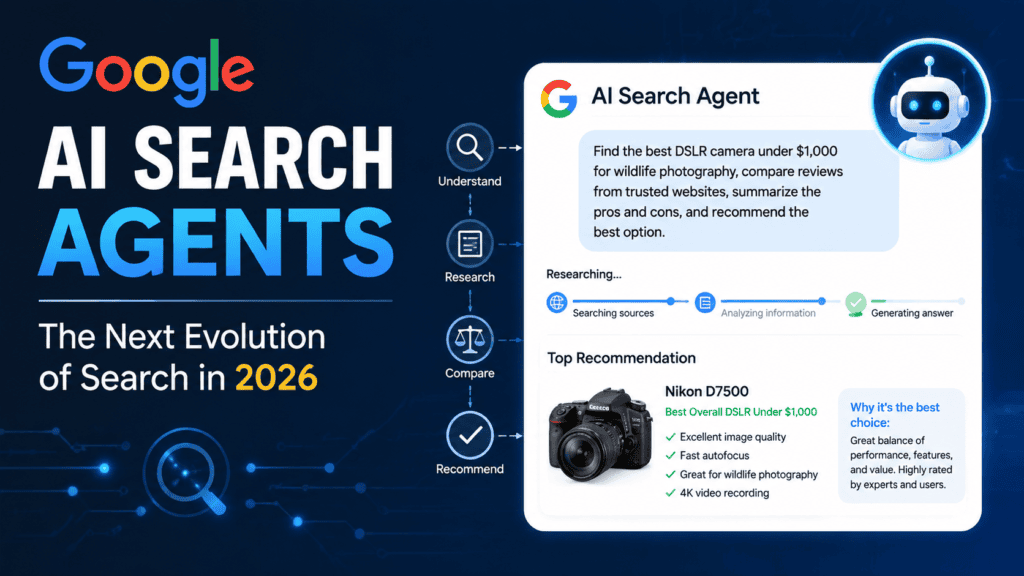
Search is entering a new phase. Instead of simply showing links, Google is moving toward AI systems that can understand tasks, research information across multiple sources, compare options, and even complete actions on behalf of users. These systems are increasingly being referred to as Google AI Search Agents.
For website owners, marketers, publishers, and everyday users, this represents one of the biggest changes to search since Google’s original ranking algorithms.
This article explains what Google AI Search Agents are, how they work, how they differ from AI Overviews, and what practical changes businesses should prepare for over the next few years.
What You’ll Learn
By the end of this article, you’ll understand:
- What Google AI Search Agents actually are
- How they differ from traditional Google Search
- Why they matter for SEO and content marketing
- Which industries are likely to benefit first
- How publishers can prepare for the agent-driven search era
Read Also: Google AI Studio Custom URLs: Complete 2026 Guide to Custom AI.Studio Domains
What Are Google AI Search Agents?
Google AI Search Agents are AI-powered systems designed to perform multi-step search tasks rather than simply returning a list of web pages.
Instead of typing:
“Best DSLR camera”
Users may ask:
“Find the best DSLR camera under $1,000 for wildlife photography, compare reviews from trusted websites, summarize the pros and cons, and recommend the best option.”
Rather than expecting the user to visit 15 different websites, an AI Search Agent can:
- Search multiple trusted sources
- Evaluate information
- Compare products
- Summarize findings
- Ask follow-up questions
- Continue researching if needed
- Complete certain actions such as bookings or purchases
The focus shifts from searching for information to completing a task.
Why Google Is Moving Toward AI Agents
Traditional search works well when users know exactly what they’re looking for.
But many searches are actually complex tasks:
- Planning vacations
- Buying laptops
- Researching universities
- Comparing insurance
- Finding software
- Learning technical skills
These often require opening dozens of tabs.
AI agents reduce that workload by acting as an intelligent research assistant.
Google’s broader AI strategy—including Gemini-powered experiences, AI Overviews, and agentic capabilities demonstrated at Google I/O—points toward search becoming increasingly conversational and task-oriented.
Google AI Search Agents vs AI Overviews
| Feature | AI Overviews | Google AI Search Agents |
|---|---|---|
| Answers questions | ✔ | ✔ |
| Multi-step reasoning | Limited | Extensive |
| Performs research | Basic | Advanced |
| Compares multiple sources | Limited | Yes |
| Remembers conversation | Yes | Better context |
| Completes tasks | Rare | Expected capability |
| Handles workflows | No | Yes |
AI Overviews summarize.
AI Search Agents collaborate.
How Google AI Search Agents Work
Although Google hasn’t publicly documented every technical detail, the emerging architecture combines several AI technologies.
1. Natural Language Understanding
The AI interprets the user’s real intent rather than matching keywords.
Instead of:
“cheap flights”
It understands:
“I need the cheapest weekend trip from New York in October.”
2. Multi-Source Research
Instead of relying on one webpage, the agent can evaluate:
- Official documentation
- Trusted publishers
- Government websites
- Product specifications
- Reviews
- Maps
- Business listings
3. Reasoning
The AI weighs evidence.
It identifies conflicting information.
It determines which sources appear more reliable.
4. Task Completion
Future capabilities may include:
- Booking reservations
- Filling forms
- Comparing prices
- Creating itineraries
- Scheduling appointments
- Purchasing products with user approval
Industries That Will Change the Most
Several industries are likely to see significant changes.
Ecommerce
Instead of visiting multiple stores, shoppers may ask an AI agent to compare products, shipping costs, reviews, and warranty information.
Travel
Agents can create complete travel plans, including flights, hotels, restaurants, and attractions.
Healthcare Information
Users may receive AI-assisted summaries from authoritative medical sources while still being directed to licensed professionals for diagnosis and treatment.
Education
Students can receive structured research assistance instead of simple search results.
Software
Businesses evaluating SaaS tools may rely on AI agents to compare pricing, integrations, security, and customer reviews.
A Practical Framework for Preparing Content (Original Perspective)
Rather than claiming first-hand testing that hasn’t been performed, I recommend evaluating content using a practical Agent-Ready Framework. This framework reflects the direction Google has publicly signaled for AI-powered search.
A.R.E.A. Framework
Authority
- Cite primary sources.
- Identify authors.
- Demonstrate subject expertise.
Reliability
- Keep facts current.
- Clearly distinguish facts from opinions.
- Update content regularly.
Evidence
- Support claims with official documentation, research, or verifiable data.
- Include original analysis where possible.
Actionability
- Answer the user’s next question.
- Provide steps, comparisons, and decision frameworks.
- Help readers complete a task rather than merely understand a topic.
Content that satisfies these four areas is more likely to remain useful whether users arrive through classic search results, AI Overviews, or future AI agents.
Common Mistakes Publishers Are Making
Writing for keywords instead of users
Many articles still target search engines first.
AI agents reward pages that genuinely solve problems.
Repeating existing content
Thousands of articles say exactly the same thing.
If your page adds no original analysis, it becomes easier for AI to summarize without sending traffic.
Weak sourcing
Google increasingly favors primary documentation over unsupported claims.
Thin author profiles
Expertise matters.
Articles should identify qualified authors with relevant experience.
Ignoring content freshness
AI systems favor updated information, especially for rapidly changing technology topics.
How Businesses Should Prepare
- Publish original research whenever possible.
- Cite primary sources instead of secondary summaries.
- Create topic clusters rather than isolated articles.
- Improve author credibility with detailed bios.
- Keep content updated as products and policies change.
- Add structured data such as Article, FAQ, and Breadcrumb schema.
- Focus on solving complete user tasks, not just answering isolated questions.
Future Outlook
Over the next several years, AI agents are expected to become more capable of handling end-to-end workflows across search, productivity, shopping, and planning. Rather than replacing websites entirely, they are likely to reward sources that provide unique expertise, trustworthy information, and original reporting—especially content that goes beyond what AI can easily synthesize from existing pages.
For publishers, success will depend less on producing more articles and more on producing articles with clear evidence, distinctive insights, and genuine value.
Read Also: Google Maps Media Controls Removed: Full Guide 2026
Key Takeaways
- Google AI Search Agents represent a shift from finding information to completing tasks.
- They extend beyond AI Overviews with multi-step reasoning and workflow capabilities.
- Original, well-sourced, expert content is increasingly important.
- Publishers should optimize for usefulness, authority, and actionability rather than keyword density.
- Businesses that adapt early are better positioned for the evolving search landscape.
Frequently Asked Questions
What are Google AI Search Agents?
They are AI-powered systems designed to research, reason across multiple sources, and help users complete complex tasks rather than simply displaying search results.
Are Google AI Search Agents the same as AI Overviews?
No. AI Overviews primarily summarize information, while AI Search Agents are intended to support more advanced, multi-step workflows and decision-making.
Will AI Search Agents replace traditional Google Search?
Not entirely. Traditional search results are expected to continue alongside AI-driven experiences, with users choosing the interaction that best fits their needs.
How will AI Search Agents affect SEO?
SEO will place greater emphasis on originality, expertise, trustworthy sourcing, and content that directly helps users accomplish their goals.
Should publishers still create long-form articles?
Yes. In-depth articles that provide unique insights, evidence, and practical guidance remain valuable and are more likely to be referenced by AI systems than thin, repetitive content.