
 By
By
What Happened to Pocket? Shutdown Timeline and the Best Alternatives in 2026
If you searched for Pocket expecting to find your saved articles, here’s the short version: the app is gone. Mozilla shut Pocket down for good, and the servers that used to hold your reading list no longer exist. This isn’t a bug on your end and there’s no way to log back in.
Below is what actually happened, when it happened, and — since Pocket isn’t coming back — where former users have actually landed in 2026.
The Short Answer
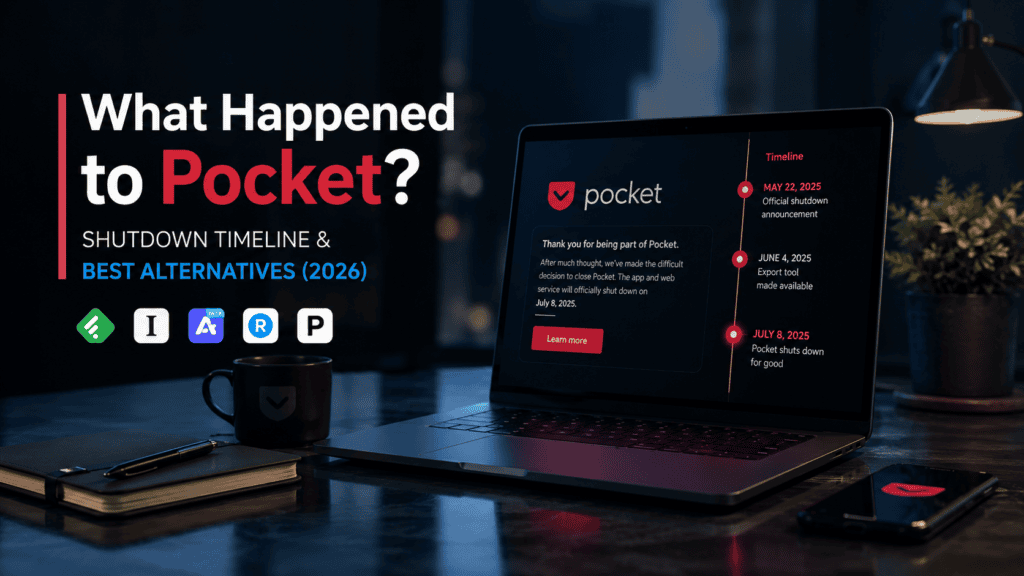
Mozilla announced on May 22, 2025 that it would shut down Pocket. New signups closed that same day. The app, web version, and browser extensions stopped working on July 8, 2025. Users could still export their saved articles during a wind-down window, and that window closed too: reporting on the final deletion date varies slightly by source, landing anywhere between October and mid-November 2025, but every account agrees on the outcome — the data is gone now, and there is no recovery path.
If you’re looking for a new home for your reading habit, the two apps most former Pocket users landed on are Instapaper and Raindrop.io, with Readwise Reader as the step up for people who want AI summaries and highlight syncing.
The Full Timeline
Pocket had a longer run than most read-later apps. It launched in 2007 as a Firefox extension called Read It Later, and Mozilla acquired it a decade later, in 2017. Here’s how the ending played out:
- May 22, 2025 — Mozilla published a “Farewell, Pocket” post announcing the shutdown. New account creation was disabled immediately.
- July 8, 2025 — Pocket’s apps, browser extensions, and website stopped functioning. This was the actual cutoff for using the product.
- July–October 2025 — An export-only window, during which existing users could pull their saved links and highlights out as a file but couldn’t add anything new.
- Fall 2025 — All remaining user data was permanently deleted from Mozilla’s servers, closing the export window for good.
Mozilla’s stated reason was that reading habits have moved on from the save-it-for-later model Pocket was built around, and that the company preferred to put its resources into projects tied more directly to Firefox, like the New Tab content recommendations Pocket had already been powering behind the scenes. Premium subscribers were refunded on a prorated basis rather than being billed through a service that was about to disappear.
Can You Still Get Your Data Back?
No. The export window is closed, and Mozilla has stated the data was permanently deleted. If you exported an HTML file of your saves before the deadline, that file is the only surviving copy of your Pocket library, and it’s worth locating it now if you haven’t already, since most of the migration paths below depend on having it.
If you never got around to exporting, there isn’t a workaround — the servers holding that data no longer have it to give.
Why This Keeps Happening to Read-Later Apps
Pocket wasn’t an isolated case. Omnivore, a well-liked independent read-later app, was acquired and then shut down within weeks in late 2024 — a pattern commonly described as an acquihire, where a company wants the team rather than the product. Two prominent apps in the same small category disappeared within about a year of each other, which is part of why “will this company still exist in five years” has become a real factor in how people choose a replacement, not just a hypothetical one.
That’s worth keeping in mind below: a generous free tier doesn’t mean much if the company behind it isn’t sustainable.
The Best Pocket Alternatives in 2026
There’s no single one-size-fits-all replacement, because Pocket quietly did two different jobs at once — a distraction-free reading queue and a simple bookmark archive. Most alternatives are better at one than the other.
Instapaper — best if you just want the basics back
Instapaper is the closest thing to Pocket’s original simplicity: save a link, get a clean, ad-free version of the article, read it later, even offline. It’s been through fewer strategy shifts than most of its competitors, and it added Kobo e-reader support after Pocket’s shutdown, which made it the default pick for a chunk of former Pocket users who read on e-ink devices. The free tier covers unlimited saves; a paid Premium tier (priced somewhere in the $60/year range depending on when you check) adds full-text search and speed-reading tools.
Raindrop.io — best if you cared more about organizing links than reading them
Raindrop is technically a bookmark manager rather than a pure reading app, and it shows: collections, tags, and a visual card layout make it good for people who saved things to find later rather than to sit down and read start to finish. Its free tier is unusually generous for the category, with a low-cost Pro tier (well under $40/year) unlocking full-text search across everything you’ve saved.
Readwise Reader — best if you want AI and highlight syncing
Readwise Reader goes further than a save-and-read tool: it pulls in newsletters, RSS feeds, PDFs, and even YouTube transcripts into one inbox, and every highlight you make feeds into a spaced-repetition review system so ideas actually resurface later instead of sitting untouched. There’s no permanent free tier — pricing runs roughly $8–10/month depending on billing cycle — which makes it a better fit for people who read and highlight heavily than for someone who wants an occasional article saved.
Matter — best free option on iPhone
Matter’s free plan is one of the more generous in the category, with unlimited saves and browser extensions included at no cost. Its paid tier adds text-to-speech and an AI reading assistant. It’s iOS-first in feel and design, so Android or desktop-heavy readers may find the other options a better fit.
Wallabag — best if you don’t want to depend on any company
Wallabag is open-source and self-hostable, which sidesteps the entire “what if this company shuts down” problem, since you control the server it runs on. That control comes with real setup overhead compared to the polished apps above, so it suits people comfortable running their own software more than it suits someone who wants to install an app and move on.
Quick Comparison
| App | Best for | Free tier | Paid tier (approx.) |
|---|---|---|---|
| Instapaper | Simplicity, e-readers | Unlimited saves | ~$60/year |
| Raindrop.io | Organizing & bookmarking | Generous, unlimited bookmarks | ~$28–38/year |
| Readwise Reader | Highlights, AI, newsletters | None | ~$95–120/year |
| Matter | Free iOS reading | Unlimited saves | ~$60/year |
| Wallabag | Self-hosters, no vendor risk | Free (self-hosted) | N/A |
Pricing on all of these shifts fairly often, so treat the numbers above as a starting point and check each app’s current pricing page before committing.
How to Migrate If You Still Have Your Pocket Export
If you exported your data before Pocket’s servers went dark, most major alternatives — including Instapaper, Raindrop.io, and Readwise Reader — accept Pocket’s HTML export format directly through an import tool in their settings. The general steps are the same across apps:
- Locate the HTML file you exported from Pocket before the deadline.
- Open the import or “add bookmarks” option in your new app’s settings.
- Upload the file and let the app process it — larger libraries can take several minutes.
- Spot-check a handful of imported articles to confirm formatting and tags carried over correctly.
If you never exported, unfortunately there’s nothing to import — you’ll be starting your reading library fresh in whichever app you choose.
Frequently Asked Questions
Is Pocket still available at all? No. The apps, browser extensions, and website all stopped functioning on July 8, 2025, and the account data behind them has since been deleted.
Why did Mozilla shut down Pocket? Mozilla said reading and browsing habits had moved away from the save-it-for-later model, and that it wanted to focus resources on projects tied more closely to Firefox, including the content recommendations Pocket had already been powering in the New Tab page.
Can I still log into my old Pocket account? No. The servers are offline, and login is no longer possible.
Is there any way to recover my saved articles now? Only if you personally exported them to a file before the export window closed. Mozilla has stated the underlying account data was permanently deleted.
What’s the closest replacement to how Pocket used to work? Instapaper is generally considered the closest match for the original save-and-read-later experience. Raindrop.io is closer if you mostly used Pocket as a bookmark folder rather than a reading queue.
Did other read-it-later apps shut down too? Yes. Omnivore, an independent read-later app, was acquired and shut down within weeks in late 2024, which is part of why long-term company stability has become a real consideration when picking a replacement.
Do I need to pay for a replacement app? Not necessarily. Instapaper, Raindrop.io, and Matter all have functional free tiers that cover the basics Pocket offered for free. Readwise Reader is the main option in this space without a permanent free plan.