
 By
By
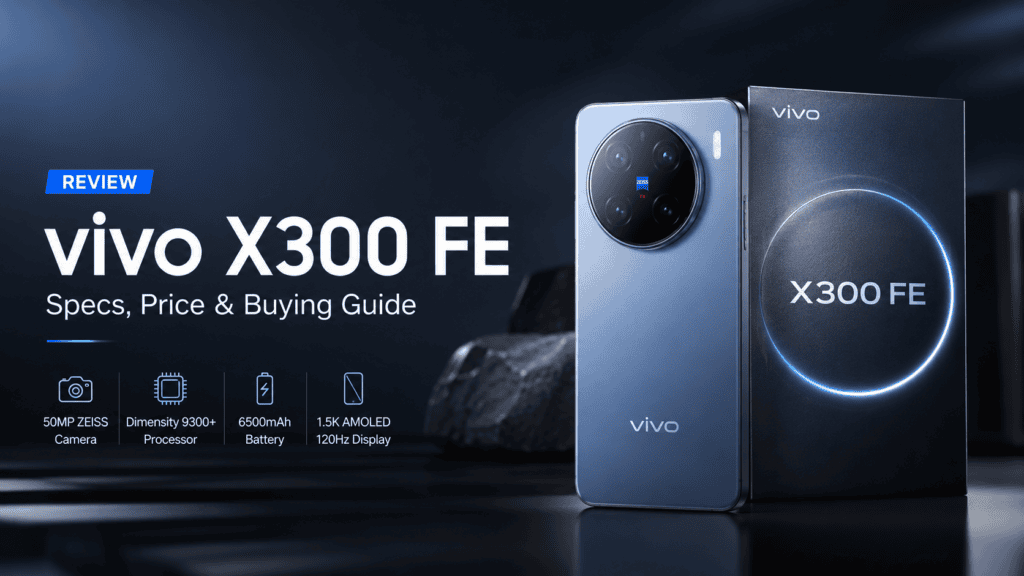
vivo X300 FE Review: Is This Compact Flagship Worth Your Money?
If you’ve been shopping for a flagship phone that doesn’t require a bigger pocket, the vivo X300 FE probably showed up in your search results next to the Galaxy S26 and the iPhone 17. It launched in April 2026 as the “Fan Edition” of vivo’s X300 line, sitting below the X300 and X300 Pro but sharing most of the hardware that made those phones worth talking about. This guide breaks down what the X300 FE actually gets right, where it falls short, and whether it deserves a spot on your shortlist.
What Is the vivo X300 FE, Exactly?
The FE badge — borrowed conceptually from Samsung’s Galaxy FE naming — signals a toned-down flagship rather than a budget phone. In vivo’s case, the X300 FE isn’t really “toned down” in any way that hurts daily use. It runs the same Snapdragon 8 Gen 5 chipset found in pricier X300 models, pairs it with 12GB of RAM, and offers 256GB or 512GB of storage. What you’re actually trading for the lower price tag is the top-tier camera hardware and a slightly smaller battery than the Ultra model — not raw performance.
Vivo positioned the X300 FE as the “balanced” member of the family: strong battery life, a compact 6.31-inch body, and a camera system built around everyday shooting rather than pixel-peeping specs. It launched alongside the X300 Ultra in most global markets, though availability skews toward Asia, the Middle East, and Latin America — it isn’t sold in the UK or US.
Design and Build
At roughly 150.8mm tall, 71.8mm wide, and about 8mm thick, the X300 FE is genuinely one of the more pocketable flagships on the market right now — closer in footprint to the base Galaxy S26 or iPhone 17 than to most “compact” phones that quietly aren’t compact at all. Weight lands around 190-192g depending on color, which is light for a phone packing a 6,500mAh battery.
The build uses a glass front and back with an aluminum frame, and it carries an IP68/IP69 rating, meaning it survives dust, submersion, and even high-pressure water jets. The horizontal camera bar sitting near the top of the back panel is a departure from vivo’s usual circular camera island — reviewers have compared the look to recent Pixel and iPhone Air designs. Color options include Mist Purple, White, Black, and a green variant.
One notable omission: there’s no extra action button or camera control shutter, a feature vivo experimented with on the X300 Pro and X200 Ultra. The FE keeps things simple with just a power button and volume rocker.
Display: A Familiar, Proven Panel
The X300 FE reuses the 6.31-inch LTPO AMOLED panel from the standard X300 and the X200 Pro mini, running at 1,216 x 2,640 resolution (about 460 PPI) with a dynamic 1-120Hz refresh rate. That’s not a downgrade so much as a smart reuse of a panel that already performs well.
Independent lab testing measured around 617 nits at maximum manual brightness and up to roughly 1,850 nits under bright ambient light with a small highlight area — well short of vivo’s marketed 4,500-5,000 nit peak claim, though outdoor visibility in practice has been reported as strong. The panel supports HDR10 and HDR10+, 10-bit color, and 2160Hz PWM dimming, which should reduce eye strain for users sensitive to flicker at lower brightness.
Who this matters for: if you’ve found recent flagship displays overly reflective or hard to read outdoors, the X300 FE’s real-world brightness handling is a genuine strength, even if it doesn’t hit vivo’s headline number.
Performance
The Snapdragon 8 Gen 5 isn’t Qualcomm’s absolute top chip for 2026, but it’s close enough that day-to-day performance, gaming, and multitasking all feel like a true flagship experience. Combined with 12GB of RAM and UFS 4.1 storage, the X300 FE handles demanding apps and heavier games without the RAM-related hiccups that plague some mid-tier phones.
Thermal management gets real engineering attention here too — vivo built in a large vapor chamber (around 4,005 mm²) paired with graphite sheeting, which matters more than it sounds on a phone this thin. Sustained gaming sessions are less likely to trigger the throttling that ruins frame-rate consistency on thinner competitors.
Battery Life and Charging
This is arguably the X300 FE’s strongest selling point. A 6,500mAh cell — about 460mAh larger than the standard X300’s battery — is unusually large for a phone this compact and light. Lab testing recorded nearly 19 hours of active-use endurance, with particularly strong results in calling, web browsing, and video streaming, plus roughly 10 hours of continuous gaming.
Charging is fast in both directions: 90W wired charging took the battery from empty to 32% in 15 minutes and to a full charge in under 50 minutes using the bundled charger and cable. 40W wireless charging and reverse charging (wired and wireless) round out the package. A charging-limit feature, capping charge at a chosen percentage between 70-100%, helps preserve long-term battery health — a feature power users will appreciate more than casual buyers.
Camera System
The X300 FE’s rear setup consists of a 50MP primary sensor, a 50MP 3x telephoto lens, and an 8MP ultrawide camera, backed by a 50MP autofocus selfie camera up front. Vivo also sells a Zeiss Professional Kit as an accessory — a Gen 2 telephoto extender lens (equivalent to 200mm reach) with a mounting case, aimed at users who want reach beyond the built-in 3x zoom without stepping up to the Ultra model.
Photo processing benefits from vivo’s Zeiss color science, which reviewers have consistently praised across the X300 lineup for natural skin tones and pleasing contrast. AI editing tools are baked in as well, including AI Magic Move, AI Image Expander, and AI Reflection Erase — useful for cleaning up group shots or removing unwanted reflections in glass and water.
The clear weak point is the ultrawide camera. At just 8MP, it lags noticeably behind the primary and telephoto sensors in detail and low-light performance, and multiple reviewers have flagged it as the one component that doesn’t feel flagship-grade — a fair critique given the phone’s price bracket.
Common Question: Does the X300 FE Take Good Low-Light Photos?
The primary and telephoto sensors handle low light competently thanks to vivo’s processing pipeline, but as with most phones in this class, the ultrawide camera is where noise and detail loss become noticeable after dark. If night photography with an ultra-wide lens is a priority, this isn’t the strongest option in the lineup.
Software and Long-Term Support
The X300 FE ships with OriginOS 6 on top of Android 16. Vivo bundles cross-platform productivity tools (Office Kit for Windows, Mac, and iPad) and a one-tap transfer feature for users migrating from iPhone. Security-conscious users get a “Private Space” sandbox for sensitive files and apps.
Support commitments are genuinely strong for the price tier: seven years of security updates and five years of OS upgrades, matching or exceeding what most Android manufacturers outside Google and Samsung currently offer. This is worth weighing heavily if you tend to keep phones for four or more years.
vivo X300 FE vs. vivo X300: What’s the Real Difference?
| Feature | vivo X300 FE | vivo X300 |
|---|---|---|
| Display | 6.31″ LTPO AMOLED, 120Hz | 6.31″ LTPO AMOLED, 120Hz |
| Chipset | Snapdragon 8 Gen 5 | Snapdragon 8 Gen 5 |
| RAM | 12GB | 12GB/16GB options |
| Battery | 6,500mAh | ~6,040mAh |
| Telephoto | 50MP 3x, Zeiss extender compatible | Higher-res telephoto, no extender support |
| Design | Horizontal camera bar | Circular camera island |
| Action button | No | Varies by market |
The FE actually wins on battery capacity and arguably on design distinctiveness, while the standard X300 edges ahead in RAM ceiling and telephoto resolution. For most buyers who aren’t chasing the absolute best zoom quality, the FE is the more sensible purchase — you’re not losing much and you’re gaining battery life.
Who Should Buy the vivo X300 FE
- Buy it if: you want flagship-level performance and battery life in a genuinely compact, light body, and you don’t need the best possible ultrawide camera.
- Consider the X300 or X300 Pro instead if: camera versatility (especially ultrawide quality) matters more to you than pocketability.
- Consider a different brand if: you need guaranteed availability and full carrier support in the US or UK, where vivo doesn’t officially sell this model.
Common Mistakes When Shopping for the X300 FE
- Assuming “FE” means budget hardware. The chipset and RAM are shared with pricier siblings — you’re not sacrificing raw speed.
- Ignoring regional availability. Buyers in North America and the UK will need grey-market importing, which affects warranty and software updates.
- Overlooking the ultrawide limitation. If wide-angle shots are central to how you use your phone’s camera, test this specific lens before committing.
- Skipping the charging-limit setting. Leaving it at 100% charging by default shortens long-term battery lifespan unnecessarily.
Frequently Asked Questions
Is the vivo X300 FE waterproof? It carries an IP68/IP69 rating, meaning it resists dust ingress and can survive submersion up to 1.5 meters for 30 minutes, as well as high-pressure water jets.
What chipset does the vivo X300 FE use? It uses the Qualcomm Snapdragon 8 Gen 5, the same chip found in the standard vivo X300.
How big is the vivo X300 FE’s battery? 6,500mAh, with 90W wired and 40W wireless charging support.
Does the vivo X300 FE support the Zeiss telephoto extender? Yes — vivo sells an optional Zeiss Professional Kit with a Gen 2 telephoto extender lens for additional optical reach.
Is the vivo X300 FE available in the US or UK? No. It launched primarily in Asian markets, the UAE, Saudi Arabia, Brazil, India, Pakistan, and select European countries including Spain, Austria, Hungary, and Poland.
How long will the vivo X300 FE receive software updates? Vivo has committed to seven years of security patches and five years of OS version upgrades.
What’s the biggest weakness of the vivo X300 FE? Its 8MP ultrawide camera is noticeably behind the primary and telephoto sensors in detail and low-light performance.
How does the vivo X300 FE compare in size to other 2026 flagships? It’s close in footprint to the base Galaxy S26, iPhone 17, and Xiaomi 17, making it one of the more compact flagship options this year.