
 By
By
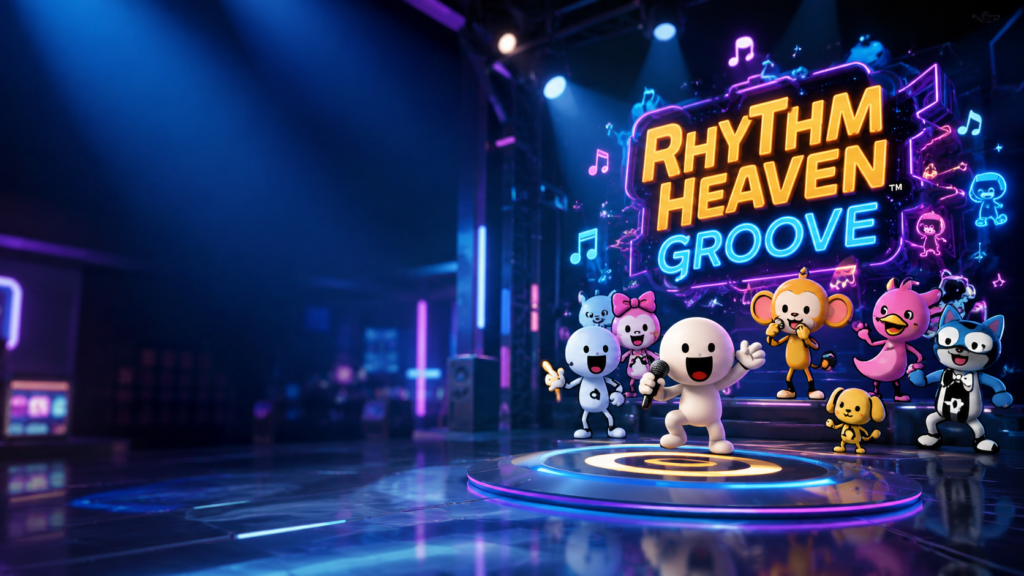
Rhythm Heaven Groove: The Complete Guide to Nintendo’s Long-Awaited Comeback
Ten years is a long time to wait for a sequel. For fans of Nintendo’s quirky button-tapping series, that wait ends on July 2, 2026, when Rhythm Heaven Groove arrives on Switch. If you’ve spent the last decade wondering whether the series that turned chimp head-bobbing and tambourine-clinking into legitimate gaming skills was ever coming back, this guide covers what the game actually is, how it plays, what’s new, and whether it’s worth your $39.99.
What Is Rhythm Heaven Groove?
Rhythm Heaven Groove is the fifth mainline entry in Nintendo’s Rhythm Heaven series, developed by Nintendo alongside TNX and published by Nintendo for Switch. It follows Rhythm Heaven Megamix, which reached the West in 2016 on 3DS, making this the first new installment international fans have seen in roughly a decade. In Japan and parts of Asia it’s known as Rhythm Heaven: Miracle Stars, while PAL territories will see it as Rhythm Paradise Groove — the naming split the series has carried since its debut.
The premise hasn’t changed at its core. You press one or two buttons in time with a beat, watch a short visual cue, then perform the action correctly when the rhythm tells you to. What’s deceptively simple in description becomes a genuine test of timing, listening, and pattern recognition once the game starts layering in fakes, tempo shifts, and silent stretches where you have no choice but to trust your internal clock.
Series producer Tsunku — the songwriter and former Morning Musume producer behind every prior Rhythm Heaven soundtrack — returns to compose and produce. Notably, he worked on Groove after losing his vocal cords to laryngeal cancer treatment in 2014, composing instrumentally rather than through the scratch vocals he historically used to sketch songs. Lead art designer Ko Takeuchi also returns, though Groove breaks from series tradition by mixing several distinct art styles across its games rather than locking into one unified look.
Release Date, Price, and Platforms
Rhythm Heaven Groove launches Thursday, July 2, 2026, exclusively as a Nintendo Switch title — though it runs natively on Switch 2 via backward compatibility. Pricing undercuts typical first-party Nintendo releases:
| Edition | Price |
|---|---|
| Digital (Nintendo eShop) | $39.99 |
| Physical cartridge | $49.99 |
That $39.99 digital price sits well below the $49.99–$59.99 range most current Switch titles command, and reception to the pricing has been largely positive. The game was first revealed at the March 27, 2025 Nintendo Direct alongside Tomodachi Life: Living the Dream — two long-dormant franchises resurrected in the same breath. The confirmed release date and pricing arrived later, on April 9, 2026, via the Nintendo Today! app rather than a dedicated Direct.
Single-Player, Multiplayer, and the New Beatspell Mode
Groove’s content volume is the largest the series has attempted. The full package includes:
- 80+ single-player rhythm games — short, self-contained challenges, each built around a distinct visual gag and input pattern
- 30+ multiplayer rhythm games — local co-op and competitive challenges supporting up to four players on one console
- Beatspell — a new role-playing-style mode, unlocked by progressing through single-player content, where players cast spells through rhythm-based button combinations to battle monsters across a series of dungeons
Beatspell is the headline structural addition. Previous Rhythm Heaven games strung minigames together with light narrative framing and “Remix” stages that remixed earlier songs into new combined challenges. Beatspell goes further, wrapping rhythm inputs in actual RPG progression — equipping spells, fighting enemies, and advancing through dungeons — which is a first for the series. Early hands-on coverage describes it as combo-based spellcasting rather than a deep RPG system, so don’t expect a full turn-based battler; it’s rhythm gameplay with an RPG coat of paint.
The whole experience is narrated by a character called Lil’ Miss Reeds, who walks players through menus and instructions. Her dialogue is generated through AI text-to-speech, with a different synthesized voice for each of the game’s many localizations — a notable break from the hand-recorded narration of earlier entries. Players who find the narration excessive can disable it.
What’s New Compared to Previous Rhythm Heaven Games
For returning fans wondering what’s actually changed beyond “more games,” a few details stand out:
Mixed art direction. Earlier entries (the DS original, Fever, and Megamix) each committed to one visual style throughout. Groove instead varies its art per minigame — some games look hand-drawn, others lean into flatter, more graphic design, and a few use 3D elements. It’s a deliberate departure meant to keep eighty-plus games visually distinct rather than samey.
Regional firsts. This is the first Rhythm Heaven game to release in Taiwan and Hong Kong, and the first to receive official Dutch and Chinese localizations (both Traditional and Simplified). The series has historically had spotty localization, with the original DS game never reaching Europe at all, so this expansion is meaningful for the global fanbase.
Lower price point. As covered above, the digital price undercuts standard Nintendo first-party pricing, which several outlets have framed as a deliberate move to reduce the barrier to entry for a franchise that’s been dormant long enough to need reintroduction to a newer Switch audience.
AI-narrated, multi-language Reeds. No prior Rhythm Heaven game used synthesized voice work for its narrator; Groove’s reliance on TTS for Lil’ Miss Reeds across every language track is new ground for the series, likely driven by the scale of simultaneous localization.
Hands-On Impressions: What Early Previews Say
Limited press hands-on sessions have taken place ahead of launch, and early impressions have been largely positive. One preview from TechRadar — based on a session played via Switch 2 backward compatibility, though the game remains a native Switch 1 release — described the moment-to-moment minigames as immediately familiar but still inventive, citing examples like guiding a character through hoops on a marching beat and a kitchen-themed game involving catching vegetables to keep them from a hungry cat. The same preview highlighted the local multiplayer as a genuine highlight, singling out a competitive game where four players race to grab a treat the instant a clock hits a target time.
Reviewers consistently note that the difficulty curve follows series tradition: games introduce their mechanic clearly, then twist it — removing visual cues, swapping which beat matters, or changing the color scheme to throw off your sense of timing. That “rug pull” structure has always been the series’ signature, and Groove appears to lean into it rather than soften it for newcomers.
The Free Demo: What’s Included and How Progress Carries Over
Nintendo released a Starter Demo on the eShop on June 22, 2026, ten days ahead of launch. It’s free, runs on both Switch and Switch 2, and includes:
- Five single-player games: Hoop Trundling, Brolly Good Show, Disc Dog, Feeding the Beast, and a “Remix 1” stage combining them
- One multiplayer game: Rhythm Tweezers, supporting up to four players
The standout feature is that demo progress isn’t thrown away at launch. Nintendo built the demo as the literal opening chapter of the full game, so medals earned and games completed transfer directly into the retail release — players who finish the demo’s solo content simply continue from where they left off on July 2 rather than replaying it. If you’re on the fence, downloading the demo is close to a risk-free way to gauge whether the timing-based gameplay clicks with you before committing to a purchase.
Should You Buy Rhythm Heaven Groove? Who It’s For
Returning series fans have the clearest case to buy day one. After a decade-long gap, the structure, humor, and difficulty design described in previews all track closely with what made the DS, Wii, and 3DS entries beloved — full-bore Rhythm Heaven rather than a soft reboot.
Newcomers curious about the series are arguably the audience Nintendo is courting hardest with the lower price and the free demo. Because each minigame is short, self-contained, and explained before it starts, there’s effectively no entry barrier beyond willingness to fail a few times while you find your timing.
Local multiplayer groups get a genuine reason to care this time — earlier entries were almost entirely single-player, while Groove dedicates over 30 games specifically to local co-op and competitive play, making it a stronger pick-up-and-play party option than its predecessors.
Players looking for deep narrative or open-world content should look elsewhere. Even with Beatspell’s RPG trappings, the developers have been explicit that the game isn’t chasing a big story — it’s built around a large volume of short, funny, mechanically distinct rhythm challenges, which is either exactly what you want from the series or a reason to pass.
Common Questions and Misconceptions
One thing worth clarifying: despite running on Switch 2 in preview events, Rhythm Heaven Groove is a native Switch (not Switch 2) title, and original Switch owners aren’t being left behind — Switch 2 access is backward compatibility, not a separate enhanced version. Another point of confusion involves the regional names; Rhythm Heaven Groove, Rhythm Paradise Groove, and Rhythm Heaven: Miracle Stars all refer to the identical game, differing only by territory.
Future Outlook
With the franchise selling more than four million copies across its earlier international releases and clearly still commanding affection from a dedicated fanbase, Groove’s reception over its launch window will likely determine whether Nintendo treats this as a one-off Switch send-off or the start of a more regular release cadence for the series — something producer Tsunku has publicly hoped for since at least 2020, when he first floated the idea of a Switch-native entry.
Key Takeaways
- Rhythm Heaven Groove launches July 2, 2026, exclusively for Nintendo Switch (Switch 2 compatible)
- $39.99 digital / $49.99 physical — below typical Nintendo first-party pricing
- Over 80 single-player and 30+ multiplayer rhythm minigames
- New Beatspell mode adds RPG-style spellcasting tied to rhythm inputs
- A free, progress-carrying demo is available now on the eShop
- First Rhythm Heaven entry localized for Taiwan, Hong Kong, and in Dutch and Chinese
FAQ
When does Rhythm Heaven Groove release? July 2, 2026, on Nintendo Switch.
How much does Rhythm Heaven Groove cost? $39.99 digitally on the eShop, or $49.99 for a physical cartridge.
Is Rhythm Heaven Groove on Switch 2? It’s a native Switch title that also runs on Switch 2 through backward compatibility — there’s no separate Switch 2 edition.
Is there a demo? Yes. A free Starter Demo released June 22, 2026, with five single-player games and one multiplayer game; progress carries into the full release.
What is Beatspell? A new RPG-style mode where players cast spells through rhythm-based button combos to fight enemies across dungeons, unlocked by progressing through single-player content.
How many minigames does it have? Over 80 single-player games and more than 30 multiplayer games.
Who composes the music? Series producer Tsunku, returning for his fifth Rhythm Heaven soundtrack.
Do I need to have played earlier Rhythm Heaven games first? No. Each entry, including Groove, is designed as a self-contained collection of minigames with no required series knowledge.
Is Rhythm Heaven Groove the same as Rhythm Paradise Groove? Yes — Rhythm Paradise Groove is the PAL (European/Australian) name for the identical game; it’s also called Rhythm Heaven: Miracle Stars in parts of Asia.