 By
By
1. Introduction: The Power of Professionalism in People Ops
Imagine a scenario: A company is navigating a sensitive merger. Employees are anxious, rumors are rampant, and the leadership team is in a state of flux. In the middle of this, an HR Business Partner, Sarah, steps in. She doesn’t just process paperwork; she facilitates a town hall with empathy and transparency, manages the transition with discretion, and works with leadership to create a fair retention plan. Her actions, guided by a strong sense of professionalism, prevent a mass exodus of talent and maintain operational stability. She is not just doing HR; she is being HR.
This is the power of professionalism. In the modern workplace, professionalism in Human Resources is the bedrock of organizational trust, employee engagement, and legal compliance. This guide provides a comprehensive exploration of what HR professionalism truly means in 2026, moving beyond old stereotypes of “HR police” to the dynamic role of strategic partners, culture champions, and ethical stewards. We will define its core pillars, explore its complex challenges, and provide a practical roadmap for HR professionals at every stage of their career.
2. What is Professionalism in HR? Beyond the Basics
At its core, professionalism in HR is the consistent demonstration of a specific set of behaviors, values, and skills that earn trust and credibility from all stakeholders: employees, managers, and the executive team. It’s the bridge between strategic business goals and the human experience of work.
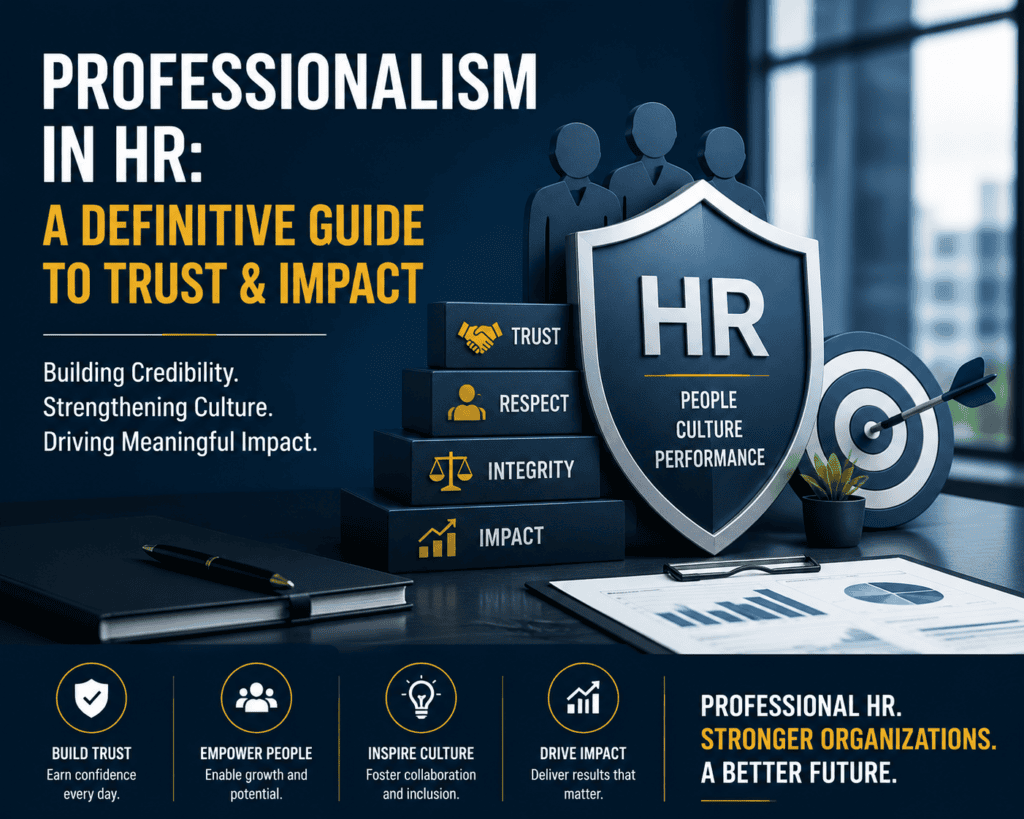
The 5 Core Pillars of HR Professionalism:
-
Competence & Expertise: Having a deep, current knowledge of HR principles, employment law, and business strategy. This isn’t just knowing the rules; it’s understanding how to apply them effectively. It means staying abreast of trends like AI in recruitment and the complexities of a hybrid workforce.
-
Integrity & Ethical Conduct: Acting with honesty, fairness, and transparency. This pillar is the foundation of trust. It means making difficult decisions based on ethical principles, not just expediency, and avoiding conflicts of interest. As we’ll explore later, this is the area where many professionals face their toughest tests.
-
Confidentiality: Handling sensitive personal, medical, and performance data with the utmost care and discretion. A breach of confidentiality, whether intentional or accidental, is a quick and permanent eroder of trust. This includes being discreet in physical spaces (e.g., not discussing sensitive files in a public area) and digital ones (e.g., secure data handling).
-
Judgment & Decision-Making: Making sound, objective, and fair decisions. This involves gathering all relevant facts, considering multiple perspectives, and weighing the potential impact on individuals and the organization. It’s about moving beyond “following policy” to applying policy with wisdom.
-
Communication & Interpersonal Skills: The ability to communicate clearly, empathetically, and assertively. This involves active listening, clear writing, and the ability to tailor communication to different audiences—from delivering tough feedback to a manager to explaining complex benefits to a new hire.
The Evolution of HR Professionalism: From Personnel to Partner
The concept of HR professionalism has fundamentally shifted. Historically, HR was seen as a primarily administrative function, the “personnel department.” Professionalism meant executing tasks efficiently. Today, HR is a strategic partner, as described by frameworks like the Ulrich Model. Modern professionalism means being a business advisor, a cultural leader, and a change agent.
3. The Strategic Role of HR Professionalism in 2026
In a world of constant disruption, HR professionalism is no longer a “nice to have” but a strategic imperative. It has a direct, measurable impact on an organization’s bottom line.
Building Trust and Credibility with Stakeholders
Trust is the currency of HR. When HR acts professionally, employees feel psychologically safe. They are more likely to voice concerns, report misconduct, and engage in the company’s mission. This trust is built over time through consistent actions: delivering on promises, maintaining confidentiality, and demonstrating genuine concern for employee well-being. For example, if an HR professional handles a harassment complaint with competence, empathy, and procedural fairness, it reinforces a culture of safety and respect. Conversely, if they mishandle it, the resulting erosion of trust can be catastrophic.
Legal and Ethical Implications
The consequences of unprofessional HR behavior are profound. Legal ramifications can include costly lawsuits, government fines, and settlements. A manager failing to provide reasonable accommodations for an employee with a disability, or a recruiter displaying unconscious bias in screening, are not just unprofessional; they are illegal. Furthermore, the “spillover effect” is significant. An unethical HR decision, such as quietly pushing out a protected employee, can become known throughout the company and even externally, leading to a toxic work environment and severe reputational damage.
Impact on Talent Retention and Organizational Culture
Professionalism is a key driver of employee retention. If the HR function is seen as incompetent or untrustworthy, top talent will be difficult to attract and keep. High performers want to work for organizations where they are valued and treated fairly. A professional HR team creates the policies, processes, and culture that make this possible.
Expert Insight: “The professionalism of HR is often the first indicator to candidates of a company’s overall integrity. It sets the tone for the entire employee experience,” says Dr. Elena Rossi, a specialist in workplace ethics.
4. The Challenges and Complexities of Upholding HR Professionalism
Despite its importance, maintaining HR professionalism is fraught with challenges. This is where the “what, why, and how” gets complex, requiring judgment and emotional intelligence.
Navigating Ethical Dilemmas: The “Double Agent” Problem
One of the most significant professional challenges for HR is balancing the needs of the organization with the needs of its employees. Often called the “double agent” problem, you are expected to be a champion for the workforce while simultaneously acting as an agent of the employer. An HR leader might be tasked with implementing a downsizing initiative. Professionalism requires conducting the layoffs with humanity, fairness, and respect while also ensuring the business’s survival. This involves providing excellent severance packages, offering outplacement services, and communicating with empathy, even when your hands are tied.
Managing Bias and Maintaining Objectivity
As humans, we all have biases. Professional HR requires actively managing them to ensure objectivity in all people processes. Consider a manager who is a micro-manager. HR must provide feedback on this management style without letting personal feelings cloud the judgment. A professional HRBP might use 360-degree feedback and performance data to build an objective case for coaching, ensuring the conversation is about behaviors and impact, not personality.
The Push and Pull of Business Strategy vs. Employee Well-being
Sometimes, business strategy and employee well-being are in direct conflict. For instance, a company might want to implement a strict return-to-office (RTO) mandate. A professional HR team would not just implement the mandate but would first investigate the “why.” They would analyze productivity data, conduct employee sentiment surveys, and weigh the arguments for and against remote work. The final policy would be communicated with empathy, considering the individual circumstances of employees.
5. Key Behaviors and Skills of a Professional HR Practitioner
To uphold the standards of professionalism, HR practitioners must cultivate a specific set of skills, many of which are rooted in emotional intelligence.
Core Competencies (Emotional Intelligence – EQ)
-
Active Listening: In a grievance meeting, do you listen to respond or to understand? Professional HR listens to understand the employee’s perspective, fears, and needs fully.
-
Empathy: An HR leader who can understand and share the feelings of an employee, even while delivering bad news, builds a deep well of trust.
-
Assertiveness: You must be able to communicate your perspective clearly and directly, especially when advising leadership. This means challenging a CEO’s risky HR decision with confidence and data, without being aggressive.
-
Conflict Resolution: Mediating a dispute between two managers requires high-level professionalism. It involves creating a safe space for both parties to be heard, focusing on the issue and not the people, and helping them find a mutually acceptable solution.
Practical Application & Decision-Making Frameworks
-
The “Rule of Three” for HR Decisions: When faced with a tough call, ask yourself: Is it legal? Is it ethical? Is it fair? This simple framework provides a powerful gut check before implementing any decision.
-
Using Data-Driven Insights: Instead of relying on intuition, a professional HR leader uses data. For example, when justifying a new benefits package, they’d prepare a presentation for the CFO showing how the cost of benefits has a higher ROI in terms of employee retention and productivity than a 5% salary increase.
6. Best Practices for Cultivating and Maintaining HR Professionalism
Professionalism isn’t a trait you’re born with; it’s a muscle you build and maintain.
Best Practices for Individual HR Professionals:
-
Embrace Lifelong Learning: The HR landscape changes constantly. Commit to continuous learning by reading industry publications like SHRM, attending webinars, and pursuing certifications like SHRM-SCP or SPHR.
-
Seek Feedback and Mentorship: Proactively ask for feedback from colleagues and leaders. “How can I be more effective in managing these difficult conversations?” A mentor can provide invaluable guidance on navigating complex organizational politics.
-
Build a Professional Network: Connect with peers. Sharing challenges and learning from others’ experiences is a powerful way to stay grounded and informed.
-
Practice Self-Reflection: Regularly take time to reflect on your interactions. Did I handle that performance review with the right balance of candor and empathy? How could I have better managed my own stress during that crisis?
Best Practices for Organizations to Foster a Professional HR Function:
-
Invest in Training and Development: Provide HR professionals with the resources they need, including training on new laws, negotiation skills, and coaching.
-
Establish and Enforce an Ethics Code: A clear code of conduct isn’t just for the rest of the company. A dedicated HR Code of Ethics can provide a clear compass for behavior. For a sample code, see the Professionalism in HR Checklist below.
-
Recognize and Reward Professional Behavior: A “Professionalism Champion” award can publicly recognize and incentivize the right behaviors within the HR team.
-
Empower HR: A key practice for leadership is to empower HR to do their jobs effectively. This means giving them a seat at the table and trusting their judgment, especially in sensitive matters.
7. HR Professionalism Comparison Table
| Dimension | HR Professional | Unprofessional HR | Impact on Organization |
|---|---|---|---|
| Communication | Listens actively, communicates complex issues clearly, and tailors the message to the audience. (e.g., Explains a change in benefits simply). | Leaves employees in the dark, uses jargon-heavy emails, or gossips about confidential matters. | Increases employee anxiety, spreads misinformation, and fosters a culture of distrust and divisiveness. |
| Decision-Making | Makes objective, data-driven decisions, considering both business needs and employee impact. (e.g., Using 360 feedback for coaching). | Makes impulsive decisions based on personal biases or “gut feeling” without facts. (e.g., Promoting a “friend”). | Leads to high turnover, low morale, and lawsuits due to perceived unfairness and inconsistent application of policy. |
| Conflict Resolution | Mediates with empathy and fairness, focusing on the issue, not the person, to find a win-win solution. | Avoids conflict, allows it to fester, or takes sides, exacerbating the issue. | Creates a toxic work environment, destroys team cohesion, and leads to high absenteeism and turnover. |
| Confidentiality | Guards sensitive data, is discreet, and follows data privacy regulations like GDPR. (e.g., Secures a performance improvement plan). | Breaks confidentiality by discussing an employee’s medical leave or personal issues with their colleagues. | Results in a complete loss of employee trust, legal liabilities, and potential data breaches, severely damaging the company’s reputation. |
| Strategic Contribution | Acts as a strategic business partner who understands the business, aligns HR initiatives with goals, and drives growth. | Remains in an administrative silo, focusing on paperwork and “process” rather than business outcomes. | The company loses a competitive advantage in talent management and culture, resulting in stagnation and an inability to adapt to market changes. |
8. Professionalism in HR Checklist
Use this checklist to self-assess and build a professional HR function.
1. Ethical Foundation
- □
Have you recently reviewed your organization’s Code of Conduct and HR’s specific ethical responsibilities?
- □
Do you have an anonymous, well-publicized mechanism for employees to report ethical concerns or misconduct?
- □
Is there a clear, non-retaliatory process for reporting HR misconduct (e.g., an HR Ombudsman or Board-level ethics officer)?
2. Confidentiality
- □
Is all employee data stored in secure, access-controlled systems?
- □
Are physical HR documents secured in locked cabinets?
- □
Have you and your team completed mandatory training on data privacy regulations like GDPR or CCPA?
- □
Is the “need-to-know” principle clearly understood and practiced (e.g., not discussing performance reviews in open-plan offices)?
3. Continuous Learning
- □
Do you have a personal development plan with specific goals for the next 12 months?
- □
Are you budgeting for and attending at least one major HR conference or industry event this year?
- □
Do you subscribe to and regularly read key industry publications (e.g., SHRM, HRDive)?
4. Objectivity & Fairness
- □
Have you reviewed your hiring processes to identify and mitigate potential unconscious biases?
- □
Are performance review processes designed to be as objective as possible (e.g., using behaviorally anchored rating scales)?
- □
Do you seek a “devil’s advocate” or an outside perspective when facing a difficult people decision?
5. Communication & Empathy
- □
In your last difficult conversation, did you focus on actively listening before responding?
- □
Do you adapt your communication style to the individual (e.g., a visual presentation vs. a detailed memo)?
- □
Do you actively solicit feedback on your communication style from trusted colleagues?
9. Common Mistakes and Actionable Recommendations
Even seasoned HR professionals can fall into traps.
Mistake 1: Mistaking Authority for Professionalism
The Problem: Some HR leaders believe that professionalism means asserting their power and strictly enforcing rules, often in an adversarial manner.
The Recommendation: Shift your mindset from “police” to “partner.” Instead of saying, “You can’t do that because of policy X,” try, “Let’s work together to find a solution that is compliant and works for the business.”
Mistake 2: Eroding Trust by Bypassing the HR Chain
The Problem: A manager who goes directly to the CEO to get a personnel decision overruled, or an HRBP who acts unilaterally without consulting their leader or legal.
The Recommendation: Professionalism includes respecting internal processes and escalation paths. If you disagree with a decision, handle it constructively by speaking to the relevant leader, building a data-backed case, and seeking to influence rather than undermine.
Mistake 3: Failing to Maintain Boundaries
The Problem: Being so focused on employee well-being that you try to become their therapist or friend, crossing professional boundaries and compromising objectivity.
The Recommendation: Empathy requires a degree of distance. Professionalism means being a trusted, caring advisor while maintaining a professional boundary. Know when to “pass the baton” to an EAP provider or a specialist.
10. The Future of Professionalism in HR: Key Trends
The future of HR professionalism will be shaped by technology, new working models, and heightened ethical scrutiny.
-
AI in HR and Algorithmic Fairness: As AI tools become common in hiring, performance management, and even layoff decisions, the new ethical challenge will be ensuring algorithmic fairness. Professional HR professionals will need to audit these systems for bias, understand their limitations, and champion transparency. They will be the guardians of human oversight in an increasingly automated world.
-
The Rise of the CHRO and CEO Activism: CEOs and CHROs are expected to take public stands on social issues. This represents a new dimension of professionalism: navigating the “political minefield” while maintaining an ethical stance. It requires careful consideration of stakeholder values and a clear articulation of the company’s purpose.
-
The “Human” in HR is a Unique Selling Proposition: In a tech-dominated world, the human element—empathy, ethical judgment, and interpersonal skills—will become an HR professional’s most powerful differentiator. As Korn Ferry’s research suggests, the value of empathy in leadership is growing, and those with high emotional intelligence (EQ) will be the most sought after.
11. Conclusion: Key Takeaways
Professionalism in HR is the cornerstone of a thriving, ethical, and high-performing organization. It is a continuous journey of learning, self-reflection, and principled action.
Key Takeaways:
-
Professionalism is a behaved competency demonstrated daily, not a title.
-
It is built on five core pillars: Competence, Integrity, Confidentiality, Judgment, and Communication.
-
Professionalism has a direct and measurable impact on trust, retention, and legal compliance.
-
The key challenge for HR leaders is the “double-agent” dilemma—balancing employee advocacy with business needs.
-
Cultivating professionalism requires a commitment to continuous learning, seeking feedback, and building emotional intelligence.
-
The future of HR demands a focus on ethical AI, algorithmic fairness, and emphasizing “the human in HR.”
The single most important action you can take today to enhance HR professionalism is to commit to self-reflection. Ask yourself: “In my last major decision, who did I empower, and what was my motivation?” Your journey to becoming a more trusted and effective HR leader begins with that honest answer.
12. Frequently Asked Questions (FAQ)
Q1: What is the single most important attribute of a professional HR person?
A: While all pillars are important, Integrity is often considered the foundational attribute. Without it, trust is impossible, and competence can be wielded unethically. It’s the bedrock upon which all other professional behaviors are built.
Q2: How does HR professionalism differ from general workplace professionalism?
A: It’s more specific. General professionalism might be about punctuality and dress code. HR professionalism encompasses a specialized ethical burden, including handling sensitive data, managing power imbalances, and enforcing policy, requiring a unique blend of legal knowledge, empathy, and strategic thinking.
Q3: How can an HR professional handle a situation where leadership is pushing for something unethical?
A: This is a crucial test. Start by gathering the facts and articulating the ethical and legal risks in a business context. Use data to support your case. If you are overruled, escalate the concern through proper channels (e.g., to legal, the CEO, or the board) while documenting your actions. Your duty to the organization and its employees often requires you to be a courageous conscience.
Q4: What are the top 3 HR certifications that signal professionalism?
A: The most recognized global certifications are the SHRM-CP (Society for Human Resource Management Certified Professional) and the SHRM-SCP (Senior Certified Professional). The HRCI (HR Certification Institute) credentials (e.g., PHR, SPHR) are also highly respected and widely recognized in the industry.
Q5: How can an organization measure HR professionalism?
A: It can be measured through a combination of metrics. Regular employee engagement surveys can measure trust in HR. Retention rates and time-to-fill for open positions can indicate the effectiveness of professional HR practices. Compliance metrics, like the number of harassment claims, can be a lagging indicator of an unprofessional culture. Ultimately, senior leadership trust in HR advice is a qualitative but powerful measure.
Read Also: techrelevant.io
[…] Vyvymanga continues to be a well-known name among online manga readers thanks to its broad collection, user-friendly interface, and accessibility across devices. It offers convenient features such as bookmarks, search filters, genre browsing, and responsive reading, making it appealing to many fans. […]