
 By
By
Introduction
For developers, AI-assisted coding tools have rapidly evolved from interesting experiments into essential parts of the software development workflow. When those tools suddenly stop working, productivity can grind to a halt.
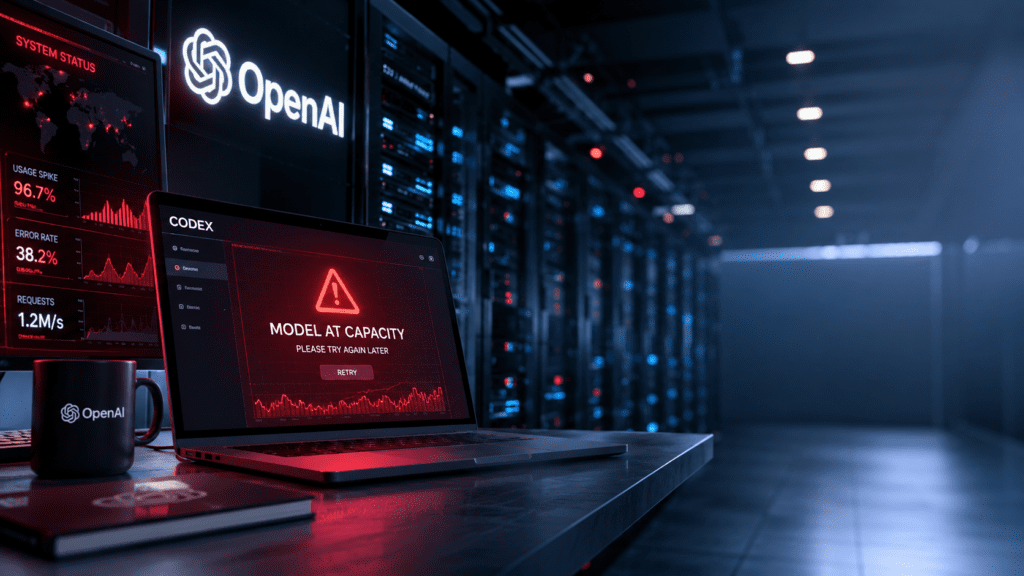
That is precisely what happened during the recent OpenAI Codex outage that triggered widespread “Selected Model is at Capacity” errors across the platform. Developers attempting to access GPT-5.5 through Codex encountered interruptions, failed tasks, stalled workflows, and unexpected service degradation. Social media channels, developer communities, and discussion forums quickly filled with reports from frustrated users wondering whether the issue was isolated, account-related, or part of a larger infrastructure problem.
The outage was eventually resolved, but the incident raised broader questions about AI infrastructure reliability, compute capacity management, model demand, and the increasing dependence of engineering teams on cloud-based coding agents.
For organizations integrating AI into critical development pipelines, outages are no longer minor inconveniences. They represent operational risks that can delay releases, interrupt debugging sessions, and disrupt collaborative workflows.
This deep-dive examines the OpenAI Codex outage, explains what caused the disruption, analyzes its broader implications, explores developer reactions, and outlines practical strategies for minimizing the impact of future AI service interruptions.
Search Intent Analysis
Before understanding the outage itself, it helps to understand why people are searching for it.
Primary Search Intent
Users want to know:
- What happened during the OpenAI Codex outage?
- Why were they seeing “Model at Capacity” errors?
- Was GPT-5.5 affected?
- Has the issue been fixed?
Secondary Search Intent
Readers are also looking for:
- Timeline of the outage
- Technical explanation
- Impact on developers
- Reliability concerns
- Future prevention measures
Emotional Intent
Many affected users experienced:
- Frustration
- Workflow disruption
- Lost productivity
- Concern over paid subscriptions
Developers rely heavily on AI coding assistants, making service interruptions particularly disruptive. Community discussions reflected this sentiment during the outage.
Information Gap
Most coverage focuses on outage announcements. Few articles explain:
- Capacity management challenges
- AI infrastructure bottlenecks
- Engineering implications
- Risk mitigation strategies
This article fills those gaps.
What Is OpenAI Codex?
OpenAI Codex is an AI-powered software engineering platform designed to help developers write, analyze, debug, and improve code using advanced language models.
Modern versions of Codex leverage OpenAI’s latest frontier models, including GPT-5.5, to assist with:
- Code generation
- Bug fixing
- Refactoring
- Documentation
- Test creation
- Repository analysis
- Agent-driven development workflows
Unlike traditional autocomplete systems, Codex can execute complex multi-step engineering tasks, making it increasingly valuable for professional software teams.
As adoption grows, so does infrastructure demand.
That growth creates a difficult balancing act between computational availability and user demand.
What Happened During the OpenAI Codex Outage?
On June 16, 2026, users began reporting elevated error rates when accessing Codex services.
The most common error message displayed was:
“Selected Model is at Capacity. Please try a different model.”
According to OpenAI’s status reports, the issue was identified as a degradation affecting Codex services. OpenAI acknowledged elevated errors and implemented mitigation measures before eventually restoring normal functionality.
The outage specifically affected:
- Codex users
- GPT-5.5 access within Codex
- Cloud-based coding workflows
- AI-assisted development sessions
Many users found themselves unable to continue active projects using their preferred models.
Timeline of the Incident
| Time Period | Event |
|---|---|
| Initial Reports | Users report “Model at Capacity” errors |
| Investigation Phase | OpenAI confirms elevated error rates |
| Mitigation Phase | Engineering teams deploy fixes |
| Monitoring Phase | Recovery observed across services |
| Resolution | Full service restoration announced |
OpenAI’s status updates indicate that the outage lasted several hours before impacted services fully recovered.
Understanding the “Model at Capacity” Error
The phrase sounds simple, but it reveals an important reality about modern AI systems.
AI models require enormous computational resources.
When demand exceeds available infrastructure capacity, providers may:
- Queue requests
- Throttle workloads
- Redirect users
- Restrict model availability
- Display capacity-related errors
The “Selected Model is at Capacity” message generally indicates that available compute resources for a specific model are temporarily exhausted or constrained. Community discussions widely interpreted the outage as a capacity-related infrastructure issue rather than an account-specific problem.
This differs from:
| Error Type | Meaning |
|---|---|
| Authentication Error | Login problem |
| API Error | Service request failure |
| Rate Limit Error | User exceeded usage quota |
| Capacity Error | Infrastructure overload |
Capacity-related disruptions often emerge during:
- Traffic spikes
- Model launches
- Sudden adoption surges
- Infrastructure migrations
Why AI Coding Platforms Experience Outages
Many users assume cloud services are infinitely scalable.
Reality is far more complicated.
Large AI systems depend on:
- GPU clusters
- High-speed networking
- Distributed inference systems
- Model orchestration layers
- Storage infrastructure
- Scheduling systems
Every coding request consumes computational resources.
As AI agents become more sophisticated, requests become significantly more expensive to process.
For example:
A simple autocomplete request may require minimal resources.
A multi-file repository analysis could consume thousands of times more computational effort.
That difference creates infrastructure planning challenges.
The Growing Demand Problem
One reason the outage attracted attention is the growing popularity of AI coding assistants.
Developer adoption has accelerated because these tools can:
- Reduce boilerplate coding
- Accelerate debugging
- Improve documentation
- Increase productivity
This success creates a paradox.
The better AI coding agents become, the more developers depend on them.
The more developers depend on them, the greater the infrastructure burden becomes.
Several community discussions before and during the outage suggested users were already observing slower performance during peak demand periods. While anecdotal, these reports reflect concerns about infrastructure strain as adoption increases.
How Developers Reacted
The outage sparked significant discussion across developer communities.
Several recurring themes emerged:
Frustration Over Workflow Interruptions
Many users reported active coding sessions suddenly stopping.
Others described being forced to switch models mid-project.
Subscription Concerns
Paid users questioned service reliability given premium subscription costs. Community feedback highlighted concerns from users paying for high-tier plans while experiencing disruptions.
Speculation About New Model Releases
Some developers wondered whether infrastructure resources were being reallocated ahead of future model launches.
No official evidence supported these theories, but such speculation spread quickly during the outage.
Reliability Discussions
Developers debated whether the incident represented:
- Temporary overload
- Capacity planning challenges
- Scaling bottlenecks
- Broader infrastructure limitations
Was GPT-5.5 Specifically Affected?
Evidence suggests GPT-5.5 access through Codex was a major source of reported problems.
Users frequently reported receiving capacity-related errors while attempting to use GPT-5.5, and OpenAI status reports had also documented previous GPT-5.5-related Codex incidents earlier in June.
That does not necessarily indicate a model flaw.
Instead, it may reflect:
- Higher demand
- Greater compute requirements
- Increased user preference
- Infrastructure concentration around popular models
Popular frontier models naturally attract heavier workloads.
The Broader Reliability Picture
The June outage was not an isolated event.
Recent status records show multiple Codex-related incidents, including:
- Elevated GPT-5.5 error rates
- Cloud task issues
- Service degradations
- Multi-service disruptions affecting Codex and ChatGPT simultaneously
This does not mean Codex is unreliable.
Rather, it highlights the reality that frontier AI systems remain operationally complex.
Unlike traditional SaaS products, AI platforms face unique challenges:
- Massive GPU requirements
- Dynamic demand spikes
- Continuous model updates
- Resource-intensive inference workloads
Expert Analysis: Why These Incidents Matter
The significance of this outage extends beyond a few hours of downtime.
It highlights an emerging dependency risk.
A growing number of engineering teams now rely on AI agents for:
- Daily coding
- Code reviews
- Documentation
- Refactoring
- Testing
That dependency introduces a new category of operational vulnerability.
Historically, developers worried about:
- Source control outages
- CI/CD failures
- Cloud downtime
Now AI availability must also be considered.
Organizations increasingly need contingency planning for AI service interruptions.
Practical Lessons for Development Teams
1. Avoid Single-Tool Dependency
Never build a workflow that depends entirely on one AI service.
Maintain alternatives such as:
- Secondary coding assistants
- Local development tools
- Traditional IDE workflows
2. Save Context Frequently
During outages:
- Sessions may fail
- Agents may stop unexpectedly
- Work history may become inaccessible
Regularly preserve:
- Prompts
- Context windows
- Development notes
3. Monitor Status Dashboards
Before troubleshooting locally, check official service status reports.
Many users spend valuable time investigating local issues that are actually platform-wide outages.
4. Design AI-Assisted Workflows for Failure
Treat AI services like any other external dependency.
Build processes that continue functioning when AI tools become unavailable.
5. Keep Human Expertise Central
AI can accelerate development.
It should not replace engineering understanding.
Teams that maintain strong fundamentals recover more quickly when tools fail.
Common Misconceptions About the Codex Outage
Myth 1: My Account Was Suspended
Many users assumed the issue was account-related.
The outage was platform-wide and affected numerous users simultaneously.
Myth 2: GPT-5.5 Was Permanently Removed
Capacity errors do not indicate model retirement.
They typically indicate temporary infrastructure constraints.
Myth 3: Paid Plans Guarantee Zero Downtime
Premium subscriptions often provide higher limits and priority access.
They do not eliminate the possibility of service disruptions.
Myth 4: Capacity Errors Mean the Model Is Broken
A model can function perfectly while infrastructure capacity becomes temporarily exhausted.
These are separate issues.
Outage Response Checklist for Developers
| Action | Priority |
|---|---|
| Check official status page | High |
| Verify community reports | High |
| Switch models if available | High |
| Save current work | High |
| Retry after recovery notice | Medium |
| Review incident updates | Medium |
| Maintain backup workflow | High |
What This Incident Reveals About the Future of AI Infrastructure
The outage underscores a broader industry trend.
Demand for advanced AI coding systems is growing faster than ever.
Providers must continuously balance:
- User growth
- Infrastructure expansion
- Cost efficiency
- Reliability
- Performance
As coding agents become more capable, infrastructure requirements will continue rising.
Future competition among AI companies may depend as much on reliability and scalability as on raw model intelligence.
The most powerful model is only useful when developers can access it.
Frequently Asked Questions
What caused the OpenAI Codex outage?
OpenAI identified elevated errors affecting Codex services and implemented mitigation measures before restoring service. Public reports centered around “Selected Model is at Capacity” errors.
What does “Selected Model is at Capacity” mean?
It generally indicates that demand for a model exceeds currently available computational resources.
Was GPT-5.5 affected?
Yes. Numerous user reports and service updates indicated GPT-5.5-related disruptions within Codex.
How long did the outage last?
Public status updates indicate the incident persisted for several hours before full recovery.
Did OpenAI fix the issue?
Yes. OpenAI reported that all impacted services had fully recovered following mitigation efforts.
Are Codex outages common?
Like many large-scale cloud services, Codex has experienced occasional incidents and service degradations, though most are resolved relatively quickly.
Can developers prevent outage-related disruptions?
They can reduce impact by maintaining backup workflows, saving context frequently, and avoiding complete dependence on a single AI platform.
Should businesses worry about AI reliability?
Organizations using AI in production workflows should include AI availability within their operational risk planning, just as they do with cloud services and APIs.
Final Thoughts
The OpenAI Codex outage was more than a temporary technical disruption. It offered a glimpse into the operational realities of modern AI infrastructure at scale.
As AI coding assistants become embedded in professional software development, reliability becomes just as important as model capability. The June 2026 incident demonstrated how quickly capacity constraints can affect thousands of developers, interrupt workflows, and trigger widespread discussion across the engineering community.
The good news is that OpenAI identified the problem, implemented mitigation measures, and restored service within hours. The larger lesson, however, is that AI-assisted development remains dependent on complex infrastructure that must continuously evolve to keep pace with growing demand.
For developers and organizations alike, the smartest approach is not to assume outages will never happen—but to build workflows resilient enough to keep moving when they do.