
 By
By
Introduction
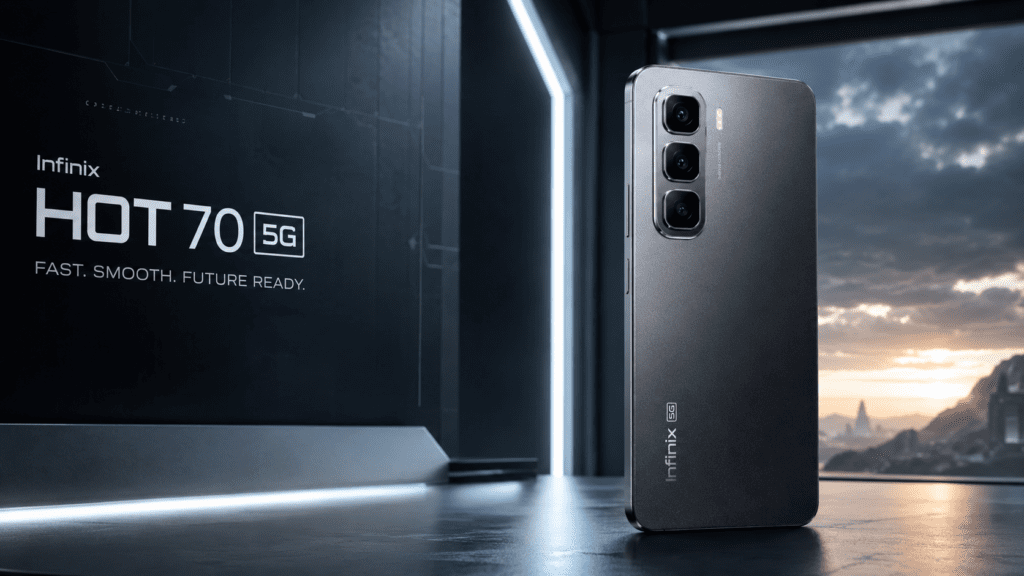
Budget 5G phones used to mean one thing: compromise everything except connectivity. That calculus is changing fast in 2026, and the Infinix Hot 70 series sits right at the center of that shift. Whether you’re eyeing the base Hot 70 for its 6,000 mAh battery or waiting for the Hot 70 Pro 5G with its leaked Dimensity 7100 chip and AMOLED display, there’s a lot to unpack before you spend your money.
This guide covers what Infinix actually shipped (the Hot 70 4G/LTE), what’s coming in the 5G Pro variant, how the whole lineup stacks up against Redmi, Tecno, and Samsung rivals, and who each model genuinely suits. No filler, no recycled spec sheets — just the information you need to decide.
What Is the Infinix Hot 70 Series? Understanding the Lineup
Before diving into specs, it’s important to clear up a point that confuses most first-time searchers: as of mid-2026, “Infinix Hot 70 5G” refers to an upcoming variant, not the phone already on sale. Here’s how the series breaks down:
Hot 70 (4G/LTE) — Launched in Indonesia (May 2026) and Bangladesh, this is the base model. It runs the MediaTek Helio G100 Ultimate — a capable 4G chip — with up to 8 GB of RAM and a 6,000 mAh battery. No 5G radio.
Hot 70 Pro 5G — Leaked and expected in India and select markets around mid-to-late 2026. Uses the MediaTek Dimensity 7100 5G chipset, a 6.76-inch HD+ display, 6,000 mAh battery with 45W charging, and runs XOS 16 based on Android 16.
Hot 70 Pro+ 5G — A higher-tier variant with a rumored 144Hz AMOLED display, targeting ₹17,000–₹21,000 in India.
This distinction matters because most spec comparison sites mix the two, leading buyers to assume 5G connectivity is already available when it isn’t on the standard model yet.
Infinix Hot 70 (Base Model): Full Specifications
Display
The Hot 70 sports a 6.78-inch IPS LCD panel with a 720 × 1576 pixel resolution and a 120 Hz refresh rate. At 256 ppi, sharpness is acceptable at arm’s length for social media and video streaming, though text-heavy apps and small print reveal the HD+ limitation versus FHD+ competitors. The screen reaches 700 nits in High Brightness Mode — enough for outdoor use in moderate sunlight — and the 240 Hz touch sampling rate keeps swipe interactions feeling snappy.
What the spec sheet won’t tell you: the 84.4% screen-to-body ratio is legitimate here. Infinix kept bezels reasonably slim, which gives the phone a clean look despite the LCD panel type.
Chipset and Performance
The Helio G100 Ultimate (6 nm) is an octa-core design with two performance cores at 2.2 GHz and six efficiency cores at 2.0 GHz, paired with a Mali-G52 MC2 GPU. This isn’t a 5G chip — the “Ultimate” branding refers to Infinix’s optimization layer on top of MediaTek’s G-series architecture.
In practical terms, daily tasks (Instagram, WhatsApp, YouTube, light gaming) run without friction. PUBG Mobile at Smooth/High settings is playable. CPU-intensive tasks like sustained gaming or 4K video editing will push the chip to its limits, and you’ll notice frame drops in graphically demanding titles after 20–30 minutes. That’s the honest ceiling, and it’s perfectly acceptable at this price tier.
RAM options are 4 GB, 6 GB, and 8 GB LPDDR4X. The 8 GB variant with UFS 2.2 storage is worth the small price premium if you multitask heavily or keep 15+ apps open simultaneously.
Battery: The Headline Feature
A 6,000 mAh cell is genuinely large. Paired with the efficient Helio G100 and an HD+ display (which demands less power than FHD+), expect 1.5 to 2 full days of moderate use. Heavy users — streaming music, active navigation, and frequent social scrolling — will still comfortably close a full day with charge to spare.
The 45W fast charging (on select variants) moves the needle meaningfully: 0 to 50% in roughly 30 minutes is the expected performance curve, with a full charge around 70–80 minutes. Note: some regional SKUs ship with 33W charging, so verify before buying.
Infinix also includes a Bypass Charging mode, which routes power directly to the phone’s components during gaming — reducing heat buildup and long-term battery wear. This is a thoughtful feature you’d normally expect at a higher price point.
Camera System
Rear: 50 MP primary sensor (f/1.9 aperture, autofocus) + auxiliary depth lens
Front: 8 MP (per GSMArena preliminary specs); some regional listings cite 16 MP — confirm for your market’s SKU
Video: Up to 1440p @ 30 fps from the main camera
The 50 MP main sensor is a starting point, not an endpoint. Daylight shots with good contrast will be solid for sharing on social platforms. The sensor size and ISP determine low-light quality more than megapixel count, and budget sensors tend to show noise above ISO 400. Night Mode processing in XOS 16 helps, but you’ll want to tap to focus and hold the phone steady.
The depth sensor exists mainly for bokeh portrait effects — it doesn’t meaningfully improve standard photography. Portrait mode results are decent in good light and overly aggressive at blurring edges in mixed lighting.
Software
XOS 16 on Android 16 is a notable advantage. Infinix promises 3 major Android OS upgrades and 5 years of security patches — a commitment that was hard to find below ₹20,000 just two years ago. The OS layer includes AI Wallpaper generation, AI Summarizer for texts and articles, and a dedicated physical AI interface button on the Pro models.
XOS has historically been criticized for pre-installed apps. The situation has improved but expect 10–15 additional apps out of the box, some of which can be uninstalled.
Build and Durability
At 7.5 mm thin and 195 g, the Hot 70 is well-proportioned for its screen size. The chassis is glass-front, plastic-back, and plastic-frame — standard for this price tier. Two finish options stand out: the Thermo Orange Edition uses a temperature-responsive back cover that visually reacts to heat, and the brand’s “Dynamic Shine” lineup offers 12 colorways — an unusually wide palette for a budget phone.
IP64 dust-tight and water-splash resistance, plus a certified 1.5-meter drop resistance, provide practical everyday durability beyond what the plastic build might suggest.
Connectivity
Wi-Fi 5 (dual-band), Bluetooth 5.4, NFC, infrared port, FM radio, USB-C 2.0 with OTG support, and a 3.5 mm headphone jack. The inclusion of NFC at this price point opens contactless payment capabilities in markets where mobile payment infrastructure is strong. The infrared blaster lets the phone double as a universal remote — a low-cost addition that users discover and appreciate weeks after purchase.
What’s absent: 5G. If 5G coverage is already rolled out in your city and future-proofing matters to you, wait for the Hot 70 Pro 5G or consider a Redmi Note 15 5G at a slightly higher price.
Infinix Hot 70 Pro 5G: What We Know So Far
The Hot 70 Pro 5G hasn’t officially launched globally as of June 2026, but leaked specs and FCC filings paint a fairly clear picture.
Expected specifications:
- Display: 6.76-inch HD+ LCD (FHD+ possible on Pro+)
- Chipset: MediaTek Dimensity 7100 5G (4 nm architecture)
- RAM/Storage: Up to 8 GB RAM, 256 GB internal storage
- Battery: 6,000 mAh with 45W fast charging
- OS: XOS 16 / Android 16
- Unique Feature: “Dot Matrix” display integrated into one of the camera cutouts — a small secondary screen showing notifications and quick info, similar in concept to Infinix’s Note 60 Pro implementation
The Dimensity 7100 is a meaningful upgrade over the Helio G100. It includes an integrated 5G modem, supports Sub-6 GHz 5G bands, and offers better sustained performance in the AnTuTu 700K range — positioning it squarely against the Redmi Note 15 5G and Samsung Galaxy A16 5G.
Pricing in India is expected around ₹12,999–₹14,999 for the base 5G variant, which would make it one of the most aggressive value propositions in the segment if Infinix holds that line.
Head-to-Head Comparison
| Feature | Infinix Hot 70 | Infinix Hot 70 Pro 5G (Expected) | Redmi Note 15 5G | Samsung Galaxy A16 5G |
|---|---|---|---|---|
| 5G | No | Yes | Yes | Yes |
| Display | 6.78″ IPS 120Hz HD+ | 6.76″ IPS/AMOLED 120Hz | 6.67″ AMOLED 120Hz FHD+ | 6.7″ AMOLED 90Hz FHD+ |
| Chipset | Helio G100 Ultimate | Dimensity 7100 | Dimensity 7025 Ultra | Exynos 1330 |
| Battery | 6,000 mAh / 45W | 6,000 mAh / 45W | 5,500 mAh / 45W | 5,000 mAh / 25W |
| RAM | Up to 8 GB | Up to 8 GB | Up to 8 GB | Up to 8 GB |
| OS Updates | 3 years + 5yr security | 3 years + 5yr security | 2 years | 4 years OS, 5yr security |
| NFC | Yes | Yes | Yes | Yes |
| Headphone Jack | Yes | Yes | Yes | Yes |
| Expected Price (India) | ~₹12,990 | ~₹13,999–₹14,999 | ~₹18,514 | ~₹19,999 |
What this table shows: The Hot 70 wins on battery and price; the Redmi Note 15 5G wins on display quality and 5G on a proven chip; Samsung leads on software support longevity. The Hot 70 Pro 5G, if priced as expected, would offer a strong battery + 5G combination that neither rival matches at under ₹15,000.
Who Should Buy the Infinix Hot 70?
The Hot 70 4G is for you if:
- Battery life is the single most important purchase driver
- 5G coverage hasn’t reached your area yet, or your carrier plan doesn’t support it
- You’re buying for a family member who does light-to-moderate use (calls, WhatsApp, YouTube, social)
- Budget is under ₹13,000 / $125
Wait for the Hot 70 Pro 5G if:
- You’re in a city with active 5G rollout
- You plan to keep the phone 3+ years and want network future-proofing
- The Dot Matrix secondary display feature appeals to you
Skip both and look at alternatives if:
- You game seriously and want sustained high-frame-rate performance
- AMOLED display contrast and color are non-negotiable
- Camera quality in low light is a priority — the 50 MP sensor has limitations there
Practical Ownership Scenarios
The commuter: Long days away from a charger, constant map navigation and podcast streaming — the 6,000 mAh battery is the single best reason to choose this phone. Real-world tests on comparable Infinix hardware suggest 7–9 hours of screen-on time at 120 Hz is achievable.
The student: XOS 16’s AI Summarizer becomes genuinely useful for condensing long reading assignments. The 8 GB RAM + 256 GB storage variant handles note-taking apps, PDF readers, streaming, and multitasking without complaint.
The first smartphone buyer (or gifting context): The combination of a large screen, simple UI, durable build, and generous battery makes the Hot 70 easy to recommend for someone upgrading from a feature phone or receiving a budget gift.
The mobile gamer: Playable at medium settings, but not optimized for competitive gaming. If BGMI or Call of Duty Mobile is central to your use case, the higher-performing Poco M7 Pro or Realme Narzo 80 5G in a similar price range handles sustained gaming loads better.
Common Buyer Mistakes to Avoid
Assuming “Hot 70” always means 5G. The standard Hot 70 uses a 4G chipset. Verify the model number and chipset (look for “Dimensity” for 5G capability, “Helio” for 4G) before purchasing from any retailer.
Choosing the 4 GB RAM variant to save money. At ₹1,000–₹1,500 more, the 6 GB or 8 GB variant extends the phone’s useful life by 12–18 months as apps become more memory-hungry. The cheapest option often isn’t the most economical one.
Ignoring regional SKU differences. Infinix ships different battery capacities (5,430 mAh vs. 5,600 mAh vs. 6,000 mAh), charging speeds (33W vs. 45W), and even chipsets across markets. Always confirm the spec sheet for your specific country’s launch.
Expecting AMOLED contrast from an IPS LCD panel. The display is good for the price, but if you’ve been using an AMOLED phone, the shift to IPS LCD will be noticeable — particularly in black levels and outdoor visibility.
Future Outlook: Where the Hot Series Is Heading
The Hot 70 series signals a clear strategic direction for Infinix. The brand grew 55% year-on-year in key markets like the Philippines and posted 14% quarter-on-quarter growth in South Asia through early 2026. Competing for volume against Redmi and Tecno requires aggressive specs-per-rupee positioning — and that’s exactly what the Hot 70 series delivers.
The commitment to 3 major OS upgrades and 5 years of security patches is notable because it matches or exceeds what competitors offer at the same price. If Infinix holds this commitment in practice (not just on paper), it changes the long-term value calculation meaningfully.
Looking past 2026, the likely trajectory is AMOLED panels trickling down to the base Hot variant, 5G becoming standard across the lineup, and Infinix’s AI features maturing as the XOS layer accumulates more real-world usage data. The Hot 70 Pro+ already hints at this with its rumored 144 Hz AMOLED display — a specification that would have been firmly mid-range territory 18 months ago.
Key Takeaways
- The Infinix Hot 70 is a 4G phone with an outstanding battery (6,000 mAh), a smooth 120 Hz display, and a low entry price — not a 5G device.
- The 5G variant is the upcoming Hot 70 Pro 5G, expected with a Dimensity 7100 chip and similar battery capacity.
- For under ₹13,000, the standard Hot 70 offers better battery endurance than any direct competitor, with the rare addition of NFC, an IR blaster, and a 3.5 mm jack.
- Buyers who need 5G or AMOLED display quality should wait for the Pro 5G or look at the Redmi Note 15 5G at a higher price point.
- Infinix’s software support commitment (3 major Android updates + 5 years security) is above average for this price tier and deserves serious weight in the buying decision.
FAQ
Is the Infinix Hot 70 a 5G phone? No. The base Hot 70 uses the MediaTek Helio G100 Ultimate, which is a 4G chipset. The 5G model is the Hot 70 Pro 5G, which features a Dimensity 7100 chip and is expected to launch in mid-to-late 2026 in markets like India.
What is the price of the Infinix Hot 70 5G in India? The base Hot 70 (4G) is expected at approximately ₹12,990 in India. The Hot 70 Pro 5G is anticipated in the ₹13,999–₹14,999 range, though official pricing will be confirmed at launch.
How long does the Infinix Hot 70 battery last? The 6,000 mAh battery delivers approximately 1.5 to 2 days of moderate use. Heavy users — with constant navigation, streaming, and active social media — can expect comfortably over a full day with charge remaining.
Does the Infinix Hot 70 have NFC? Yes. NFC is included on the Hot 70, enabling contactless payments in supported markets — unusual for a phone at this price point.
Is the Infinix Hot 70 good for gaming? Casual to moderate gaming (PUBG at smooth settings, Candy Crush, light Battle Royale) is comfortable. Sustained high-performance gaming for 45+ minutes at high settings will cause frame drops. Dedicated mobile gamers should consider the Poco M7 Pro or Realme Narzo series at a slightly higher budget.
What cameras does the Infinix Hot 70 have? A 50 MP main sensor (f/1.9, autofocus) and an auxiliary depth sensor on the rear, plus a front camera (8–16 MP depending on regional SKU). Video goes up to 1440p @ 30 fps.
Will the Infinix Hot 70 receive Android updates? Infinix has committed to 3 major Android OS upgrades and 5 years of security patches for the Hot 70 series — one of the most competitive software support policies in the budget segment.
How does the Infinix Hot 70 compare to Redmi Note 15 5G? The Hot 70 has a significantly larger battery (6,000 mAh vs. 5,500 mAh), a lower price (₹12,990 vs. ~₹18,514), and includes an IR blaster. The Redmi Note 15 5G wins on display quality (AMOLED FHD+ vs. IPS HD+), 5G connectivity, and Xiaomi’s more mature software ecosystem.
What makes the Infinix Hot 70 Pro 5G different from the standard model? The Pro 5G adds a Dimensity 7100 5G chipset, a Dot Matrix secondary notification display integrated into the camera island, and potentially a higher-quality main display depending on the final specification. The battery and software remain comparable.
Where can I buy the Infinix Hot 70? In Indonesia, it’s available through local retailers and Infinix’s official channels. In India, availability is expected through Flipkart and Infinix’s website at launch. International availability varies by region — check your local telecom retailer or Infinix’s country-specific website.