
 By
By
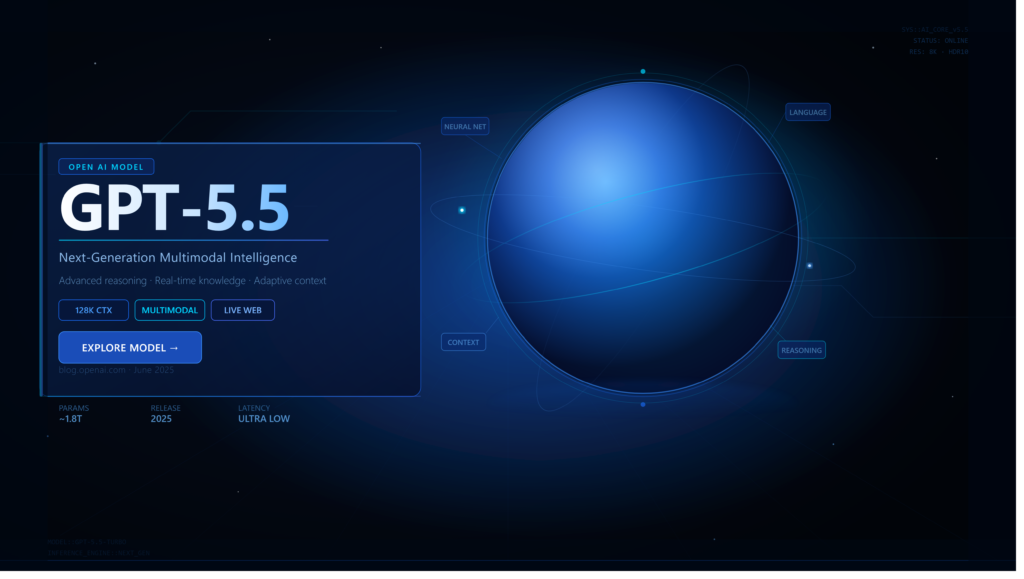
GPT-5.5: The Next Leap in Practical Artificial Intelligence
Artificial intelligence has entered a phase where raw intelligence alone is no longer the defining benchmark. Reliability, reasoning quality, contextual understanding, multimodal capabilities, and real-world usefulness now matter just as much as model size or benchmark scores.
That shift is precisely why GPT-5.5 has attracted so much attention.
For businesses, developers, researchers, content creators, educators, and everyday users, GPT-5.5 represents more than another version number. It reflects a broader evolution in how modern AI systems interact with humans, process information, and assist with increasingly sophisticated tasks.
The question many people are asking is no longer, “Can AI generate text?”
Instead, the conversation has evolved into:
- Can AI reason accurately?
- Can it understand complex intent?
- Can it reduce hallucinations?
- Can it collaborate effectively with humans?
- Can it solve practical problems at scale?
GPT-5.5 aims to address these challenges while pushing the boundaries of conversational intelligence, multimodal understanding, and agent-like capabilities.
This guide provides a comprehensive look at GPT-5.5, including what it is, how it differs from previous generations, where it excels, where it still falls short, and what its emergence means for the future of AI.
What Is GPT-5.5?
GPT-5.5 is a large language model (LLM) built on the Generative Pre-trained Transformer architecture.
At its core, the model is designed to understand, analyze, generate, and manipulate information expressed in natural language. However, GPT-5.5 extends far beyond traditional text generation.
It can:
- Understand nuanced instructions
- Process long-context conversations
- Assist with coding tasks
- Analyze documents
- Generate structured outputs
- Interpret images and visual information
- Support research workflows
- Perform advanced reasoning tasks
- Collaborate on complex projects
Rather than functioning as a simple chatbot, GPT-5.5 acts more like an intelligent reasoning assistant capable of adapting to a wide variety of professional and personal use cases.
Search Intent Analysis: Why People Are Searching for GPT-5.5
Understanding user intent reveals why GPT-5.5 has become such a high-interest topic.
Primary Intent
Users want to understand:
- What GPT-5.5 is
- How it differs from previous models
- Whether it is worth using
- What new capabilities it offers
Secondary Intent
Users are evaluating:
- Business adoption
- Productivity benefits
- Development opportunities
- AI tool selection
Emotional Intent
Many users are experiencing:
- Curiosity
- Excitement
- Skepticism
- Fear of missing out
- Concern about AI replacing jobs
Common Questions
People frequently ask:
- Is GPT-5.5 smarter than GPT-4?
- Can GPT-5.5 code better?
- Is GPT-5.5 more accurate?
- Does GPT-5.5 hallucinate less?
- What industries will benefit most?
The rest of this article addresses these questions directly.
The Evolution of GPT Models
Understanding GPT-5.5 becomes easier when viewed as part of a broader progression.
| Model | Major Strength |
|---|---|
| GPT-2 | Coherent text generation |
| GPT-3 | Large-scale language understanding |
| GPT-3.5 | Conversational usability |
| GPT-4 | Advanced reasoning and multimodal capabilities |
| GPT-4o | Real-time multimodal interaction |
| GPT-5 | Stronger intelligence and agentic behavior |
| GPT-5.5 | Enhanced reliability, reasoning, contextual understanding, and practical deployment |
The trend is clear.
Each generation moves closer to becoming a genuine cognitive assistant rather than a text prediction engine.
Key Features of GPT-5.5
1. Improved Reasoning
One of the most significant advances is deeper reasoning capability.
GPT-5.5 performs better at:
- Multi-step problem solving
- Logical analysis
- Strategic planning
- Cause-and-effect evaluation
- Decision support
Instead of producing surface-level answers, the model can maintain logical consistency across longer chains of thought.
Example
A business owner asks:
“Should I invest in SEO, paid advertising, or influencer marketing?”
Rather than giving generic advice, GPT-5.5 can:
- Analyze budget constraints
- Assess industry competition
- Compare channels
- Estimate risks
- Recommend phased implementation
This creates far more actionable outcomes.
2. Better Instruction Following
Previous models occasionally misunderstood nuanced requests.
GPT-5.5 demonstrates stronger adherence to:
- Formatting instructions
- Style requirements
- Tone preferences
- Workflow constraints
- Multi-part requests
This improvement is particularly valuable for professional users.
For example:
A lawyer requesting a structured legal summary or a software engineer requesting precise code modifications can expect more reliable outputs.
3. Stronger Long-Context Understanding
Context management is one of the most important capabilities of modern AI.
GPT-5.5 can maintain awareness across extensive conversations, documents, and projects.
Benefits include:
- Better memory within sessions
- Improved continuity
- Reduced repetition
- More coherent long-form outputs
For enterprise workflows involving thousands of words of documentation, this capability is transformative.
4. Enhanced Multimodal Intelligence
Modern AI increasingly operates across multiple forms of information.
GPT-5.5 can work with:
- Text
- Images
- Documents
- Charts
- Visual layouts
- Screenshots
This enables richer analysis and broader applications.
Example Use Cases
- Reviewing contracts
- Interpreting graphs
- Diagnosing interface issues
- Summarizing presentations
- Analyzing reports
The result is a more versatile AI assistant.
5. Improved Coding Assistance
Software development remains one of the most impactful AI use cases.
GPT-5.5 offers significant improvements in:
- Debugging
- Refactoring
- Documentation
- Architecture planning
- Code explanation
- Testing support
Developers can use it as a collaborative engineering assistant rather than a simple code generator.
How GPT-5.5 Improves Productivity
The productivity implications are substantial.
Knowledge Workers
Professionals can:
- Draft reports faster
- Analyze research efficiently
- Summarize large datasets
- Generate insights
Students
Students can:
- Understand difficult concepts
- Create study plans
- Generate practice questions
- Review learning materials
Content Creators
Creators can:
- Develop content strategies
- Generate outlines
- Research topics
- Repurpose content
Entrepreneurs
Business owners can:
- Create marketing campaigns
- Analyze competitors
- Build SOPs
- Improve customer communication
Real-World Applications of GPT-5.5
Healthcare Support
Potential uses include:
- Administrative automation
- Medical documentation
- Research assistance
- Patient communication support
Human oversight remains essential.
Education
GPT-5.5 can function as:
- Tutor
- Writing coach
- Research assistant
- Personalized learning guide
Educational experiences become more adaptive and individualized.
Software Engineering
Developers increasingly rely on AI for:
- Boilerplate generation
- Code reviews
- Troubleshooting
- Documentation
GPT-5.5 accelerates development cycles without replacing engineering expertise.
Customer Support
Organizations can improve:
- Response speed
- Ticket classification
- Knowledge retrieval
- Self-service experiences
The result is lower operational cost and improved customer satisfaction.
Marketing and SEO
SEO professionals can use GPT-5.5 for:
- Keyword clustering
- Topic mapping
- Content briefs
- Competitive analysis
- Content optimization
When combined with human expertise, it becomes a powerful productivity tool.
Expert Analysis: Why GPT-5.5 Matters
The most important shift is not necessarily raw intelligence.
The larger breakthrough lies in reliability.
Historically, AI adoption faced three major obstacles:
Hallucinations
Inconsistent reasoning
Limited context retention
GPT-5.5 addresses all three more effectively than many earlier systems.
This moves AI from experimentation toward operational deployment.
Businesses are increasingly evaluating AI based on trustworthiness rather than novelty.
That distinction matters.
An AI system that is slightly smarter but unreliable creates risk.
An AI system that is consistently accurate creates value.
GPT-5.5 vs Previous Generations
| Capability | GPT-4 | GPT-4o | GPT-5 | GPT-5.5 |
| Reasoning | Strong | Strong | Very Strong | Enhanced |
| Context Handling | Excellent | Excellent | Advanced | More Refined |
| Coding | Excellent | Excellent | Advanced | Improved |
| Multimodal Support | Strong | Very Strong | Advanced | Enhanced |
| Instruction Following | Strong | Strong | Very Strong | More Precise |
| Reliability | High | High | Very High | Further Improved |
The improvements may appear incremental on paper, but in practical workflows they often compound significantly.
Common Misconceptions About GPT-5.5
Myth 1: GPT-5.5 Is Always Correct
Reality:
Even advanced AI models can make mistakes.
Verification remains necessary for:
- Medical advice
- Financial decisions
- Legal guidance
- Scientific research
Myth 2: GPT-5.5 Replaces Human Experts
Reality:
The model amplifies expertise rather than replacing it.
The best outcomes occur when humans and AI collaborate.
Myth 3: More Intelligence Means No Hallucinations
Reality:
Hallucinations can still occur.
Advanced models reduce them but do not eliminate them entirely.
Myth 4: AI Understands Like Humans
Reality:
GPT-5.5 demonstrates remarkable language understanding but operates differently from human cognition.
Its outputs emerge from learned patterns, reasoning mechanisms, and probabilistic prediction rather than human consciousness.
Practical Ways to Get Better Results From GPT-5.5
Use Specific Instructions
Instead of:
“Write a blog post.”
Use:
“Write a 2,500-word SEO-focused article for SaaS founders with examples and actionable recommendations.”
Specificity improves output quality dramatically.
Provide Context
The model performs better when given:
- Objectives
- Constraints
- Audience information
- Background details
Context reduces ambiguity.
Break Complex Tasks Into Steps
Rather than requesting everything at once:
- Generate outline
- Review structure
- Expand sections
- Refine final version
This workflow often produces stronger results.
Request Critiques
Ask:
- What are weaknesses?
- What assumptions are being made?
- What risks exist?
This encourages deeper analysis.
Verify High-Stakes Information
Always fact-check:
- Statistics
- Regulations
- Medical information
- Legal claims
Responsible use remains essential.
The Future of GPT-5.5 and AI Systems
Several trends are becoming increasingly clear.
More Agentic Behavior
AI systems are moving beyond conversation.
Future models will increasingly:
- Execute tasks
- Manage workflows
- Coordinate tools
- Complete objectives
Greater Personalization
AI assistants will become more adaptive.
They will better understand:
- Preferences
- Work habits
- Communication styles
- Long-term goals
Stronger Enterprise Integration
Organizations are integrating AI into:
- CRM platforms
- Productivity suites
- Customer service systems
- Development environments
GPT-5.5 represents another step toward AI-native workplaces.
Human-AI Collaboration
The future is unlikely to be humans versus AI.
The more realistic outcome is humans working alongside increasingly capable AI systems.
The individuals who learn to collaborate effectively with AI are likely to gain substantial advantages in productivity and decision-making.
Pros and Cons of GPT-5.5
| Pros | Cons |
| Stronger reasoning | Can still make mistakes |
| Better context understanding | Requires fact-checking |
| Improved coding support | Not a substitute for expertise |
| Enhanced multimodal abilities | May misunderstand ambiguous prompts |
| More reliable outputs | High-stakes decisions need human oversight |
| Better instruction following | Quality depends on prompt quality |
GPT-5.5 Best Practices Checklist
Before Using GPT-5.5
Define your goal clearly
Provide sufficient context
Specify output format
Identify audience
Set quality expectations
During Use
Ask follow-up questions
Request revisions
Challenge assumptions
Explore alternatives
After Use
Verify facts
Review reasoning
Edit final output
Apply human judgment
Frequently Asked Questions (FAQ)
What is GPT-5.5?
GPT-5.5 is an advanced generative AI model designed for reasoning, language understanding, content creation, coding assistance, multimodal analysis, and complex problem solving.
Is GPT-5.5 better than GPT-4?
GPT-5.5 generally improves upon earlier generations through stronger reasoning, better instruction following, enhanced reliability, and improved contextual understanding.
Can GPT-5.5 write code?
Yes. GPT-5.5 can generate, debug, explain, review, and optimize code across multiple programming languages.
Does GPT-5.5 support images?
Yes. Modern GPT systems can analyze images and visual content alongside text, enabling multimodal interactions.
Can GPT-5.5 replace human jobs?
GPT-5.5 is more likely to automate specific tasks rather than fully replace most professions. Human expertise, judgment, creativity, and accountability remain essential.
Is GPT-5.5 free to use?
Availability depends on the platform, subscription plan, and deployment environment where GPT-5.5 is offered.
Does GPT-5.5 hallucinate?
It can. While hallucinations are reduced compared to earlier systems, users should still verify important information.
What industries benefit most from GPT-5.5?
Education, healthcare administration, software development, marketing, customer service, research, finance, and professional services are among the sectors seeing substantial benefits.
Is GPT-5.5 suitable for business use?
Yes. Organizations increasingly use advanced AI models for automation, content creation, customer support, analysis, and productivity enhancement.
What is the biggest advantage of GPT-5.5?
Its greatest strength is the combination of intelligence, reliability, contextual understanding, and practical usefulness across a broad range of real-world tasks.
Final Thoughts
GPT-5.5 represents a meaningful evolution in artificial intelligence. The most significant change is not merely that it can generate better text—it is that it increasingly functions as a capable collaborative partner. Whether the task involves research, coding, strategic planning, education, analysis, or content creation, the model demonstrates a level of utility that moves AI closer to becoming an everyday cognitive tool.
The organizations and individuals gaining the most value from GPT-5.5 are not treating it as a replacement for human expertise. They are using it as a force multiplier. That distinction is likely to define the next phase of AI adoption, where competitive advantage comes not from having access to advanced models, but from knowing how to work with them effectively.