 By
By
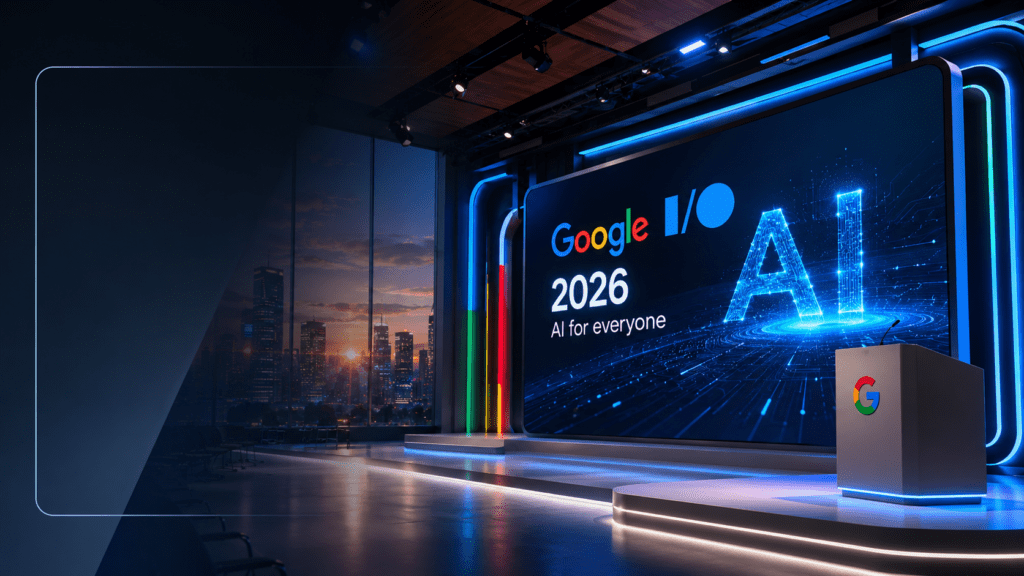
Google I/O 2026 Was More Than a Developer Conference—It Was an AI Showcase Built by AI
For years, Google I/O has served as the company’s annual stage for unveiling its most ambitious technologies. In 2026, however, something fundamentally changed.
Instead of merely presenting artificial intelligence as a product category, Google used AI as the engine behind the event itself.
From animated films and music production to interactive games, visual branding, storytelling, and live experiences, Google I/O 2026 demonstrated what happens when advanced AI systems move from being tools used by creators to becoming active collaborators in the creative process.
The company revealed that a significant portion of the event’s creative identity was produced using a growing ecosystem of AI technologies, including Gemini, Gemini Omni, Nano Banana, Google Flow, Lyria 3, and experimental models developed by Google DeepMind.
This shift matters because it provides one of the clearest real-world examples yet of how generative AI is transforming professional creative workflows. Rather than relying solely on traditional design, animation, music production, and software development pipelines, Google showcased an AI-assisted production ecosystem operating at enterprise scale.
For developers, creators, marketers, filmmakers, musicians, and technology enthusiasts, Google I/O 2026 offered a glimpse into a future where AI becomes a creative operating system rather than just a productivity tool.
What Happened at Google I/O 2026?
Google I/O 2026 wasn’t simply a product launch event.
It functioned as a large-scale demonstration of how Google’s AI ecosystem can produce complete creative experiences.
According to Google, many of the event’s visual assets, animations, music compositions, storytelling elements, and interactive demonstrations were built using combinations of generative AI systems working together.
Instead of showcasing isolated AI features, the company highlighted an interconnected workflow where multiple AI models contributed to different stages of content creation.
The result was an event that blurred the line between software development, entertainment production, and digital creativity.
The AI Tools Behind Google I/O 2026
Gemini: The Central Intelligence Layer
At the heart of Google’s AI ecosystem sits Gemini.
Throughout I/O 2026, Gemini served as more than a chatbot or assistant. It acted as a collaborative creative engine capable of generating concepts, scripts, narratives, production ideas, and development workflows.
Google increasingly positions Gemini as a multimodal system capable of understanding:
- Text
- Images
- Audio
- Video
- Code
- Documents
- Complex workflows
This broader capability allows Gemini to function as a bridge connecting multiple creative tools together.
Rather than replacing specialists, Gemini often acts as the coordinator of larger AI-assisted projects.
Why This Matters
Traditional creative production requires teams of writers, designers, editors, researchers, and producers.
AI systems like Gemini introduce a new layer where ideation, prototyping, iteration, and production can happen dramatically faster.
For businesses and creators, this potentially reduces:
- Development costs
- Production timelines
- Creative bottlenecks
- Resource requirements
Gemini Omni and Multimodal Intelligence
One of the recurring themes of Google I/O 2026 was multimodality.
Gemini Omni expands AI interaction beyond text.
Instead of handling information in separate silos, multimodal models process multiple forms of media simultaneously.
For example, an AI system could:
- Analyze video footage
- Generate music
- Create narration
- Suggest visual edits
- Produce captions
- Build interactive experiences
—all within a unified workflow.
This capability represents one of the most important shifts in modern AI development.
The future of generative AI isn’t about better text generation alone.
It’s about understanding and generating every major form of digital content.
Nano Banana: Experimental Creative Generation
Among the more intriguing technologies highlighted was Nano Banana.
While Google has shared limited public technical details, the model appears to be part of Google’s experimental creative AI initiatives focused on rapid content generation and artistic workflows.
Its inclusion signals Google’s willingness to explore highly specialized AI models designed for creative experimentation.
Historically, breakthrough creative technologies often begin as research projects before becoming mainstream products.
Nano Banana may represent one of those early-stage innovations.
Google Flow: The Future of AI-Powered Filmmaking
Perhaps one of the most exciting developments showcased at I/O 2026 was Google Flow.
Flow represents Google’s vision for AI-assisted video creation.
Video production traditionally involves:
- Storyboarding
- Asset creation
- Scene planning
- Animation
- Editing
- Sound design
- Rendering
These processes can require weeks or months of work.
Google Flow aims to dramatically reduce production complexity by enabling creators to generate cinematic sequences using natural language instructions and AI-powered workflows.
What Makes Flow Important?
Video is becoming the dominant format across:
- YouTube
- TikTok
- Advertising
- Education
- Enterprise communication
The demand for video content continues to outpace traditional production capacity.
AI-powered systems like Flow could make professional-quality video creation accessible to:
- Small businesses
- Independent creators
- Educators
- Startups
- Marketing teams
This democratization may become one of the defining trends of the next decade.
Lyria 3: Google’s Next Generation Music AI
Music generation was another major focus.
Google highlighted Lyria 3 as part of its expanding AI music ecosystem.
Generative music models are advancing rapidly.
Instead of producing simple background tracks, modern systems can increasingly create:
- Structured compositions
- Dynamic soundtracks
- Adaptive audio
- Mood-specific music
- Interactive sound experiences
Lyria 3 appears designed to push these capabilities further.
Why AI Music Matters
The modern content economy depends heavily on audio.
Creators need music for:
- Videos
- Podcasts
- Games
- Marketing campaigns
- Livestreams
- Virtual experiences
Traditional music licensing can be expensive and restrictive.
AI-generated music opens new possibilities for scalable content creation while introducing important discussions around authorship, copyright, and artistic identity.
TPU Training Day: A Case Study in AI-Assisted Animation
One of the most talked-about creative projects from Google I/O 2026 was an animated film called TPU Training Day, sometimes referred to internally as “Timmy TPU.”
The project serves as a fascinating example of how modern AI workflows can enhance creative production.
How the Film Was Created
The production reportedly began with simple handcrafted cardboard puppets.
Rather than abandoning traditional creativity, the team combined physical prototyping with AI-assisted production tools.
This hybrid workflow is important.
Many people imagine AI replacing human creativity.
What Google demonstrated instead was augmentation.
Human creators supplied ideas, characters, visual concepts, and storytelling direction.
AI accelerated execution.
This collaborative model may become the dominant production framework for future creative industries.
AI-Generated Games at Google I/O 2026
Gaming represented another major showcase area.
Google demonstrated AI-generated interactive experiences capable of adapting content, narratives, and gameplay elements dynamically.
Historically, game development has required large teams and significant budgets.
Generative AI introduces new possibilities:
Procedural World Creation
AI can generate environments, assets, and landscapes rapidly.
Dynamic Storytelling
Narratives can evolve based on player choices.
Personalized Experiences
Different players may encounter unique content.
Accelerated Development
Developers can prototype ideas significantly faster.
For independent studios especially, these capabilities could reduce barriers to entry and encourage experimentation.
Why Google I/O 2026 Signals a Major Industry Shift
The significance of I/O 2026 extends beyond Google’s products.
It reflects broader industry trends.
The technology sector is moving from:
AI as an assistant
to
AI as an active collaborator.
This transition affects nearly every creative profession.
Industries Being Transformed
| Industry | Potential AI Impact |
|---|---|
| Film Production | Faster previsualization and editing |
| Music Creation | AI-assisted composition |
| Software Development | Automated coding and testing |
| Marketing | Personalized campaign generation |
| Education | Interactive learning experiences |
| Gaming | Dynamic content creation |
| Journalism | Research augmentation |
| Design | Rapid visual prototyping |
The organizations that learn to integrate these systems effectively may gain substantial competitive advantages.
Expert Analysis: What Google Is Really Building
Viewed strategically, Google I/O 2026 reveals a much larger ambition.
Google is not merely developing isolated AI products.
It appears to be building an integrated creative ecosystem.
The goal seems to be creating a platform where:
- Ideas become assets
- Assets become experiences
- Experiences become products
with minimal friction between stages.
This is similar to how cloud computing transformed infrastructure.
Instead of managing physical servers, developers gained access to scalable computing resources.
Google’s AI vision applies similar principles to creativity itself.
The company is effectively attempting to create “creative infrastructure.”
That could become one of the most valuable technology markets of the next decade.
Common Misconceptions About AI Creativity
AI Replaces Human Creativity
Reality is more nuanced.
The strongest results still emerge from human direction combined with AI acceleration.
Ideas, taste, judgment, storytelling, and emotional resonance remain deeply human strengths.
AI Generates Finished Work Automatically
Most professional AI projects require:
- Iteration
- Editing
- Refinement
- Quality control
- Human oversight
AI often accelerates workflows rather than eliminating them.
AI Creativity Is Only for Large Companies
Many modern AI tools are becoming accessible to:
- Freelancers
- Small businesses
- Students
- Independent creators
The democratization effect may be one of AI’s most transformative impacts.
Practical Lessons Creators Can Learn From Google I/O 2026
1. Adopt AI as a Creative Partner
Treat AI as a collaborator rather than a replacement.
Use it for:
- Brainstorming
- Draft generation
- Prototyping
- Iteration
while maintaining human control over strategy and quality.
2. Learn Multimodal Workflows
Future creators will increasingly work across:
- Text
- Audio
- Video
- Images
- Interactive media
Understanding how these mediums connect will become a valuable skill.
3. Focus on Creative Direction
As production becomes easier, creative judgment becomes more valuable.
Knowing what to create may matter more than knowing how to create it.
4. Build AI Literacy Early
The professionals who understand AI workflows today may be better positioned for future opportunities.
Learning:
- Prompt engineering
- AI-assisted design
- Generative media production
- Multimodal collaboration
can provide long-term advantages.
Google I/O 2026 AI Announcements at a Glance
| Technology | Primary Purpose | Significance |
| Gemini | Multimodal AI assistant | Core intelligence platform |
| Gemini Omni | Advanced multimodal interaction | Unified content understanding |
| Google Flow | AI video creation | Next-generation filmmaking |
| Lyria 3 | Music generation | AI-powered audio production |
| Nano Banana | Experimental creative AI | Rapid content innovation |
| AI Games | Dynamic experiences | Future game development |
The Bigger Question: What Happens Next?
Google I/O 2026 offered a preview of a future where AI participates in nearly every stage of digital creation.
The most important takeaway isn’t that AI can write scripts, compose music, generate visuals, or build games.
It’s that these capabilities are beginning to merge into unified creative systems.
When text, audio, video, software, and interactivity become interconnected through AI, entirely new forms of content become possible.
The next generation of creators may spend less time wrestling with technical limitations and more time shaping ideas.
Whether that future ultimately empowers creativity or overwhelms it will depend largely on how humans choose to use these technologies.
What seems increasingly clear is that Google views AI not as a feature added to products but as the foundation of an entirely new creative computing era.
Frequently Asked Questions (FAQs)
What was the biggest AI announcement at Google I/O 2026?
One of the most significant themes was Google’s use of AI to create large portions of the event itself, showcasing tools like Gemini, Google Flow, and Lyria 3 in real production workflows.
What is Google Flow?
Google Flow is Google’s AI-powered video creation platform designed to help creators generate cinematic content using advanced generative AI technologies.
What is Lyria 3?
Lyria 3 is Google’s next-generation music generation model focused on creating high-quality AI-generated audio and musical compositions.
Was Google I/O 2026 built using AI?
According to Google, many elements of the event’s creative identity, animations, music, and interactive experiences were developed with significant assistance from AI systems.
What is Gemini Omni?
Gemini Omni expands multimodal AI capabilities, allowing AI systems to understand and generate content across text, images, audio, video, and other media formats.
How will AI affect content creators?
AI is likely to accelerate production, reduce costs, improve experimentation, and enable creators to produce more complex content with fewer resources.
Are AI-generated games becoming mainstream?
The gaming industry is increasingly exploring AI-generated environments, narratives, and gameplay systems, making dynamic game creation a rapidly growing field.
Does AI eliminate the need for human creativity?
No. Current evidence suggests that the most successful creative projects combine human vision, judgment, storytelling, and artistic direction with AI-assisted production tools.