 By
By
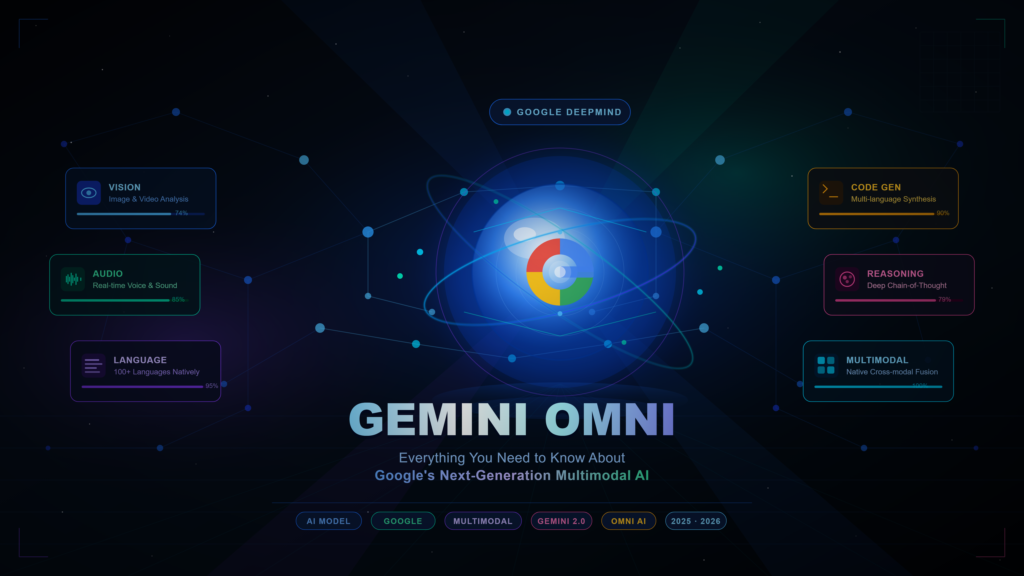
Gemini Omni Explained: Features, Capabilities, Use Cases, and Why It Matters
Artificial intelligence is moving through a period of rapid transformation. What began as text-based chatbots has evolved into systems that can understand images, audio, video, documents, code, and natural conversation simultaneously. At the center of this evolution is Google’s Gemini family of AI models.
One term that has generated growing attention across the AI community is Gemini Omni. The name is often associated with Google’s broader vision of creating a truly multimodal AI assistant—an AI system capable of understanding and responding across multiple forms of human communication in real time.
For developers, businesses, content creators, researchers, and everyday users, the interest is understandable. People no longer want separate tools for writing, searching, analyzing images, interpreting documents, generating code, translating languages, or assisting with productivity. They want a single intelligent system that can do all of it naturally.
That expectation is precisely where the idea behind Gemini Omni becomes important.
The concept represents a future in which AI can seamlessly interact through voice, text, images, video, and contextual understanding, making technology feel less like software and more like a capable digital collaborator.
This article explores what Gemini Omni is, how it works, its major capabilities, practical applications, limitations, competitive position, and what it could mean for the future of artificial intelligence.
Understanding Gemini Omni
The word “Omni” generally refers to something that encompasses multiple modes or capabilities.
In AI terminology, an omni-model is designed to process and generate information across different formats simultaneously, including:
- Text
- Images
- Audio
- Video
- Documents
- Code
- Real-time interactions
Gemini Omni is often discussed as Google’s vision of extending the Gemini ecosystem into a fully multimodal intelligence platform.
Instead of treating text, speech, images, and video as separate tasks, the system aims to understand them as interconnected pieces of information.
For example:
A user could upload a photo, ask a question about the image through voice, request a written summary, and then generate a presentation—all within a single workflow.
Traditional AI systems often require separate tools to perform those actions.
An omni-model attempts to combine them into one experience.
The Evolution of Gemini
To understand Gemini Omni, it helps to understand how Google’s AI strategy evolved.
Early Language Models
Google spent years developing large language models capable of understanding human language.
Important milestones included:
- BERT
- PaLM
- PaLM 2
These models significantly improved natural language understanding.
Introduction of Gemini
Gemini marked a major shift.
Unlike earlier models focused primarily on text, Gemini was designed from the beginning to be multimodal.
The Gemini ecosystem introduced capabilities involving:
- Text generation
- Image understanding
- Coding assistance
- Reasoning
- Knowledge retrieval
- Multimodal analysis
This foundation created the pathway toward more advanced omni-style AI systems.
What Makes Gemini Omni Different?
The defining characteristic of Gemini Omni is integration.
Many AI systems can perform multiple tasks.
Few can perform them naturally within a unified experience.
Core Differences
| Feature | Traditional AI | Gemini Omni Vision |
|---|---|---|
| Text Understanding | Yes | Yes |
| Voice Conversations | Limited | Advanced |
| Image Analysis | Separate Tool | Integrated |
| Video Understanding | Partial | Unified |
| Real-Time Interaction | Limited | Enhanced |
| Context Retention | Moderate | Broader |
| Multimodal Reasoning | Basic | Advanced |
The goal is not simply adding more features.
The goal is enabling the AI to reason across different types of information simultaneously.
Key Features of Gemini Omni
1. Advanced Multimodal Understanding
Perhaps the most significant capability is multimodal intelligence.
The model can analyze:
- Photographs
- Screenshots
- Charts
- PDFs
- Documents
- Videos
- Audio recordings
It can then combine insights from multiple inputs into a single coherent response.
Example
Imagine uploading:
- A business report
- A sales chart
- A recorded meeting
Gemini Omni could potentially:
- Summarize findings
- Identify trends
- Highlight risks
- Recommend actions
Without requiring separate analysis tools.
2. Real-Time Voice Interaction
Human communication is primarily verbal.
Typing remains useful, but natural conversation is often faster and more intuitive.
Gemini Omni aims to support:
- Low-latency responses
- Natural dialogue
- Interruptions during speech
- Context-aware conversations
This makes interactions feel closer to speaking with a knowledgeable assistant rather than issuing commands to software.
3. Visual Intelligence
Visual understanding has become one of the most important developments in AI.
Gemini Omni can interpret:
- Images
- Infographics
- Product photos
- UI screenshots
- Diagrams
- Educational materials
Users can ask questions about what appears in the image and receive contextual answers.
Practical Scenario
A student uploads a physics diagram.
The AI can:
- Explain components
- Solve related questions
- Clarify formulas
- Generate study notes
All from a single image.
4. Video Understanding
Video contains multiple information layers:
- Speech
- Visuals
- Context
- Movement
- Text overlays
Traditional AI often struggles with integrating these layers effectively.
Gemini Omni seeks to understand video more holistically.
Potential capabilities include:
- Video summarization
- Scene analysis
- Educational insights
- Meeting recaps
- Content indexing
5. Enhanced Reasoning
One of the most important metrics in modern AI is reasoning ability.
Users increasingly expect AI to:
- Solve problems
- Compare options
- Analyze evidence
- Draw conclusions
Rather than merely generating text.
Gemini Omni builds upon Gemini’s reasoning capabilities to handle more complex tasks involving multiple information sources.
6. Long Context Processing
Context length determines how much information a model can process at once.
Large context windows enable:
- Analysis of lengthy reports
- Research papers
- Books
- Large codebases
- Multi-document workflows
This is especially valuable for enterprise users and researchers.
7. Coding and Development Assistance
Software development remains one of the most impactful AI applications.
Gemini Omni can support:
- Code generation
- Debugging
- Documentation
- Refactoring
- Architecture recommendations
Developers can also combine screenshots, logs, and source code within the same interaction.
How Gemini Omni Works
Although Google’s internal architecture continues to evolve, modern multimodal AI systems generally operate through several layers.
Input Processing
The system receives:
- Text
- Voice
- Images
- Video
- Documents
Multimodal Encoding
Different data formats are converted into representations the model can understand.
Context Integration
Information from multiple sources is merged into a shared understanding.
Reasoning Layer
The AI analyzes relationships between inputs.
Response Generation
The output may include:
- Text
- Audio
- Visual explanations
- Structured summaries
This architecture enables a more human-like understanding process.
Real-World Applications of Gemini Omni
Education
Students can:
- Learn concepts visually
- Ask questions verbally
- Upload assignments
- Receive explanations
Teachers can generate:
- Lesson plans
- Assessments
- Study materials
Healthcare
Potential applications include:
- Medical documentation
- Research assistance
- Patient communication support
- Clinical knowledge retrieval
Human oversight remains essential, but AI can reduce administrative workload.
Business Intelligence
Organizations generate enormous amounts of information daily.
Gemini Omni can help analyze:
- Reports
- Dashboards
- Meeting transcripts
- Financial documents
The result is faster decision-making.
Customer Support
Support teams can leverage AI to:
- Interpret screenshots
- Understand customer issues
- Generate responses
- Escalate complex cases
This can improve response speed while maintaining quality.
Content Creation
Creators can use Gemini Omni for:
- Script writing
- Research
- Editing
- Video planning
- Social media content
A single platform can potentially support the entire creative workflow.
Software Development
Developers increasingly use AI as a collaborative coding partner.
Gemini Omni extends this capability by combining:
- Code analysis
- Documentation review
- UI interpretation
- Error diagnosis
Within one interface.
Gemini Omni vs Other Leading AI Models
The AI industry is increasingly competitive.
Major players include:
- OpenAI
- Anthropic
- Meta
- Microsoft
Here’s how Gemini Omni is generally positioned.
| Capability | Gemini Omni | Typical LLM |
| Text Generation | Excellent | Excellent |
| Image Understanding | Strong | Moderate to Strong |
| Voice Interaction | Advanced | Varies |
| Video Analysis | Strong Potential | Limited |
| Google Ecosystem Integration | Excellent | Limited |
| Real-Time Multimodal Workflows | High | Moderate |
The biggest differentiator is Google’s extensive ecosystem and multimodal infrastructure.
Common Misconceptions About Gemini Omni
It’s Just Another Chatbot
Reality:
Gemini Omni is designed to handle much more than text conversations.
It can work across multiple information formats simultaneously.
Multimodal Means Better at Everything
Not necessarily.
Different tasks still vary in complexity.
Performance depends on data quality, context, and task requirements.
AI Fully Replaces Human Expertise
AI accelerates work.
It does not eliminate the need for:
- Judgment
- Creativity
- Domain expertise
- Ethical decision-making
The strongest outcomes usually come from human-AI collaboration.
Challenges and Limitations
Despite impressive capabilities, several challenges remain.
Accuracy
AI systems can still generate incorrect information.
Verification remains important.
Privacy
Organizations must carefully evaluate:
- Data handling
- Security requirements
- Regulatory compliance
Especially when dealing with sensitive information.
Bias
AI systems learn from large datasets.
Bias mitigation continues to be an active area of research.
Computational Cost
Advanced multimodal models require substantial computing resources.
Balancing capability and efficiency remains a major challenge.
Best Practices for Using Gemini Omni
To maximize results:
Be Specific
Detailed prompts produce better outputs.
Instead of:
“Analyze this report.”
Try:
“Identify the three biggest revenue risks and explain supporting evidence.”
Provide Context
Additional information improves response quality.
Include:
- Goals
- Constraints
- Audience
- Desired outcome
Use Multiple Inputs
One of Gemini Omni’s strengths is multimodal processing.
Combine:
- Images
- Documents
- Voice instructions
- Text prompts
For richer analysis.
Verify Critical Information
Always review outputs used for:
- Legal decisions
- Financial planning
- Medical guidance
- Compliance matters
The Future of Gemini Omni
The trajectory of AI development suggests several likely trends.
More Natural Conversations
Voice interactions will become increasingly fluid and human-like.
Better Context Awareness
Future systems may maintain deeper understanding across longer interactions.
Stronger Personalization
AI assistants will adapt more effectively to user preferences and workflows.
Seamless Device Integration
Users may move between phones, computers, wearables, and smart devices without losing context.
Unified Digital Assistance
The distinction between search engines, assistants, productivity tools, and AI models may gradually disappear.
Instead, users will interact with a single intelligent layer capable of handling all these functions.
Gemini Omni represents a major step toward that vision.
Expert Perspective: Why Gemini Omni Matters
The significance of Gemini Omni extends beyond individual features.
The real innovation lies in reducing friction between humans and technology.
Historically, users adapted themselves to software.
They learned interfaces, commands, menus, and workflows.
Modern multimodal AI reverses that relationship.
Technology increasingly adapts to human communication.
People can speak naturally, show images, upload documents, and ask questions in the same conversation.
That shift may prove more transformative than any individual AI capability.
The long-term winners in AI are unlikely to be the systems with the most parameters alone. They will be the systems that make intelligence feel effortless, accessible, and genuinely useful.
Gemini Omni is Google’s attempt to move closer to that future.
Frequently Asked Questions (FAQ)
What is Gemini Omni?
Gemini Omni refers to Google’s vision of an advanced multimodal AI system capable of understanding and generating content across text, images, audio, video, and documents within a unified experience.
Is Gemini Omni different from Gemini AI?
Gemini Omni is generally associated with extending Gemini’s multimodal capabilities into a more integrated, real-time, omni-modal assistant experience.
Can Gemini Omni understand images?
Yes. It can analyze photos, screenshots, diagrams, charts, and other visual content to provide contextual responses.
Does Gemini Omni support voice conversations?
Yes. Real-time voice interaction is one of the major capabilities associated with the omni-modal AI approach.
Can Gemini Omni analyze videos?
It is designed to process video content by understanding visual elements, audio, and contextual information together.
Is Gemini Omni useful for businesses?
Yes. Potential applications include business intelligence, document analysis, customer support, workflow automation, and productivity enhancement.
Can developers use Gemini Omni for coding?
Absolutely. It can assist with code generation, debugging, documentation, and software development workflows.
Is Gemini Omni better than traditional chatbots?
For multimodal tasks involving text, images, audio, and contextual reasoning, Gemini Omni offers capabilities that extend far beyond traditional chatbot functionality.
Does Gemini Omni replace human expertise?
No. It serves as an intelligent assistant that enhances productivity and decision-making rather than replacing professional expertise.
What is the future of Gemini Omni?
Future development is expected to focus on deeper multimodal understanding, improved reasoning, stronger personalization, and more natural interactions across devices and platforms.
Final Thoughts
The race toward truly multimodal artificial intelligence is no longer theoretical. It is happening now. Gemini Omni represents a broader shift in how people interact with technology—moving from isolated tools toward unified intelligence systems capable of understanding information in the same interconnected way humans do.
Whether you’re a developer building applications, a business seeking productivity gains, a researcher handling complex information, or simply someone curious about the future of AI, Gemini Omni offers a glimpse of what the next generation of digital assistance may look like: conversational, contextual, visual, intelligent, and increasingly woven into everyday work and life.