
 By
By
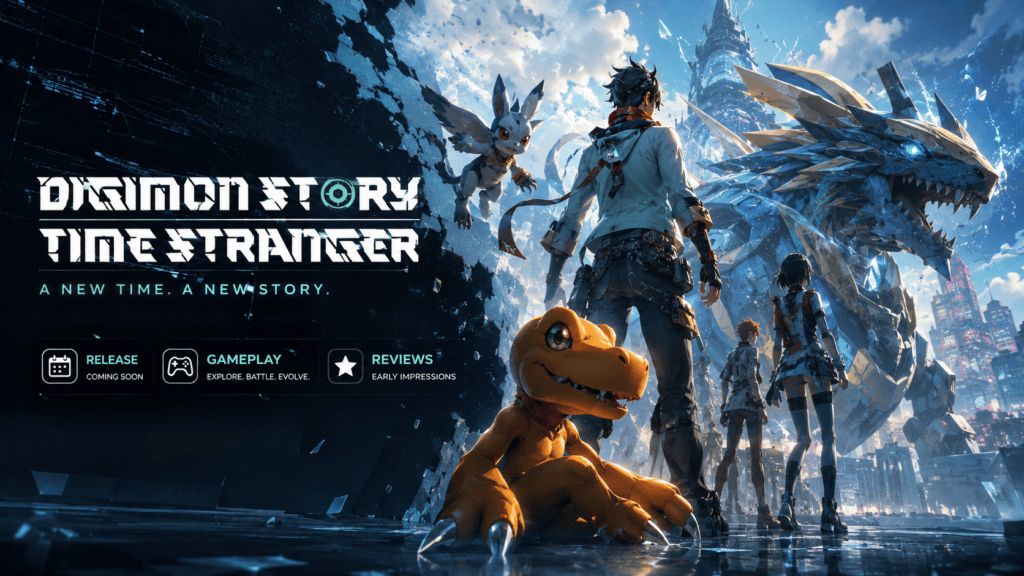
Digimon Story: Time Stranger: What’s Actually Different This Time
Eight years is a long gap between mainline Digimon Story games. That’s roughly how long fans waited between Cyber Sleuth – Hacker’s Memory and this one, and it shows in how much Time Stranger changes underneath the familiar “collect and raise Digimon” formula. It’s not a bigger Cyber Sleuth. The encounter system, the stat model, and even how attributes work have all been rebuilt.
This piece covers what’s confirmed as of mid-2026: release dates for every platform, how the battle and Digivolution systems actually function, what critics and players landed on after launch, and the questions people keep asking after the basic pitch.
Release Dates, By Platform
The PlayStation 5, Xbox Series X/S, and Windows versions launched worldwide on October 3, 2025 (a day earlier, October 2, in Japan), published by Bandai Namco and developed by Media.Vision — the studio behind the Cyber Sleuth games. It is the seventh game in the Story subseries, releasing eight years after Digimon Story: Cyber Sleuth – Hacker’s Memory.
If you’re on Nintendo hardware, you waited longer. The Nintendo Switch and Switch 2 versions arrived July 10, 2026, with pre-orders open ahead of launch for Standard, Digital Deluxe, and Digital Ultimate editions. By the time that port landed, the game had already sold more than 1 million units across its original platforms.
The Switch 2 version isn’t a straight port, either. Players get a choice between Quality Mode — 4K HDR at up to 30FPS docked, Full HD at up to 30FPS handheld — and Performance Mode, which runs Full HD at up to 60FPS in both docked and handheld play.
Pre-order and edition breakdown (Switch release):
- Standard Edition: base game, plus Uniform of a Certain School costumes, an Adventure Item set, and black-colored Agumon and Gabumon
- Digital Deluxe Edition: everything above, plus Cyber Sleuth-themed costumes and the Season Pass
- Digital Ultimate Edition: everything above, plus an extra costume pack and early unlocks
The Season Pass bundles three DLC packs, and each one adds five additional Digimon plus a new story episode, along with a Golden Moai item for decorating your Digifarm. The first two episode packs — Alternate Dimension and a second entry — released in late 2025, and a third pack, subtitled Anti-ParadoX, launched March 12, 2026, centering on characters Asuna Shiroki and Monica Simmons in a story that runs parallel to the main campaign.
Read Also: EA Sports College Football 27: Full Guide & Review (2026)
Story Setup: Why “Time Stranger” Is Literal
The premise isn’t just flavor text. You play an agent of ADAMAS, a covert organization investigating anomalies in the Digital World, when a catastrophic incident — the Shinjuku Inferno — erupts during a Digimon conflict that devastates the city. The agent then reawakens eight years in the past, tasked with uncovering the mystery of the world’s collapse, with encounters that reshape the timeline and, eventually, fate itself. You move between the human world and the Digital World, called Iliad, across both time periods.
It’s a heavier setup than past Story games leaned on for their opening hours, and reviewers noticed: several called out grief, loss, and survivor’s guilt as recurring themes rather than background noise. That’s a deliberate shift from the more procedural, case-file structure of Cyber Sleuth.
The Battle System: What Actually Changed
If you’ve played a Digimon Story game before, three changes matter more than the rest.
Symbol encounters replace random battles. Enemy Digimon now roam visibly around dungeons rather than triggering fights at random, and making contact starts a turn-based battle. It sounds small, but it changes how you approach exploration — you can route around fights you don’t want, which the older random-encounter model never allowed.
Stats went back to a growth model. The DS-era Story games let every Digimon reach max stats eventually; Cyber Sleuth locked stats to fixed values per Digimon; Time Stranger reverts to the max-stats approach. If you disliked how rigid Cyber Sleuth’s stat spreads felt, this is the biggest quality-of-life change in the game.
Elements were removed in favor of individual matchups. Digimon no longer carry a fixed elemental type. Instead, each one has its own specific strengths and weaknesses, the same approach used in Digimon Survive. The game does add new Attributes — Variable, Unknown, and “NO DATA” — plus Ice and Steel Elements, though these largely function the same as the existing Free attribute.
Support Skills and penetrating attacks are gone too; each Personality now carries its own “Personality Skill” instead. And notably, the game drops PvP entirely, unlike all six prior Story titles — this is built as a single-player experience, full stop.
The roster: more than 450 raisable Digimon, some tied to pre-order bonuses, viewable through a Field Guide that shows models, attacks, base stats, learnable moves, background lore, stat growth from level 1 to 99, and full Digivolution paths.
What Reviewers Actually Said
The critical picture is consistent but not uniform. Aggregate scores landed around 79 on both Metacritic and OpenCritic, which several outlets pointed out is a meaningful jump for a series that has historically sat in the mid-70s at best.
The praise clusters around three things: the Digivolution system’s depth, the scale of the Digimon roster, and presentation. IGN scored it 8/10; PlayStation Universe and GameGrin both landed at 95/100; Noisy Pixel gave it a 9/10. One OpenCritic reviewer called it the best Digimon game to date, pointing to vibrant, detailed visuals and a mechanically rich system that works for newcomers and longtime fans alike.
The criticism is just as consistent, and it’s almost always about pacing and map design. Push Square (6/10) and Dexerto (6/10) both landed on the low end, and the common thread across mixed reviews is small, linear maps, tedious training loops, and mechanics that don’t fully deliver on their early promise. One critic summed it up as a game that would rank higher if it just let its strong RPG systems breathe instead of constantly interrupting them.
Player reviews on Metacritic echo this split almost exactly. The positive side calls out a balanced difficulty curve, strong English voice work, and a narrative willing to sit with grief and survivor’s guilt rather than skate past it. The negative side is sharper: one detailed critical review argues the pacing is genuinely exhausting, that low EXP gain turns the back half into a grind, and that paid Deluxe content noticeably reduces the game’s difficulty — a complaint worth knowing about before you decide which edition to buy, since it touches directly on value for money.
Worth noting for anyone comparing notes across regions: four Famitsu critics gave it a combined 34 out of 40 in Japan, roughly in line with the Western critical consensus.
Common Mistakes People Make Going In
Assuming it plays like Cyber Sleuth. The symbol-encounter system, the return to max-stat growth, and the loss of PvP mean muscle memory from the last two games only gets you so far. Go in expecting a different rhythm, not a bigger version of the same one.
Buying the Ultimate Edition purely for the DLC without checking difficulty impact. Multiple player reviews flagged that some Deluxe-tier content meaningfully softens the game’s challenge. If you want the full difficulty curve, that’s worth weighing before you pick an edition — a Standard purchase plus the Season Pass later might suit you better than the day-one Ultimate bundle.
Ignoring the Switch version’s mode choice. If you’re buying on Switch 2, decide up front whether Quality Mode’s higher resolution or Performance Mode’s higher frame rate matters more for how you play — docked versus handheld makes a real difference here since the resolution and frame targets change between the two.
Skipping the demo. The demo covers the opening chapter and its save data carries over into the full game, so there’s little real cost to trying before buying, aside from remembering not to delete demo data if you plan to transfer it.
Digimon Story: Time Stranger vs. Cyber Sleuth — Quick Comparison
| Cyber Sleuth / Hacker’s Memory | Time Stranger | |
|---|---|---|
| Encounters | Random | Visible, avoidable “symbol” encounters |
| Stats | Fixed per Digimon | Growth-based, max stats attainable |
| Typing | Fixed elemental types | Individual strengths/weaknesses per Digimon |
| PvP | Included | Removed |
| Roster size | Smaller | 450+ Digimon |
| Setting | Single timeline | Dual timelines, human world + Digital World |
FAQ
Is Digimon Story: Time Stranger open world? No. It uses discrete, dungeon-style areas rather than a continuous open world, and this is one of the more common criticisms in reviews — several critics specifically flagged the maps as small and linear compared to genre peers.
How long is the main story? Reviewer estimates for a full campaign playthrough generally land around 30–40 hours, though that stretches significantly if you’re aiming to fill out the Digimon roster or complete side content.
Does it have PvP or multiplayer? No. Unlike every previous Story-subseries entry, Time Stranger is single-player only.
Can Switch and Switch 2 players play together, or transfer saves between them? No — Bandai Namco’s own product notes specify that demo save data only transfers within the same platform, not between the Switch and Switch 2 versions.
What’s included in the Season Pass? Three DLC episode packs, each adding five new Digimon and a story episode, plus a cosmetic farm item.
Was there a delay for any platform? Not exactly a delay — the Nintendo Switch and Switch 2 versions were always planned as a later release, arriving July 10, 2026, roughly nine months after the PlayStation, Xbox, and PC launch.
Is the story connected to Cyber Sleuth? It shares the same broader universe but runs on a different timeline, so it doesn’t require playing Cyber Sleuth first.
What does the DLC pack “Anti-ParadoX” add? A side story centered on Asuna Shiroki and Monica Simmons, separate from the main campaign, released March 12, 2026, as the third Season Pass episode.
Read Also: Endless RagnarokEndless Ragnarok Guide Guide: Everything in Relink’s Expansion
Key Takeaways
- PS5, Xbox Series X/S, and PC launched October 3, 2025; Switch and Switch 2 followed July 10, 2026.
- The battle system swaps random encounters for visible ones, restores max-stat growth, replaces fixed elemental types with per-Digimon matchups, and drops PvP entirely.
- Critical consensus sits around 79/100 — a high point for the series — with praise for the Digivolution system and roster size, and consistent criticism of pacing and map design.
- Player feedback is split on grind pacing, with some reviews flagging that paid DLC content reduces difficulty.
- The demo’s save data transfers into the full game, making it a low-risk way to try the opening chapter first.