 By
By
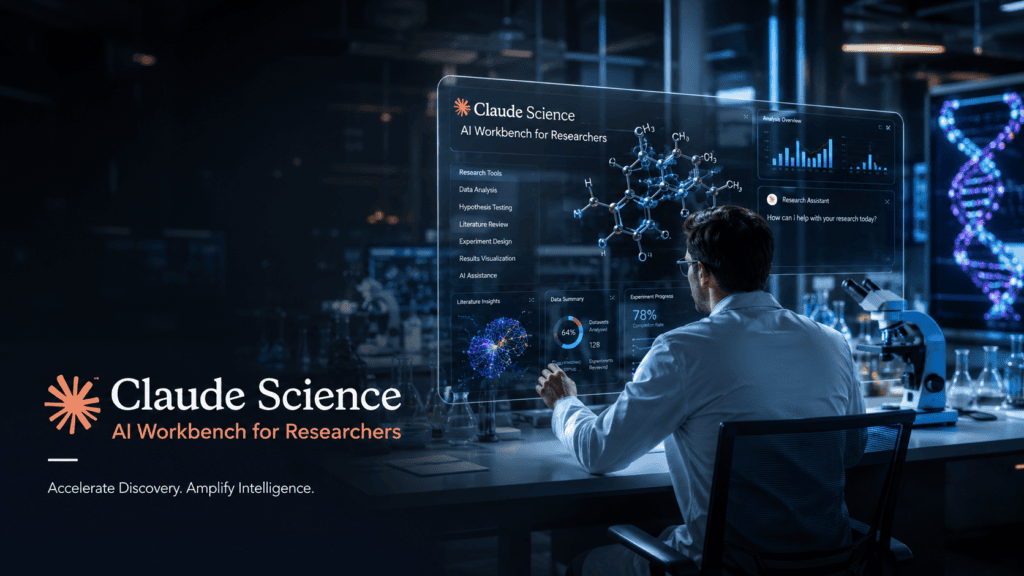
Claude Science: Inside Anthropic’s AI Workbench for Scientists
A biology postdoc spends less time discovering things than most people assume. A bigger share of the week goes to reformatting a CSV so a genome browser will read it, remembering which of six databases has the right protein annotation, or waiting on a cluster job that failed three hours in because of a missing dependency. Anthropic’s answer to that problem, launched in beta on June 30, 2026, is Claude Science — a workbench that tries to fold literature search, data wrangling, compute orchestration, and figure generation into a single conversation with an AI agent.
This guide covers what Claude Science actually does, who it’s built for, how it fits alongside Claude Code and Claude Cowork, what it costs, and where it falls short — so you can decide whether it belongs in your lab’s workflow.
What Claude Science Is
Claude Science is not a new AI model. It runs on Anthropic’s existing Claude Opus 4.8, the same model available to any paying subscriber, with no specialized fine-tuning and no gated access model underneath it. What Anthropic built is the scaffolding around that model: a coordinating agent that can hand off work to specialist sub-agents, a reviewer agent that checks citations and numerical claims, connections to more than 60 scientific databases, and native rendering for the file types scientists actually work with — 3D protein structures, genome browser tracks, and chemical structures.
Anthropic frames the product as the scientific equivalent of Claude Code: a domain-specific agent harness layered on top of a general-purpose model, aimed at a job that involves a lot of repetitive tool-switching and validation work. Where Claude Code targets software engineers, Claude Science targets researchers working in genomics, single-cell biology, proteomics, structural biology, and cheminformatics, with biology and biomedical research as the initial focus.
Why Anthropic Built It Now
This isn’t Anthropic’s first move into life sciences. The company introduced Claude for Life Sciences the previous October — a set of connectors and skills that gave Claude access to scientific databases and tooling. Claude Science is a substantial expansion of that groundwork, arriving alongside a separate and more unusual announcement: Anthropic said it will run its own preclinical drug-discovery programs targeting neglected and rare diseases, partly as a way to stress-test the product on real research rather than only shipping it to outside labs.
The company’s reasoning tracks its own playbook. Anthropic’s leadership has argued that building strong tools for a domain requires doing real work in that domain — the same logic behind Claude Code being built by a company that also employs software engineers who use it daily.
How Claude Science Works
At the center of Claude Science is a hierarchical multi-agent setup. A coordinating agent takes a request in plain language, decides which specialist agents or connectors it needs, and manages the sequence of steps. A separate reviewer agent runs alongside this process, checking whether citations are traceable and whether calculations hold up, and correcting errors as they surface rather than leaving them for a human to catch during peer review.
Domain coverage on day one. The workbench ships pre-configured for genomics, single-cell analysis, proteomics, structural biology, and cheminformatics, with native connections to resources researchers already rely on — UniProt, the Protein Data Bank, Ensembl, Reactome, ClinVar, ChEMBL, and GEO among them, alongside journals and preprint servers. Rather than a scientist manually querying each database and reconciling schemas, the coordinating agent distributes that work across specialist sub-agents and synthesizes the result.
Model integration through BioNeMo. Claude Science uses NVIDIA’s BioNeMo Agent Toolkit to connect to life-sciences models scientists already trust, including Evo 2, Boltz-2, and OpenFold3, rather than asking labs to abandon tools they’ve already validated.
Native rendering of scientific artifacts. Because so much of scientific communication is visual, Claude Science displays proteins, molecular structures, and genome tracks directly, without a separate viewer. A researcher can ask the agent, in ordinary language, to adjust a figure — remove gridlines, switch an axis to a log scale — and the agent edits the underlying code itself.
Reproducibility by default. Every figure comes bundled with the exact code and computational environment that produced it, a plain-language explanation of the method, and the full message history behind it. That combination is meant to address a real and growing problem: AI-assisted writing has been linked to a rise in fabricated citations and unverifiable statistics in published papers, and a workbench that can’t show its work adds to that risk rather than reducing it.
Compute handling. Large scientific jobs — folding a protein, running a genomics pipeline — usually mean configuring a compute job, waiting, checking for failures, and pulling results back manually. Claude Science drafts a plan, asks before consuming new compute resources, and lets a researcher review or cancel any step before submission. It can submit jobs to a lab’s own high-performance computing cluster or to cloud compute, including credits provided through Modal for selected projects.
Who Claude Science Is For
Beginners and students get a single conversational entry point instead of having to learn PubMed’s search syntax, Jupyter, R, and a cluster terminal all before running a first real analysis.
Working researchers and postdocs get compression on tasks that used to take weeks. At the Allen Institute, a computational neuroscientist used Claude Science to build an automated literature-review pipeline; reviews that once took up to two years to compile can now exceed 100 pages of synthesized material in a fraction of that time, with the reviewer agent verifying citations along the way. At UCSF’s Brain Tumor Center, an epidemiologist reported that comprehensive germline analysis of glioma, previously a lengthy manual process, can now be completed dramatically faster.
Principal investigators and lab heads get a tool that manages compute costs and job orchestration on behalf of the team, plus a discounted Team plan aimed specifically at active academic and nonprofit labs, with eligibility verified through the lab’s principal investigator.
Pharma and biotech teams get a workbench purpose-built for drug discovery workflows — target identification, molecular design, and clinical data analysis — the same category of work Anthropic is testing on its own rare-disease programs.
Advanced practitioners working on hard, judgment-heavy problems — the kind where feedback loops are slow and biology is messy rather than clean — should treat Claude Science as a serious accelerant, not a replacement for expert judgment. A Harvard physicist working with Anthropic’s tools put the model’s performance on scientific tasks at roughly the level of a second-year graduate student, a comparison Anthropic itself has referenced as a calibration point rather than a marketing claim.
Claude Science vs. Alternatives
| Claude Science | Google DeepMind tools (e.g., AlphaFold lineage) | OpenAI’s biology-focused model | Building your own pipeline on the API | |
|---|---|---|---|---|
| What it is | Agent workbench on top of a general model | Specialized scientific models | Domain fine-tuned model, limited access | Custom-built harness |
| Access | Beta, all paid Claude plans (Pro, Max, Team, Enterprise) | Varies by tool, often research-only | Restricted to vetted US enterprise customers | Open to any API user, but requires engineering time |
| Database integration | 60+ pre-connected databases out of the box | Narrower, tool-specific | Not a general workbench | Manual, built by your team |
| Reproducibility tracking | Built in — code, environment, and history per output | Varies | Not disclosed publicly | Depends on what you build |
| Best fit | Labs wanting an integrated, low-setup research environment | Deep structural biology work in DeepMind’s specific domains | Enterprises already inside that vendor’s ecosystem | Teams with specific needs a general workbench won’t cover |
The honest caveat here: independent benchmarking of AI models on real research tasks remains difficult, and even the best-performing specialized models on rigorous test suites have cleared only a minority of realistic research tasks. Claude Science’s advantage is less about raw model capability and more about removing the integration tax that keeps scientists from using AI on the tasks that matter.
Setting Up Claude Science: A Practical Checklist
- Confirm your plan tier — Claude Science is in beta on macOS and Linux for Pro, Max, Team, and Enterprise plans
- If you’re on a Team or Enterprise plan, have an admin enable Claude Science in organization settings; it isn’t on by default
- Check whether your lab qualifies for the discounted academic/nonprofit Team plan, verified through your principal investigator
- If you want compute credits, apply to the AI for Science program before the July 15, 2026 deadline — up to $30,000 in credits plus up to $2,000 in Modal compute for selected projects
- Identify which of the 60+ integrated databases matter most for your work, and confirm your existing pipelines (BioNeMo models, cluster configuration) are compatible
- Start with a low-stakes task — a literature synthesis or a figure regeneration — before routing critical-path analysis through the agent
- Establish a review habit: treat the reviewer agent’s citation and calculation checks as a first pass, not a replacement for your own verification before publication
Common Mistakes and Recommendations
Treating it as a black box. The entire design point of Claude Science is traceability — every output links back to the code and environment that made it. Skipping that trail defeats the purpose and reintroduces the reproducibility risk the tool is meant to reduce.
Assuming domain coverage is universal. The initial rollout leans heavily toward biology and biomedical research. Researchers in physics, materials science, or social science should expect a thinner set of pre-built connectors and plan accordingly.
Skipping human verification on judgment calls. Independent estimates comparing model performance to a second-year graduate student are a useful sanity check, not a guarantee. Novel hypotheses, ambiguous data, and high-stakes clinical conclusions still need expert review.
Ignoring compute costs. Because Claude Science can submit jobs to cloud compute or a cluster, an unsupervised agent with a broad mandate can rack up real costs. The built-in step where the agent asks before reaching new resources is there for a reason — don’t disable that habit even when it feels slow.
Where This Is Heading
Anthropic’s own framing suggests Claude Science is a foundation rather than a finished product: broader domain coverage beyond biology, deeper integration with lab hardware and cluster environments, and continued investment in the reviewer-agent concept as a check against AI-introduced errors in the scientific record. The competitive picture is also moving quickly, with other major AI labs pursuing their own domain-specific science tools and benchmarks, so the comparison table above is a snapshot rather than a permanent ranking. Expect capability and access details to keep shifting through the rest of 2026.
Key Takeaways
- Claude Science is an agent-based workbench, not a new model — it runs on Claude Opus 4.8 with domain-specific tooling layered on top
- It’s aimed first at biology, genomics, proteomics, structural biology, and cheminformatics, with 60+ integrated databases
- Reproducibility is a core design feature: every output ships with its code, environment, and message history
- It’s in beta on macOS and Linux, available to Pro, Max, Team, and Enterprise subscribers, with admin enablement required on Team/Enterprise
- Grants of up to $30,000 in credits are available to qualifying research projects through July 15, 2026
- It compresses time-consuming tasks like literature synthesis and genomic analysis, but still requires expert oversight on judgment-heavy science
FAQ
Is Claude Science a separate AI model from Claude? No. It runs on Claude Opus 4.8, the same model available to paying subscribers, with an agent framework and database connections built around it rather than a specialized model underneath.
Which plans include Claude Science? It’s in beta for Pro, Max, Team, and Enterprise plans on macOS and Linux. Team and Enterprise admins need to enable it for their organization before members can use it.
Does Claude Science replace Claude Code or Claude Cowork? No. Anthropic has said it’s designed to complement those tools, not replace them — scientists still write code, and Claude Science adds compute orchestration, database access, and scientific visualization on top of that workflow.
What scientific fields does it currently support best? Genomics, single-cell analysis, proteomics, structural biology, and cheminformatics are supported out of the box, reflecting the initial focus on biology and biomedical research.
Can academic labs get a discount? Yes. Anthropic offers a discounted Team plan for active scientific labs at academic institutions and nonprofit research organizations, with eligibility tied to the lab’s principal investigator.
How does Claude Science handle reproducibility? Every figure or result comes with the exact code and computational environment used to produce it, a plain-language explanation of the method, and the full conversation history, so results can be traced and re-verified later.
Is there funding available for research projects using Claude Science? Anthropic’s AI for Science program is backing up to 50 projects with as much as $30,000 in credits each, with an additional $2,000 in Modal compute for select projects. Applications close July 15, 2026, with awards announced by July 31.
How reliable is Claude Science for high-stakes conclusions? Treat it as a strong research assistant, not a final authority. Independent assessments have compared its performance on scientific tasks to roughly a second-year graduate student — useful, but not a substitute for expert review before publication or clinical use.
Does Claude Science work with existing lab compute infrastructure? Yes. It can submit jobs to a lab’s own high-performance computing cluster or to cloud compute on demand, and it asks for approval before consuming new compute resources.
How does Claude Science compare to specialized biology models from other AI labs? Competing approaches include highly specialized fine-tuned models with restricted access versus Claude Science’s strategy of pairing a general-purpose model with a broad integration layer. Neither approach has a settled performance edge yet, and benchmarking in this space is still evolving.