
 By
By
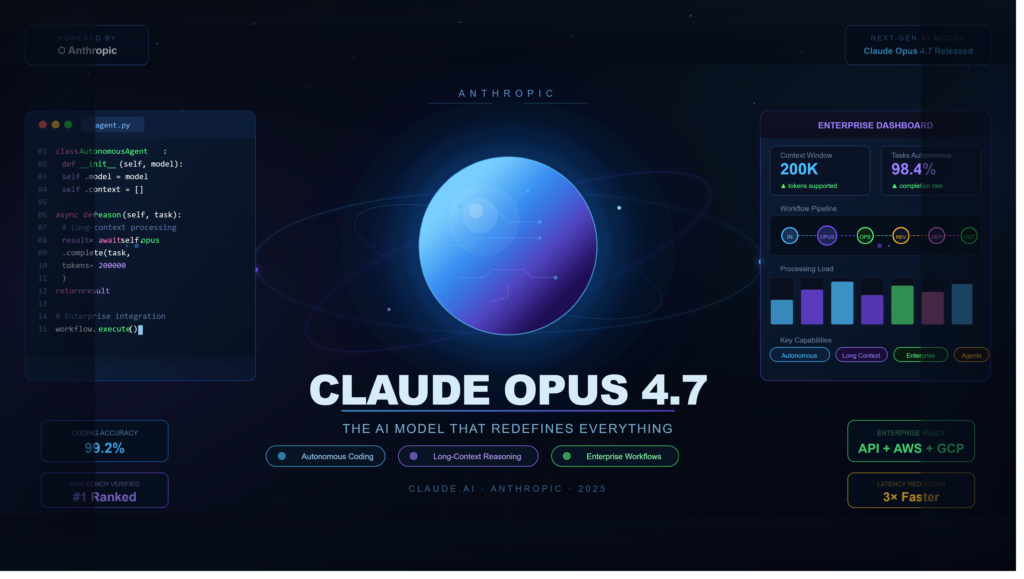
Introduction
Every major AI release claims to be smarter, faster, or more capable than the last. Most deliver incremental improvements. A few fundamentally change how people work.
Claude Opus 4.7 belongs to the second category.
Released by Anthropic in April 2026, Claude Opus 4.7 arrived at a time when the AI industry was shifting its focus away from simple chatbot interactions and toward something far more ambitious: reliable AI agents capable of completing complex tasks with minimal supervision. Rather than competing solely on benchmark scores, Anthropic positioned Opus 4.7 around a challenge that has frustrated developers and businesses for years—getting AI systems to consistently finish difficult work without breaking, hallucinating, or requiring constant correction.
That positioning matters.
Organizations are no longer evaluating language models based solely on how well they answer questions. They want systems that can analyze codebases, manage long-running projects, interpret large documents, understand images, execute multi-step workflows, and verify their own results before responding.
Claude Opus 4.7 was designed specifically for those scenarios.
Early reports from developers, enterprise teams, and AI researchers suggest that Opus 4.7 delivers meaningful gains in advanced software engineering, instruction following, multimodal reasoning, and long-duration task reliability. Anthropic also introduced improved vision capabilities, expanded agentic features, and new controls for balancing reasoning quality against speed.
Yet the story isn’t entirely straightforward.
While many users praise the model’s capabilities, others have raised concerns about increased token consumption, changes in reasoning behavior, and workflow adjustments required after upgrading from previous Claude models.
Understanding Claude Opus 4.7 therefore requires more than reading benchmark charts. It requires examining what the model actually does, where it excels, where it struggles, and why it represents a significant moment in the evolution of modern AI systems.
Search Intent Analysis: Why People Are Searching for Claude Opus 4.7
Before diving into technical details, it’s worth understanding the questions users are actually asking.
Primary Search Intent
People want to know:
- What is Claude Opus 4.7?
- How does it compare with previous Claude models?
- Is it better than GPT-5.4 and Gemini?
- What new capabilities does it introduce?
- Is it worth using for coding and enterprise work?
Secondary Search Intent
Users also want answers about:
- Pricing
- Context window limits
- Vision capabilities
- API availability
- Agent workflows
- Benchmark performance
- Real-world use cases
Emotional Intent
Many users are evaluating a strategic decision:
- Should they switch models?
- Can they trust it with important work?
- Will it improve productivity?
- Is the hype justified?
Common Confusion
Several misconceptions appeared immediately after launch:
- Some assumed Opus 4.7 was Anthropic’s most powerful model.
- Others believed it was merely a rebranded Opus 4.6.
- Many confused Opus 4.7 with Anthropic’s restricted Mythos Preview model.
The reality sits somewhere in between.
What Is Claude Opus 4.7?
Claude Opus 4.7 is Anthropic’s flagship generally available large language model released on April 16, 2026. It succeeds Claude Opus 4.6 and focuses heavily on advanced reasoning, software engineering, multimodal understanding, and long-running autonomous tasks.
Key specifications include:
| Feature | Claude Opus 4.7 |
|---|---|
| Release Date | April 16, 2026 |
| Context Window | 1 Million Tokens |
| Maximum Output | 128K Tokens |
| Knowledge Cutoff | January 2026 |
| API Model Name | claude-opus-4-7 |
| Availability | Claude, API, Bedrock, Vertex AI, Microsoft Foundry |
| Pricing | $5 Input / $25 Output per Million Tokens |
Unlike many AI releases focused on raw benchmark leadership, Opus 4.7 was optimized around reliability and completion quality.
Anthropic repeatedly emphasized that the model can handle difficult, long-running tasks while maintaining consistency and instruction adherence.
Why Claude Opus 4.7 Matters
The AI industry has discovered an uncomfortable truth.
Many models perform impressively on short tests but struggle during extended real-world workflows.
Consider a software engineer who asks an AI to:
- Analyze a 50,000-line codebase.
- Identify architectural problems.
- Refactor multiple components.
- Create tests.
- Verify functionality.
- Document changes.
A surprising number of AI systems lose coherence somewhere along the process.
Claude Opus 4.7 specifically targets that weakness. Anthropic reports substantial improvements in long-duration task execution, instruction tracking, and self-validation behaviors.
This reflects a broader industry trend.
The next generation of AI competition is increasingly about:
- Reliability
- Autonomy
- Persistence
- Tool usage
- Multi-step reasoning
Rather than simply producing clever answers.
Major New Features in Claude Opus 4.7
1. Advanced Software Engineering Performance
Anthropic highlights software engineering as Opus 4.7’s biggest leap forward.
According to early testing, developers report:
- Better debugging
- Stronger code generation
- Improved architectural reasoning
- Fewer tool-use failures
- Better completion rates on difficult tasks
The model appears particularly effective when handling projects that require sustained attention across multiple iterations.
Real Example
A developer may ask Opus 4.7 to:
- Audit an entire repository
- Find race conditions
- Generate fixes
- Build tests
- Validate results
Previous models often required frequent intervention.
Opus 4.7 was designed to reduce that supervision burden.
2. Improved Long-Running Agent Workflows
One of the most significant upgrades involves agentic behavior.
The model demonstrates stronger performance during:
- Multi-step workflows
- Autonomous project execution
- Extended tool usage
- Recursive reasoning tasks
This is especially valuable for:
- AI coding agents
- Enterprise automation
- Research assistants
- Technical analysis systems
Anthropic’s own messaging repeatedly emphasizes long-duration reliability as a core design goal.
3. Better Vision Capabilities
Claude Opus 4.7 significantly improves visual understanding.
Enhancements include:
- Higher image resolution support
- Better diagram interpretation
- More detailed visual reasoning
- Improved multimodal workflows
Reports indicate image processing resolution increased substantially compared to previous Claude models.
For businesses handling:
- Technical diagrams
- Product images
- UI screenshots
- Engineering drawings
This represents a meaningful productivity improvement.
4. Enhanced Instruction Following
A common frustration with AI systems is instruction drift.
Users provide detailed requirements, and the model gradually deviates from them.
Claude Opus 4.7 appears noticeably better at:
- Maintaining constraints
- Following detailed prompts
- Preserving context
- Respecting formatting requirements
This becomes especially important during enterprise deployments where compliance and consistency matter.
5. New Effort Levels
Anthropic introduced additional reasoning controls.
The new “xhigh” effort setting gives users finer control over reasoning intensity versus response speed.
This creates more flexibility:
| Use Case | Recommended Effort |
|---|---|
| Quick Answers | Medium |
| Coding Tasks | High |
| Complex Analysis | XHigh |
| Research Workflows | XHigh |
Claude Opus 4.7 vs Claude Opus 4.6
Many users want to know whether upgrading is worthwhile.
Here’s the practical comparison.
| Area | Opus 4.6 | Opus 4.7 |
|---|---|---|
| Coding | Strong | Significantly Improved |
| Long Tasks | Good | Better Reliability |
| Vision | Good | Higher Resolution |
| Instruction Following | Strong | More Precise |
| Agent Workflows | Capable | More Autonomous |
| Pricing | Same | Same |
The most important point:
Anthropic kept pricing unchanged while improving capabilities.
Claude Opus 4.7 vs GPT-5.4 and Gemini
Competitive comparisons are inevitably difficult because benchmarks vary.
However, industry reporting suggests Opus 4.7 performs exceptionally well in:
- Agentic coding
- Tool use
- Software engineering
- Multi-step workflows
- Financial analysis
Some reports indicate it temporarily reclaimed leadership among publicly available frontier models in several categories.
Where Claude Excels
- Long-context reasoning
- Coding reliability
- Instruction precision
- Autonomous workflows
Where Competition Remains Strong
- General ecosystem integration
- Consumer productivity tools
- Platform reach
The best model still depends heavily on the specific workflow.
Enterprise Use Cases
Claude Opus 4.7 is particularly appealing to organizations operating at scale.
Software Development
Teams use it for:
- Code reviews
- Architecture planning
- Bug detection
- Refactoring
- Documentation
Research
Researchers leverage:
- Long-context analysis
- Large document review
- Technical summarization
- Evidence synthesis
Operations
Companies deploy it for:
- Workflow automation
- Knowledge management
- Process documentation
- Internal copilots
Cybersecurity and Safety Changes
One of the more interesting aspects of Opus 4.7 is what Anthropic intentionally removed.
After developing the more powerful Mythos Preview model, Anthropic introduced safeguards and reportedly reduced certain cybersecurity-related capabilities before releasing Opus 4.7 publicly.
The company also launched:
- Cyber Verification Program
- Request filtering systems
- Risk-detection safeguards
These measures are intended to balance capability with responsible deployment.
Common Misconceptions About Claude Opus 4.7
It’s Just a Minor Update
Reality:
Anthropic positions Opus 4.7 as a meaningful upgrade focused on difficult engineering and agent tasks.
It Is Anthropic’s Most Powerful Model
Reality:
Mythos Preview reportedly exceeds Opus 4.7 in several areas but remains restricted. Opus 4.7 is Anthropic’s most capable generally available model.
Bigger Benchmarks Mean Better Workflows
Reality:
Real-world productivity often depends more on reliability and consistency than peak benchmark performance.
This is arguably the central philosophy behind Opus 4.7.
Potential Drawbacks and Criticism
A balanced evaluation should acknowledge criticism.
Some users report:
- Increased token usage
- Higher consumption rates
- Occasional reasoning regressions
- Adaptive reasoning adjustments
Anthropic has acknowledged ongoing tuning efforts in response to feedback.
For organizations with strict token budgets, testing before full migration is advisable.
Best Practices for Getting the Most From Claude Opus 4.7
Use Explicit Instructions
The model excels when requirements are clear.
Break Massive Projects Into Milestones
Even with a million-token context window, structured workflows remain beneficial.
Use Self-Verification Prompts
Ask the model to:
- Review outputs
- Check assumptions
- Validate conclusions
Leverage Vision Features
Upload diagrams, screenshots, and architecture maps when relevant.
Adjust Effort Levels
Reserve higher reasoning settings for genuinely difficult tasks.
The Bigger Picture: What Claude Opus 4.7 Signals About AI’s Future
Claude Opus 4.7 highlights a major shift in AI development.
For years, companies competed on intelligence.
Now they’re competing on reliability.
The future frontier is not merely generating impressive responses.
It’s completing meaningful work.
That means:
- Maintaining context
- Using tools effectively
- Following instructions
- Checking outputs
- Completing projects autonomously
Claude Opus 4.7 represents one of the clearest examples of that transition.
Final Thoughts
Claude Opus 4.7 is not simply another model update with slightly improved benchmarks. It reflects a broader evolution in AI strategy—away from isolated question answering and toward dependable, long-running autonomous work.
Its strongest advantages emerge in software engineering, multi-step reasoning, enterprise workflows, and instruction-sensitive tasks. Combined with a million-token context window, improved vision capabilities, stronger agent behavior, and unchanged pricing, it offers a compelling package for developers and organizations seeking production-grade AI.
The model is not without tradeoffs. Token consumption concerns and user-reported regressions remind us that frontier AI systems remain works in progress. Yet the overall direction is clear.
Claude Opus 4.7 pushes the industry closer to AI systems that don’t merely assist humans—they increasingly collaborate with them.
Frequently Asked Questions (FAQ)
What is Claude Opus 4.7?
Claude Opus 4.7 is Anthropic’s flagship generally available AI model released in April 2026, focused on advanced reasoning, software engineering, multimodal understanding, and long-running autonomous tasks.
How does Claude Opus 4.7 differ from Opus 4.6?
It offers stronger coding performance, improved instruction following, better vision capabilities, enhanced reliability in long workflows, and more advanced agent behavior while maintaining the same pricing.
What is Claude Opus 4.7’s context window?
Claude Opus 4.7 supports a 1-million-token context window.
Is Claude Opus 4.7 better than GPT-5.4?
Performance depends on the task. Opus 4.7 appears particularly strong in coding, agent workflows, tool use, and long-context reasoning.
Does Claude Opus 4.7 support images?
Yes. The model includes significantly enhanced vision capabilities and supports higher-resolution image analysis than previous Claude versions.
What does Claude Opus 4.7 cost?
Anthropic lists pricing at approximately $5 per million input tokens and $25 per million output tokens.
Is Claude Opus 4.7 available through APIs?
Yes. It is available through the Anthropic API, Amazon Bedrock, Google Vertex AI, Microsoft Foundry, and Claude products.
Can Claude Opus 4.7 be used for enterprise applications?
Yes. Its improvements in reliability, long-context reasoning, coding, and workflow automation make it particularly attractive for enterprise deployments.
Is Claude Opus 4.7 Anthropic’s most powerful AI?
It is Anthropic’s most capable publicly available model, though the company has indicated that the restricted Mythos Preview model exceeds it in some areas.
Should developers upgrade to Claude Opus 4.7?
For teams focused on coding, agent workflows, and complex multi-step tasks, Opus 4.7 offers substantial advantages. Testing against existing workloads remains the best way to evaluate ROI.