 By
By
How Claude’s Growing Role in AI Development Is Reshaping the Future of Intelligence
Artificial intelligence has long been defined by a simple relationship: humans build machines, and machines perform tasks. That boundary is beginning to blur.
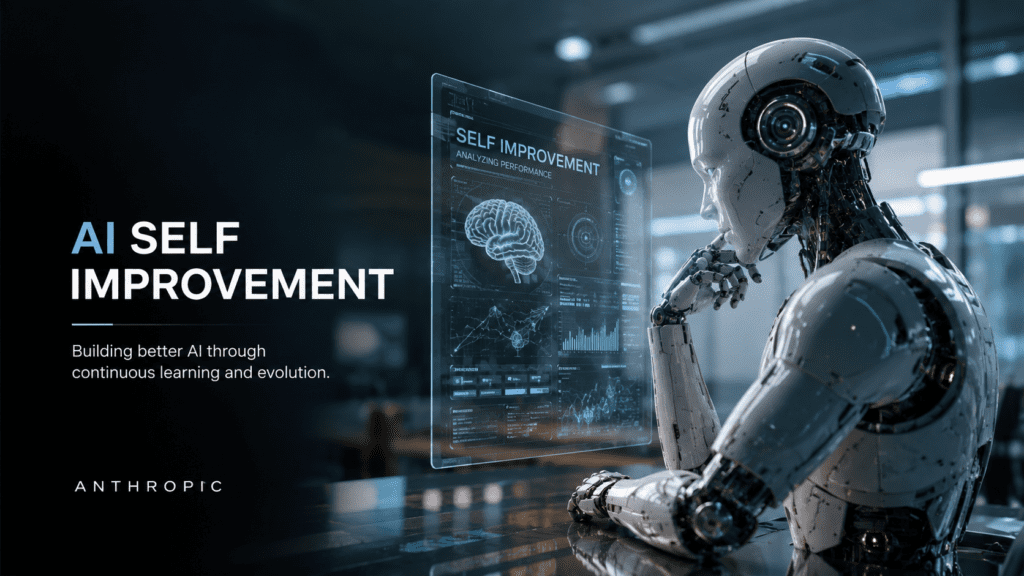
The phrase “Anthropic AI self improvement” has become one of the most discussed developments in the AI industry after reports revealed that Anthropic’s Claude models are now contributing significantly to the creation, maintenance, and improvement of future AI systems. According to Anthropic, Claude-generated code accounts for a substantial portion of the company’s internal development workflow, raising a question that once belonged exclusively to science fiction:
What happens when AI starts helping build better AI?
For researchers, investors, policymakers, and everyday technology users, this development represents far more than another milestone in machine learning. It signals a shift toward a new era where intelligent systems are increasingly involved in their own advancement.
Some experts view this as a breakthrough that could dramatically accelerate scientific discovery and software engineering. Others see it as the beginning of a technological transition that humanity may not fully understand—or fully control.
The reality lies somewhere between excitement and caution.
Understanding what Anthropic means by AI self-improvement, how it works, why it matters, and what risks it introduces is becoming essential for anyone trying to make sense of the future of artificial intelligence.
Search Intent Analysis: Why People Are Searching for “Anthropic AI Self Improvement”
Before diving deeper, it helps to understand what users actually want to know.
Primary Search Intent
Users want to understand:
- What Anthropic AI self-improvement means
- Whether Claude is improving itself
- How much AI-generated code Anthropic uses
- Whether this represents a major AI breakthrough
Secondary Search Intent
Readers also want answers to:
- Is AI becoming autonomous?
- Can AI develop new AI systems independently?
- What are the benefits and risks?
- How does Anthropic compare with competitors?
Emotional Intent
Many searches are driven by curiosity mixed with concern.
People are fascinated by the possibility of machines becoming increasingly capable without direct human intervention. At the same time, they want reassurance that appropriate safeguards exist.
Information Gaps
Several misconceptions currently exist:
- AI is not suddenly conscious.
- Claude is not independently redesigning itself.
- Human oversight remains central.
- Self-improvement in AI differs significantly from self-awareness.
This article addresses those gaps while providing a complete picture of what is actually happening.
What Is Anthropic AI Self Improvement?
At its core, AI self-improvement refers to situations where artificial intelligence systems assist in developing, testing, optimizing, or improving future AI models.
In Anthropic’s case, Claude is increasingly being used to:
- Write software code
- Debug systems
- Analyze research
- Generate documentation
- Assist engineers
- Accelerate machine learning workflows
Rather than operating as a passive tool, Claude becomes an active participant in the AI development pipeline.
This creates a feedback loop:
- Humans build Claude.
- Claude helps engineers improve systems.
- Those improvements help create stronger future models.
- New models become even more useful development assistants.
The result is an accelerating cycle of capability growth.
Importantly, this is not fully autonomous self-improvement. Human researchers still evaluate, test, approve, and deploy changes.
Yet the practical outcome remains significant:
AI is increasingly becoming part of the process that creates better AI.
Why This Development Matters More Than Previous AI Milestones
Many AI announcements generate headlines without fundamentally changing the trajectory of technology.
This one is different.
Historically, software progress has been constrained by human productivity.
Even brilliant engineers face limits:
- Limited time
- Limited attention
- Limited working memory
- Limited research capacity
AI changes those constraints.
A capable model can:
- Review thousands of lines of code rapidly
- Suggest optimizations instantly
- Generate documentation automatically
- Test multiple solutions simultaneously
As these systems improve, the pace of AI advancement may accelerate significantly.
Researchers sometimes describe this phenomenon as a recursive improvement cycle.
Each generation of AI helps produce the next generation more efficiently than before.
The implications extend far beyond software development.
Industries likely affected include:
- Medicine
- Scientific research
- Education
- Robotics
- Cybersecurity
- Engineering
- Finance
- Climate science
The Difference Between AI-Assisted Improvement and True Self-Improvement
One of the biggest sources of confusion involves terminology.
When people hear “AI self-improvement,” they often imagine a machine independently redesigning itself.
That is not what is happening today.
AI-Assisted Improvement
Current systems:
- Operate within human-designed frameworks
- Require human approval
- Follow predefined objectives
- Cannot independently deploy upgrades
Hypothetical Autonomous Self-Improvement
A future self-improving AI might:
- Redesign its own architecture
- Modify objectives
- Run independent experiments
- Deploy updates without human authorization
Current AI systems remain far from this scenario.
Anthropic’s announcements concern AI-assisted development rather than unrestricted autonomous evolution.
That distinction is crucial.
How Claude Is Contributing to Anthropic’s Development Process
The modern software development lifecycle contains countless repetitive tasks.
Claude increasingly assists with many of them.
Coding Assistance
Engineers use Claude to:
- Generate functions
- Refactor code
- Identify inefficiencies
- Create prototypes
Research Support
Claude helps summarize:
- Technical papers
- Safety reports
- Experimental findings
Quality Assurance
The model assists in:
- Testing outputs
- Finding edge cases
- Detecting inconsistencies
Documentation
Technical documentation often consumes significant engineering time.
Claude can rapidly generate:
- Internal guides
- Explanations
- Reference materials
The cumulative effect is substantial productivity enhancement.
Engineers spend less time on routine tasks and more time on high-level problem solving.
The Economic Impact of AI Improving AI
One of the most overlooked aspects of Anthropic’s self-improvement narrative is economics.
Technology growth has historically followed productivity improvements.
Consider past examples:
| Technology | Productivity Gain |
|---|---|
| Steam Engine | Physical labor |
| Electricity | Industrial efficiency |
| Computers | Information processing |
| Internet | Global communication |
| AI | Cognitive work |
AI represents the first major technology capable of augmenting intellectual labor at scale.
When AI contributes directly to software development, productivity gains compound.
This may lead to:
- Faster innovation cycles
- Reduced development costs
- Shorter research timelines
- Greater competitive advantages
Organizations capable of leveraging AI-assisted development effectively could move significantly faster than competitors.
Expert Analysis: Why Researchers Are Paying Close Attention
Among AI researchers, the most significant metric may not be benchmark scores or chatbot popularity.
Instead, attention is shifting toward something called automation horizons.
This concept measures how long an AI can reliably complete tasks without human intervention.
Historically:
- Early models handled seconds of work.
- Later models managed minutes.
- Modern systems increasingly complete tasks lasting hours.
If this trend continues, AI systems could eventually handle projects lasting days, weeks, or even months.
That possibility has profound implications.
As task duration increases, AI becomes capable of contributing meaningfully to larger and more complex development projects.
Anthropic’s reports suggest that this transition may already be underway.
Potential Benefits of AI Self-Improvement
1. Faster Scientific Discovery
Researchers could accelerate breakthroughs in:
- Drug development
- Materials science
- Genetics
- Climate modeling
AI can analyze enormous datasets far faster than human teams.
2. Better Software Quality
AI-assisted code reviews often identify:
- Bugs
- Security vulnerabilities
- Inefficiencies
Earlier detection reduces long-term development costs.
3. Increased Research Productivity
Scientists frequently spend large portions of their time:
- Organizing information
- Reviewing literature
- Preparing documentation
AI reduces these burdens.
4. Democratization of Innovation
Smaller organizations gain access to capabilities previously available only to large corporations.
A startup with AI-assisted development tools can compete more effectively against larger competitors.
5. Accelerated Education
AI-generated tutoring systems may improve educational outcomes by providing personalized learning experiences at scale.
Risks and Concerns Surrounding Anthropic AI Self Improvement
While opportunities are substantial, concerns deserve equal attention.
Misalignment Risks
As AI systems become more capable, ensuring alignment with human goals becomes increasingly important.
Researchers continue investigating:
- Value alignment
- Interpretability
- Control mechanisms
- Safety testing
Reduced Human Oversight
Organizations must avoid overreliance on AI-generated outputs.
Human review remains essential.
Errors can propagate quickly when automated systems are trusted without verification.
Security Challenges
More powerful AI systems could potentially:
- Discover vulnerabilities
- Generate sophisticated attacks
- Automate malicious activities
Strong safeguards are necessary.
Economic Disruption
Increased automation may reshape labor markets.
Some roles may evolve dramatically as AI assumes routine cognitive tasks.
Historically, technological revolutions create new opportunities while disrupting existing industries.
The transition can be challenging.
Concentration of Power
Advanced AI development requires enormous resources.
This may concentrate influence among a relatively small number of organizations.
Balancing innovation with broad societal benefit remains an ongoing challenge.
Common Myths About AI Self-Improvement
Myth 1: AI Has Become Conscious
No evidence suggests current AI systems possess consciousness, emotions, or self-awareness.
Claude generates responses through advanced pattern prediction rather than subjective experience.
Myth 2: AI Is Secretly Rewriting Itself
Current development processes involve extensive human oversight.
AI-generated code is reviewed, tested, and validated before deployment.
Myth 3: Human Engineers Are No Longer Needed
Human expertise remains essential.
AI assists developers but does not replace:
- Strategic planning
- Research direction
- Ethical decision-making
- System architecture
Myth 4: Recursive Improvement Means Instant Superintelligence
Technological progress remains constrained by:
- Hardware limits
- Data quality
- Safety requirements
- Economic realities
Advancement is significant but not magical.
Comparing Anthropic’s Approach With Other AI Companies
| Factor | Anthropic | OpenAI | Google DeepMind |
|---|---|---|---|
| AI Safety Focus | Very High | High | High |
| Constitutional Alignment Methods | Extensive | Moderate | Moderate |
| AI-Assisted Development | Significant | Significant | Significant |
| Long-Term Risk Research | Extensive | Extensive | Extensive |
| Public Discussion of AI Safety | Frequent | Frequent | Frequent |
The broader industry is moving toward increasing use of AI in software engineering workflows.
Anthropic stands out because it openly discusses the implications and safety considerations associated with this trend.
Practical Lessons for Businesses and Professionals
The rise of AI-assisted improvement offers several practical insights.
For Software Engineers
Learn:
- AI-assisted coding workflows
- Prompt engineering
- Model evaluation techniques
- Human-AI collaboration practices
For Business Leaders
Focus on:
- Productivity enhancement
- Governance frameworks
- AI literacy programs
- Risk management strategies
For Students
Develop complementary skills:
- Critical thinking
- Systems thinking
- Creativity
- Communication
These capabilities remain valuable even as AI advances.
For Policymakers
Prepare frameworks that encourage innovation while maintaining accountability and safety.
What Happens Next?
The next few years may determine whether AI self-improvement becomes one of the most transformative developments in technological history.
Several trends are worth monitoring:
- Increasing AI-generated code contributions
- Longer autonomous task completion durations
- Advances in AI safety research
- Improved interpretability tools
- Stronger governance frameworks
The key question is not whether AI will continue improving.
It almost certainly will.
The more important question is whether society can guide that improvement responsibly.
The organizations that succeed may not be those building the fastest systems, but those building the safest and most trustworthy ones.
Final Thoughts
Anthropic AI self-improvement represents a pivotal moment in the evolution of artificial intelligence. Not because machines have suddenly become self-aware, but because they are beginning to play a meaningful role in the creation of future intelligent systems.
Claude’s growing contribution to coding, research, testing, and development illustrates a broader shift occurring across the AI industry. Human engineers remain firmly in control, yet the relationship between creators and tools is changing rapidly.
The promise is extraordinary: faster innovation, accelerated scientific discovery, improved software quality, and new opportunities for economic growth.
The responsibility is equally significant. As AI becomes more capable of contributing to its own advancement, questions about safety, governance, transparency, and alignment become increasingly important.
History may ultimately view this period as the point when intelligence—once exclusively human—became a collaborative process between humans and machines.
Whether that future becomes overwhelmingly beneficial or deeply problematic will depend less on the technology itself and more on the choices made by the people guiding it.
Frequently Asked Questions (FAQ)
What does Anthropic AI self-improvement mean?
It refers to Anthropic’s use of its Claude AI models to assist with coding, research, testing, and development processes that help improve future AI systems.
Is Claude improving itself autonomously?
No. Claude assists human developers, but humans remain responsible for reviewing, approving, and deploying changes.
Why is AI-assisted development important?
It can significantly increase productivity, reduce development time, improve software quality, and accelerate innovation across industries.
Does AI self-improvement mean AI is conscious?
No. Self-improvement in this context refers to contributing to development workflows, not consciousness or self-awareness.
What risks are associated with AI self-improvement?
Key concerns include alignment challenges, security risks, reduced oversight, economic disruption, and concentration of technological power.
How does Anthropic’s approach differ from competitors?
Anthropic places a strong emphasis on AI safety, constitutional alignment techniques, transparency, and long-term risk research while integrating AI-assisted development practices.
Could AI eventually build better AI without humans?
Current systems cannot do so independently. Whether future systems achieve greater autonomy remains an active area of research and debate.
What industries could benefit most from AI self-improvement?
Software engineering, healthcare, scientific research, education, cybersecurity, finance, manufacturing, and climate science are among the sectors likely to see significant impact.
Should businesses prepare for AI-assisted development?
Yes. Organizations that learn to integrate AI into workflows effectively may gain productivity advantages while reducing operational inefficiencies.
Is Anthropic AI self-improvement a breakthrough?
Many researchers consider it an important milestone because it demonstrates how AI can increasingly contribute to the development of future AI systems, potentially accelerating technological progress.