
 By
By
Introduction
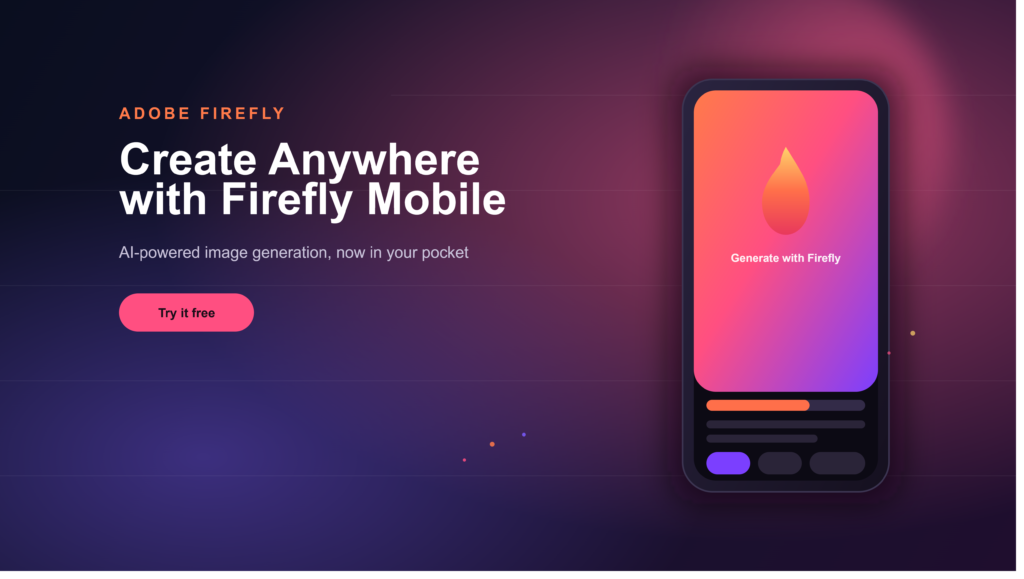
Creative inspiration doesn’t wait for you to be at your desk. That used to be a problem — the best AI image tools required a browser, a fast machine, or at minimum a decent keyboard. Adobe’s answer arrived in June 2025: a dedicated Firefly app for iPhone and Android that brings the full generative AI stack directly to your phone.
This isn’t a stripped-down companion app. It’s the same text-to-image, generative fill, and video generation pipeline that powers Photoshop and the Firefly web experience — redesigned for a touchscreen and built to sync with your Creative Cloud account the moment you hit generate. Whether you’re a designer sketching concepts between client calls, a marketer who needs a visual asset before a 3pm deadline, or a content creator who simply works faster on mobile, the Firefly app is designed around your actual schedule.
This guide covers everything: what the app does, how each feature works, what it costs, how to get the most out of your credits, and where it falls short. No filler, no vague summaries — just a complete picture of what Adobe Firefly Mobile is in 2026.
What Is Adobe Firefly Mobile?
Adobe Firefly is Adobe’s family of generative AI models, commercially trained on licensed content to make every output safe to use in real client work. The mobile app — available on both iOS and Android — brings those models into a touch-native interface you can use from anywhere.
Launched on June 18, 2025, alongside an expanded Firefly web app and a new collaborative feature called Firefly Boards, the mobile app marked Adobe’s biggest push into on-device AI creation. Prior to this, Firefly-powered tools lived inside desktop apps like Photoshop or the Firefly website. The mobile app changed that by making ideation and generation a standalone, anywhere experience.
What makes it distinct from most mobile AI tools is how it fits into a larger workflow. Content created on your phone automatically syncs to your Creative Cloud account, so you can start an image on your commute and finish it in Photoshop at your desk. There’s no file export dance, no cloud upload step — it just appears.
How Firefly Differs From Other Mobile AI Apps
Most mobile AI generators are walled gardens. You create content inside the app, export a JPEG, and figure out the rest yourself. Firefly Mobile is different in two ways that matter for professional use.
First, commercial safety. Adobe trained Firefly models on licensed images, openly licensed content, and public domain material. That means generated output carries content credentials and can be used in paid work, advertising, and commercial publication without the legal grey area that surrounds outputs from models trained on scraped web data.
Second, ecosystem depth. Firefly on mobile is a front door to the same pipeline that powers Generative Fill in Photoshop and Generate Video in Premiere Pro. The images you create here aren’t trapped in a separate system — they live in Creative Cloud and move naturally into production workflows.
Core Features of Adobe Firefly Mobile
Text-to-Image Generation
The foundation of the app. You describe what you want in plain language — subject, style, lighting, mood, composition — and Firefly generates the image. The app supports multiple model choices, including Adobe’s own Firefly Image Model 4, Google’s Imagen 3 and 4, and OpenAI’s image generator.
Model choice affects both aesthetic and credit cost. Firefly’s native models tend toward photorealistic precision and are good at following detailed commercial briefs. Third-party models like Imagen or OpenAI’s generator have their own distinctive aesthetics. The ability to switch models without leaving the app is one of the genuine advantages over competing platforms — you can generate the same prompt across three models and compare results in seconds.
Firefly Image Model 4 Ultra, the highest-fidelity option, is designed for creators who need maximum detail: complex architectural renders, portraits requiring accurate facial structure, fine-texture fabric or material work. For rapid ideation, the standard Image Model 4 generates faster with slightly less computational overhead.
Style and Structure References
One of the more underutilized features: you can upload a reference image and instruct Firefly to match its composition (Structure Reference) or visual style (Style Reference) without copying the content. This is particularly useful if you have a client’s existing photography and want to generate concept variants that feel consistent with their aesthetic without reproducing the actual images.
Style Reference analyzes texture, color treatment, lighting approach, and tonal range. Structure Reference preserves the spatial layout — useful for generating multiple variations of a scene without the composition drifting between outputs.
Generative Fill and Expand
Familiar to Photoshop users, Generative Fill lets you select a region of an image and replace or add content using a text prompt. On mobile, this works through a brush tool — paint over the area you want to change, describe what should appear instead, and generate.
Generative Expand extends the image canvas outward. This is particularly useful for social media work where you need the same image in multiple aspect ratios: generate a square crop for Instagram, expand to 9:16 for Stories, expand horizontally for a Twitter banner — all from the same source image.
Text-to-Video and Image-to-Video
Video generation came to the Firefly mobile app as part of the June 2025 launch and has expanded since. You can generate short video clips from text prompts or animate a static image into video using Firefly’s own video model, Google’s Veo 2, or a selection of third-party models.
Generating videos with transparent backgrounds — a recent addition — makes mobile-generated clips immediately usable in motion graphics work without additional compositing. You can layer a transparent-background generated clip directly over existing footage.
The Firefly video editor, accessible from the app, lets you trim clips, add audio, arrange a timeline, and apply transitions without leaving Firefly. For quick social content, this eliminates the need to export to a separate video app.
Sound Effect Generation
A newer addition to the mobile experience: text-to-sound. Describe an audio effect — “rain on a tin roof,” “a door creaking in an empty corridor,” “crowd applause fading to silence” — and the app generates it. Generated sound effects can be added directly to the video timeline inside the app. This makes Firefly Mobile a more complete content production environment for short-form creators who need visual, motion, and audio assets in one place.
Firefly Boards (Mobile Access)
Firefly Boards, currently in public beta on the web, is Adobe’s AI-first moodboarding and collaboration surface. While the full Boards experience lives on the web, content generated on the mobile app syncs into Boards projects. Teams can use Boards to collaboratively explore image and video concepts, iterate on visual directions, and hand off polished assets to production — with everything generated on mobile automatically available in the shared workspace.
Getting Started: Download, Setup, and Your First Generation
The Firefly app is available on the App Store (iOS) and Google Play (Android). You need a free Adobe account to sign in; no Creative Cloud subscription is required to try it, though a paid plan unlocks more monthly generation capacity.
After sign-in, the app presents a redesigned home workspace with quick access to image, video, audio, and design workflows. A search function uses natural language to find past generations in your history, so you can say “the mountain landscape I made last Tuesday” rather than scrolling through a grid.
First generation, step by step:
- Tap “Generate Image” from the home screen
- Type a prompt. Be specific: subject first, then style, then lighting, then mood. “A senior architect reviewing blueprints at a drafting table, warm afternoon light, editorial photography style” will outperform “person working”
- Choose a model. For your first generation, the default Firefly Image Model 4 is a good starting point — it generates quickly and handles most prompt types well
- Tap generate. The image appears in seconds
- Tap “Edit” to open Generative Fill if you want to modify a region, or “Expand” to extend the canvas
- The result is automatically saved to your Creative Cloud account
Prompt tips from real workflows: Separate your descriptive layers with commas. Put the most important element first — the model gives priority to what comes early in the prompt. If you’re generating for a specific medium (print, social, web), mention it: “for a full-page magazine spread” signals different compositional choices than “for a 1080×1080 Instagram post.”
Adobe Firefly Mobile Pricing: What It Actually Costs
Firefly uses a credit-based system. Standard generations — basic image outputs at standard resolution — are unlimited for paid plan subscribers. Credits are consumed by premium features: high-resolution outputs, video generation, partner model use (Imagen, Veo, OpenAI), and audio generation.
Current plan tiers:
| Plan | Monthly Cost | Premium Credits | Video Capacity |
|---|---|---|---|
| Free | $0 | Limited (allocated on first use, expire monthly) | Not included |
| Standard | $9.99/mo | 2,000/month | ~20 five-second clips |
| Pro | $19.99/mo | 4,000/month | ~40 five-second clips |
| Premium | $199.99/mo | 50,000/month | ~500 five-second clips or 166 min translation |
Creative Cloud All Apps subscribers ($59.99/month) receive 4,000 monthly credits — equivalent to the standalone Pro plan — so a separate Firefly subscription is redundant if you’re already a full CC subscriber.
Credits do not roll over. Unused credits expire on your billing date each month. If you consistently exhaust your allocation before the reset, that’s a reliable signal to upgrade — not to search for workarounds.
Understanding credit consumption: Standard image generation at standard resolution costs no credits on paid plans. A 5-second video clip at standard resolution costs roughly 100 credits. Premium resolution image generation and partner model outputs (Imagen 4, Veo 2, OpenAI) consume credits at higher rates that vary by model and resolution choice. Adobe shows your remaining credit balance in the account picker within the app.
The free tier, honestly evaluated: The free plan allocates a small batch of credits on your first use, which expires after one month. It’s sufficient to test how the interface works and whether Firefly’s image quality suits your needs. It is not a reliable production option — free plan outputs are also not licensed for commercial use, which matters if you’re evaluating this for client work.
Adobe Firefly Mobile vs. the Web App: What’s Different?
The mobile and web apps draw from the same underlying models and sync to the same Creative Cloud account. The differences are primarily interface and workflow:
What mobile does well: Touch-based editing with Generative Fill is genuinely faster for brush-style selections than a mouse. The app is optimized for portrait orientation and single-task generation. For quick concept generation between other work, the mobile interface has less visual overhead.
What the web app adds: The full Firefly Boards experience, more detailed prompt controls, vector generation via Illustrator integration, the complete video timeline editor, and features that benefit from a larger screen — like Scene to Image, which generates images from a 3D scene composition.
What they share completely: All AI models, the credit system, Creative Cloud sync, content credentials, and commercial safety guarantees.
The practical workflow for most professionals: generate concepts on mobile, refine in the Firefly web app or Photoshop, produce final assets in the full Creative Cloud suite. The phone handles the ideation layer; the desktop handles production.
Comparison: Adobe Firefly Mobile vs. Competing AI Apps
There are other mobile AI image generators. The choice between them depends on what you’re optimizing for.
| Feature | Firefly Mobile | Midjourney (Mobile) | ChatGPT (Mobile) |
|---|---|---|---|
| Commercial licensing | Explicitly safe | Varies by plan | Varies by plan |
| Creative Cloud integration | Full sync | None | None |
| Video generation | Yes | No | Limited |
| Audio generation | Yes | No | No |
| Editing (fill/expand) | Yes | No | Limited |
| Free tier | Yes (limited) | No | Yes (limited) |
| Multi-model choice | Yes | No | No |
Midjourney produces more stylistically distinctive images — it remains the preference for editorial illustration and creative concept work where aesthetic ambition is the priority. Firefly’s real advantage is the combination of commercial safety with direct integration into production tools. If you generate an image in Firefly and need to refine it in Photoshop, that workflow is one tap. If you generate in Midjourney, you’re exporting and uploading.
For creators already inside the Adobe ecosystem, the comparison isn’t really Firefly vs. Midjourney — it’s whether the mobile app adds meaningful value to a workflow they’re already running. It does.
Practical Workflows: How Different Creators Use Firefly Mobile
Social media manager: Between meetings, generates 4–5 concept images for a campaign brief using text prompts. Shares the Creative Cloud link in Slack for client review without exporting anything. Back at the desk, the approved concept is already in Photoshop ready for final art direction.
Freelance designer: Uses Generative Expand on mobile to adapt a hero image into multiple aspect ratios for a client’s media kit — square, portrait, landscape — while commuting. Delivers assets same-day that would previously have required an afternoon in the studio.
Content creator (YouTube/social): Generates a thumbnail concept on mobile, animates it to a 3-second intro clip using image-to-video, adds a generated sound effect, and exports from the app. The full asset pipeline — image, motion, audio — without opening a laptop.
Brand team: Uses Firefly Boards for collaborative mood-boarding. Team members generate concepts independently on mobile during a workshop, which surface immediately in the shared Boards project for group review. No file-sharing friction.
Common Mistakes and How to Avoid Them
Vague prompts. “A nice office” generates something generic. “A modern open-plan office with exposed concrete ceilings, afternoon light through floor-to-ceiling windows, warm wood accents, no people” generates something actually useful. The models are responsive to specificity — use it.
Ignoring model selection. Many users generate on the default model without exploring the alternatives. For a given prompt, Imagen 4 and Firefly Image Model 4 can produce noticeably different results. Run the same prompt across two models when you’re not sure which direction suits the brief.
Burning credits on iterations that could be refined locally. If you’re unsure about a composition, sketch it with a reference image first. Generative Fill is credit-efficient for targeted changes — regenerating the full image for small adjustments is a credit-heavy approach.
Not using Generative Expand for aspect ratio work. This is one of the most credit-efficient features in the app. Generating separate images for each required format is slower and more expensive than expanding a single strong base image.
Treating the free plan as production-ready. The free tier is a trial. The commercial licensing limitations alone make it unsuitable for professional output, regardless of credit limits.
Expert Analysis: The Bigger Picture
Adobe Firefly Mobile represents something more deliberate than a feature release. For several years, Adobe’s generative AI tools lived inside existing apps — Photoshop, Illustrator, Premiere — as features within familiar contexts. Firefly the standalone app, and Firefly Mobile specifically, signals Adobe repositioning generative AI as the starting point of the creative workflow rather than a capability layered into the middle of it.
The multi-model approach is strategically significant. By integrating Google’s Veo and Imagen, OpenAI’s generator, and third-party video models like Luma AI’s Ray 2 alongside its own models, Adobe is building a platform rather than defending a single model’s quality. This acknowledges what’s true: no single generative AI model is best at everything. Giving creators the ability to choose — and to mix outputs — makes the platform more useful than any single-model competitor.
The commercial safety position is genuinely differentiating in a way that’s easy to underestimate. Enterprises and agencies generating AI content at scale have legal exposure if they can’t verify the training data behind what they’re producing. Firefly’s documented licensing approach and content credentials infrastructure address that directly. That’s why Adobe can report that companies like Deloitte, Tapestry, and Paramount+ have integrated Firefly into production workflows — not because it makes the prettiest images, but because the provenance is defensible.
The mobile entry point extends this value to creators who previously found the Creative Cloud commitment too heavy for occasional use. A standalone Firefly plan at $9.99/month is a meaningful reduction in the cost of accessing Adobe’s AI infrastructure.
Future Trends: Where Adobe Firefly Mobile Is Heading
Based on Adobe’s stated roadmap and the trajectory of the platform through 2025 and into 2026:
AI Assistant integration: Adobe has introduced a Firefly AI Assistant (currently in beta on the web) that lets users direct multi-step creative workflows through conversational language — “generate three versions of this, expand the one on the left, and save them to my project folder.” As this matures and reaches mobile, it will substantially change how the app is used, shifting from manual menu navigation to conversational creative direction.
Deeper production pipeline: The gap between Firefly Mobile and Premiere Pro is narrowing. Sound effect generation, video timeline editing, and transparent-background video export are all steps toward a mobile environment capable of producing broadcast-quality short-form content without a desktop.
Brand Intelligence on mobile: Adobe has launched Firefly Design Intelligence for Illustrator — a system that learns a brand’s color, typography, and layout rules and applies them to new content generation. Bringing this to the mobile app would allow creators to generate brand-consistent assets on the fly without manual style checking.
Model ecosystem expansion: Partnerships with Luma AI, Ideogram, Pika, and Runway are already in place for the web experience. Their availability on mobile will expand the aesthetic range of what’s achievable without leaving the app.
Conclusion: Key Takeaways
Adobe Firefly Mobile is the most capable mobile AI creation app for creators already inside the Adobe ecosystem, and a serious option for anyone doing commercial creative work where content licensing is a real consideration.
What makes it worth using:
- Full Creative Cloud sync with no extra steps
- Commercially safe output with documented content credentials
- Multi-model selection including Google, OpenAI, and Adobe’s own models
- Video and audio generation in a single mobile environment
- Competitive pricing, especially for existing Creative Cloud subscribers
Where to be realistic:
- Heavy video workflows will consume credits quickly at Standard and Pro tiers
- Midjourney still leads on raw aesthetic quality for editorial/artistic work
- The free tier is a trial only — commercial use requires a paid plan
For most working designers, marketers, and content creators using Adobe tools, the Firefly mobile app closes a real gap. The question used to be: how do I get an AI-generated asset into my production workflow fast? Now the question is just: what do I want to make?
FAQ
Is Adobe Firefly Mobile free? Yes — there is a free plan available on both iOS and Android. It includes a limited monthly credit allocation (credited on first use, expiring after one month) and access to standard image generation. The free tier is not licensed for commercial use and does not include video generation. Paid plans start at $9.99/month.
What’s the difference between Firefly Mobile and the Firefly web app? Both run the same underlying models and sync to the same Creative Cloud account. The mobile app is optimized for touch-based creation and single-task generation. The web app includes Firefly Boards (the collaborative moodboarding tool), more advanced video timeline features, and tools that work better on larger screens. Most users move between both depending on context.
Can I use Firefly Mobile images commercially? Yes — content generated using Adobe’s native Firefly models is commercially safe and covered by Adobe’s content credentials framework. Third-party model outputs (Google Imagen, OpenAI) may carry different terms; check Adobe’s licensing documentation for specifics. Free-tier outputs are not licensed for commercial use.
Does Firefly Mobile work without a Creative Cloud subscription? Yes. The Firefly app is available as a standalone experience. You can subscribe directly to a Firefly plan (Standard, Pro, or Premium) without subscribing to Creative Cloud. However, if you already have a Creative Cloud All Apps subscription, you’re already receiving an equivalent credit allocation — a separate Firefly plan isn’t necessary.
How do Firefly credits work on mobile? Credits are consumed by premium features: high-resolution image output, video generation, audio generation, and partner model use. Standard image generation at standard resolution is unlimited on paid plans. Credits reset monthly on your billing date and do not roll over.
What happens when I run out of credits? Standard image generation continues at no credit cost. You lose access to premium resolution, video, audio, and partner model features until your credits reset or you purchase additional credits. Firefly Premium subscribers can queue up to 20 video generations for background processing even after credits are exhausted.
Is Adobe Firefly better than Midjourney for mobile AI generation? They serve different priorities. Midjourney produces more artistically distinctive images and is preferred for editorial and creative concept work. Firefly’s advantages are commercial licensing safety, direct Creative Cloud integration, and a broader feature set (video, audio, editing tools). For most commercial and marketing workflows, Firefly’s ecosystem depth outweighs Midjourney’s aesthetic edge.
Can I start a project on Firefly Mobile and finish it in Photoshop? Yes — this is one of the primary design goals of the app. Content created on mobile syncs automatically to your Creative Cloud account and is immediately available in Photoshop, Illustrator, Premiere Pro, and Adobe Express on desktop or web.
Does Firefly Mobile support video generation? Yes. You can generate videos from text prompts or animate a static image using Firefly’s video model, Google’s Veo 2, and a growing selection of third-party models. A lightweight video timeline editor within the app lets you trim, add audio, and arrange clips without exporting to another application.
What devices support Adobe Firefly Mobile? The app is available for iPhone on the App Store and Android devices on Google Play. Specific device requirements vary; check the respective store listings for current iOS and Android version requirements.