
 By
By
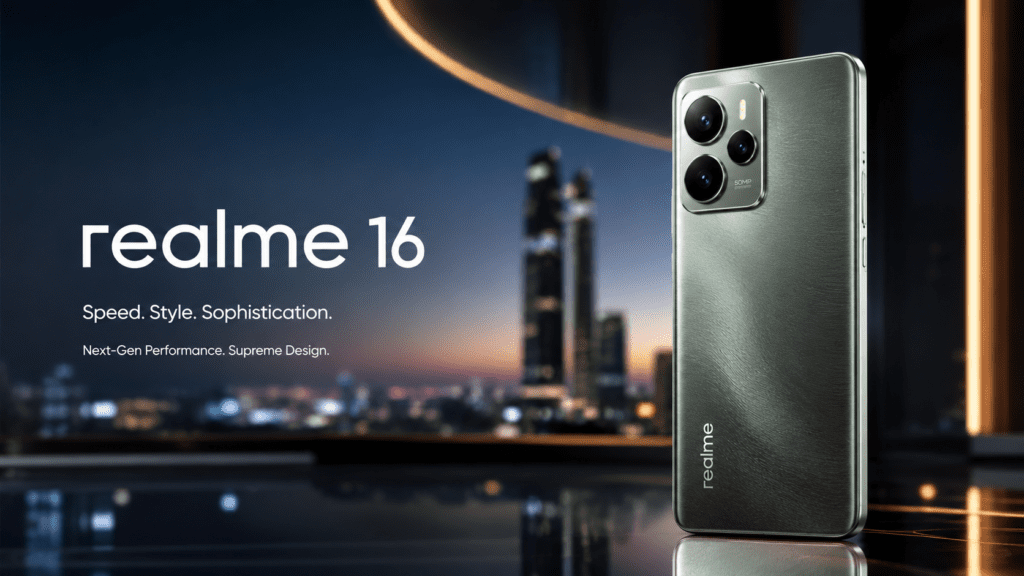
There’s a specific type of phone buyer Realme has always understood better than most of its rivals. Not the spec-sheet hunter who cross-references AnTuTu scores before breakfast. Not the camera enthusiast who pixel-peeps 100% crops on a 27-inch monitor. Realme’s sweet spot has always been the practical, value-conscious buyer who wants a phone that works — all day, every day, without drama.
The Realme 16 5G makes that philosophy its entire identity.
Launched in India in April 2026 at ₹31,999, the Realme 16 5G doesn’t arrive swinging for the fences on every spec. In some areas, it’s actually a step back from its predecessor, the Realme 15. And yet, somehow, it still manages to be one of the most sensible mid-range purchases you can make right now. Here’s why — and what you need to watch out for before pulling out your card.
What You’re Actually Getting: The Big Picture
Before diving into granular specs, it helps to understand what Realme was trying to build here. The Realme 16 isn’t positioned as a spec monster. It’s purpose-built around three pillars: long battery life, genuine durability, and a slim, stylish design that doesn’t ask you to compromise between looks and practicality.
The headline numbers tell that story clearly. A 7,000mAh battery packed into a body that’s just 8.1mm thin and weighs 183 grams. An IP69 Pro rating — that’s the highest dust and water resistance rating available on a phone at this price point. A 6.57-inch AMOLED display running at 120Hz. A Sony IMX852 50MP main sensor. And India’s first rear-mounted selfie mirror.
Stack those features against a ₹31,999 launch price, and there’s a compelling case to be made. But this phone also makes real sacrifices — no ultra-wide lens, no OIS, no 4K video, and a chipset that won’t impress anyone chasing peak performance. The question isn’t whether the Realme 16 is perfect. It clearly isn’t. The question is whether the tradeoffs make sense for you.
Design and Build Quality: Slim, Light, and Surprisingly Durable
Pull the Realme 16 out of its box and the first thing you notice is how light it feels. At 183 grams, it’s lighter than many phones with 4,500mAh batteries, let alone a 7,000mAh cell. That’s a genuine engineering achievement, and Realme deserves credit for it.
The Air White variant is the one to go for, aesthetically. Realme’s “Gleaming Wings” finish — shiny wing-like textures running across the back panel — catches light in a way that turns heads. The Air Black is considerably more reserved; fine, but nothing that distinguishes itself from a dozen other phones in this segment.
The body is plastic, which is expected at this price, and it does limit that sense of premium in-hand feel. The back is slightly slippery due to its silky texture, so a case is advisable. That said, the more compact dimensions (158.3 × 75.1mm) make one-handed use genuinely comfortable — a notable improvement over the Realme 15’s larger 6.8-inch frame.
Where the build quality truly stands out is in its durability rating. The Realme 16 carries IP66, IP68, IP69, and IP69K certifications simultaneously. That means it can handle submersion, high-pressure water jets, and dusty environments — all on a mid-range budget. For buyers in humid climates, outdoor workers, or anyone who’s ever dropped a phone in the sink, this is meaningful protection, not just marketing language.
The phone also passed extended durability testing without picking up worrying scratches or dents during real-world use. It’s a sturdy device that can take everyday knocks without exhibiting fragility.
Display: AMOLED Quality at a Fair Price
The 6.57-inch AMOLED panel on the Realme 16 is one of the cleanest aspects of this phone. Running at FHD+ resolution (2372 × 1080 pixels) with a 120Hz refresh rate, it handles scrolling, streaming, and gaming comfortably. Colors are vivid and accurate — especially in Vivid mode, which covers 100% DCI-P3. The 4,200-nit peak brightness ensures the screen remains readable under direct sunlight, which is where AMOLED panels sometimes struggle on budget devices.
Realme’s proprietary Flux Engine also contributes to display smoothness, handling what the brand calls “interruptible and parallel effects” — essentially ensuring animations don’t stutter during multitasking or mid-scroll context switches. In practice, the UI feels fluid and responsive, which matters more for daily use than raw benchmark numbers.
One gripe: the 120Hz cap means you’re not getting the 144Hz panels seen in some competing devices at similar or slightly lower prices, including even the Realme 15. For most users, 120Hz is more than adequate. But if you’re a discerning buyer who notices the difference, it’s worth flagging.
The Selfie Mirror: Gimmick or Genuine Feature?
Let’s address the most talked-about design element directly. The selfie mirror — a small physical mirror embedded into the rear camera module — is positioned as a way to frame yourself accurately when using the higher-quality 50MP rear camera for self-portraits, rather than relying on the (also capable) front camera.
It genuinely works. When shooting with the main rear camera, you can glance at the mirror to see your own reflection, adjust your angle, and frame the shot correctly. This is particularly useful for group shots, vlogging setups, or portrait-mode selfies where rear camera quality matters. It’s also a natural conversation starter.
Is it revolutionary? No. But it’s not a gimmick either. It solves a real problem — selfie framing with the superior rear sensor — in a simple, low-tech, and reliable way. Whether it’s worth the price of admission on its own is another question. But as part of the overall package, it’s a thoughtful addition.
Camera Performance: Capable Stills, Real Limitations
The camera system on the Realme 16 5G is where buyers need to set realistic expectations.
The 50MP Sony IMX852 main sensor is a genuine strength. Daytime shots are detailed, colors are naturalistic without being oversaturated, and the Luma Color processing delivers images that translate well to social media without heavy post-processing. Portrait mode is effective, and night mode — while not class-leading — handles low-light scenes better than many phones at this price.
The 50MP front camera is equally capable. For video calls, social media selfies, and casual portrait work, it delivers sharp and well-exposed images.
The missing pieces are hard to ignore, though.
There’s no ultra-wide lens. The secondary 2MP sensor is a depth assistant — essentially useless for standalone photography. This means you’re locked into a single focal length for everything. No landscape shots at a wider angle, no architectural photography, no creative framing with different perspectives. For a phone priced close to ₹32,000, the absence of an ultra-wide in 2026 is a meaningful compromise.
OIS (Optical Image Stabilization) is also gone compared to the Realme 15. This matters most in low-light and video scenarios, where the camera relies on EIS (Electronic Image Stabilization) instead. Video is capped at 1080p at 60fps — 4K recording is not supported, a direct consequence of the Dimensity 6400 Turbo chipset’s limitations. If you shoot video regularly, this should be a dealbreaker. If you’re primarily a stills photographer who posts to Instagram, it probably won’t be.
Performance: Solid Daily Driver, Not a Gaming Machine
The Realme 16 5G runs on the MediaTek Dimensity 6400 Turbo — a 6nm octa-core chipset that pairs two performance Cortex-A76 cores at 2.5GHz with six efficiency Cortex-A55 cores at 2.0GHz. In everyday use — browsing, social media, WhatsApp, streaming, light gaming — it performs without hesitation. App loading is snappy, multitasking between apps is smooth, and the 8GB or 12GB RAM configurations keep things from slowing down over time.
The Flux Engine software optimization layer deserves mention here. Realme claims the phone has passed 72 months of long-term smoothness testing (for the 8GB + 256GB variant), suggesting it’s built to maintain performance over years of use rather than being fast only when new. Whether those lab conditions translate to real-world longevity is a long-term question, but the promise is meaningful.
For gaming, the picture is more nuanced. BGMI runs at Smooth + Extreme (60fps) settings with stable frame delivery — averaging around 54fps in sustained sessions with temperatures staying below 38°C. The 650mm² VC vapour chamber cooling system is effective; the phone stays cool during casual gaming. However, the Dimensity 6400 Turbo cannot push demanding titles to 90fps or 120fps. If competitive mobile gaming is your priority, phones with Dimensity 7300 or Snapdragon 7s Gen 3 silicon in a similar price range will serve you better.
Performance Comparison
| Feature | Realme 16 5G | Realme 15 5G |
|---|---|---|
| Chipset | Dimensity 6400 Turbo | Dimensity 7300 |
| Max Gaming FPS (BGMI) | ~60fps | ~90fps |
| Refresh Rate | 120Hz | 144Hz |
| RAM Options | 8GB / 12GB | 8GB / 12GB |
| Charging Speed | 60W | 80W |
The performance regression from the 15 to the 16 is real and documented. Buyers upgrading from the Realme 15 specifically may find the chipset downgrade difficult to justify. For buyers coming from older budget phones or a different brand’s older handset, the Realme 16’s performance will feel like a meaningful step up.
Battery Life: The Single Best Reason to Buy This Phone
This is where the Realme 16 5G distinguishes itself from virtually every competitor in its price range.
The 7,000mAh battery — powered by a high-performance graphite cell with Realme’s Titan Long-life Algorithm — delivers approximately 9 to 11 hours of screen-on time in real-world testing. For normal users, that translates to 1.5 days on a single charge. For lighter users, two days is achievable. Even heavy users — those streaming video, gaming, and running social media simultaneously — report getting comfortably through a full day.
The All-Scenario Bypass Charge feature reduces battery strain during charging sessions, and Realme rates the cell for 1,600 charge cycles before significant degradation. That’s notably higher than the industry standard of around 800 cycles for most phones.
60W fast charging is the charging speed — which gets the massive 7,000mAh cell from flat to full in roughly 70–75 minutes. This is slower than the 80W charging the Realme 15 offered, and competitors with similarly large batteries sometimes match or exceed 65W. But in context, charging a 7,000mAh battery in 75 minutes is still respectable, especially when most users are plugging in overnight anyway.
The combination of battery capacity, long-life optimization, and a slim 8.1mm profile is, genuinely, the phone’s biggest achievement. No other device at this price in India delivers this combination.
Software Experience: Android 16 and Realme UI 7.0
The Realme 16 5G ships with Android 16 out of the box — a meaningful advantage in 2026. Realme UI 7.0 layers a clean, customizable interface on top, with Google Gemini integration for AI-assisted tasks, and a range of AI features including AI Framing and AI editing tools.
The software commitment is also worth noting: Realme promises three major Android upgrades and four years of security updates, which means the phone should remain current through Android 19 if those commitments are met. That’s competitive with Samsung’s Galaxy A-series update promises and better than most brands at this price.
Bloatware exists — it always does on mid-range Android phones — but it’s manageable rather than overwhelming. The overall UI is intuitive, and the Realme UI has matured considerably compared to earlier versions that felt cluttered and overly promotional.
Realme 16 vs. Realme 16 Pro: Which One Should You Choose?
This is the comparison most buyers will wrestle with.
The Realme 16 Pro, launched separately in January 2026, sits above the standard 16 with a 200MP main camera, a Dimensity 7300-Max chipset, a 144Hz 1.5K AMOLED display, and a higher AnTuTu score (over 970,000 points). It’s priced around ₹30,990 for the base variant — surprisingly close to the standard Realme 16.
If performance and camera versatility matter most to you, the 16 Pro is the better buy, even at a similar or slightly higher price point. Its chipset is meaningfully more capable, and the 200MP sensor opens up more photographic flexibility.
However, the standard Realme 16 has its own advantages: a higher IP69 Pro rating, the selfie mirror feature, and the same 7,000mAh battery. If durability, slim design, and battery longevity are your primary concerns, the standard model holds its ground.
Quick Comparison: Realme 16 vs. Realme 16 Pro
| Spec | Realme 16 5G | Realme 16 Pro 5G |
|---|---|---|
| Chipset | Dimensity 6400 Turbo | Dimensity 7300-Max |
| Main Camera | 50MP Sony IMX852 | 200MP Samsung HP5 |
| Display | 6.57″ 120Hz AMOLED | 6.x” 144Hz 1.5K AMOLED |
| IP Rating | IP69 Pro | IP67/68 |
| Selfie Mirror | Yes | No |
| Launch Price | ₹31,999 | ~₹30,990 |
Common Misconceptions About the Realme 16
“It’s an upgrade over the Realme 15 in every way.” It isn’t. The Dimensity 7300 in the Realme 15 is faster, the 15 had OIS and an ultra-wide camera, and its 144Hz panel is smoother. The Realme 16 wins on design, IP rating, and stereo speakers. If you already own a Realme 15, this is a lateral move, not an upgrade.
“The 7,000mAh battery makes it a heavy, bulky phone.” At 183 grams and 8.1mm thick, the Realme 16 is one of the lightest and slimmest phones with a 7,000mAh battery available in India. That’s the engineering story here.
“The selfie mirror replaces a proper front camera.” The selfie mirror is an additional feature — the 50MP front camera remains fully functional. The mirror simply helps you frame shots using the rear camera, which has better optics.
“IP69 means it’s fully waterproof for underwater photography.” IP69K specifically refers to resistance against high-pressure water jets (think car washing scenarios). While the phone handles submersion per its IP68 rating, sustained underwater photography sessions aren’t what this rating was designed for.
Who Should Buy the Realme 16 5G?
You’ll love it if you:
- Prioritize battery life above almost everything else
- Want a slim, stylish phone that doesn’t feel like a brick
- Take photos primarily for social media or casual use
- Work or live in conditions where water and dust resistance matter
- Are upgrading from a budget phone that’s 2–3 years old
You should look elsewhere if you:
- Play competitive mobile games and want 90fps+ performance
- Shoot video regularly and need 4K capability
- Rely on an ultra-wide camera for landscape or architectural photography
- Are upgrading from the Realme 15 and expect a performance jump
The honest answer is that the Realme 16 is a phone built for a very specific type of user, and it serves that user exceptionally well. It’s not a Swiss Army knife. It’s a really, really good kitchen knife — precise, reliable, and excellent at its primary job.
Verdict
The Realme 16 5G occupies a strange but interesting position in the mid-range landscape. On paper, it looks like a regression in some areas from the phone it replaces. In practice, it delivers something many users will find more valuable than a faster processor: genuine daily endurance, solid durability, and a design that doesn’t announce its budget origins.
The 7,000mAh battery in an 8.1mm frame is a real achievement. The Sony IMX852 sensor takes impressive stills. The IP69 Pro certification at ₹31,999 is exceptional value. Android 16 out of the box and a credible update commitment give it long-term relevance.
The lack of an ultra-wide camera, absent OIS, 1080p video ceiling, and mid-tier chipset are real limitations that keep this from being a universal recommendation. But they’re manageable limitations for the right buyer.
Rating: 7.5 / 10 — A focused, experience-first mid-ranger that over-delivers on battery, build, and design. Under-delivers on camera versatility and raw performance. Know what you’re buying, and you’ll be satisfied.
Frequently Asked Questions
What is the price of Realme 16 5G in India? The Realme 16 5G launched in India at ₹31,999 for the 8GB + 128GB variant, ₹33,999 for 8GB + 256GB, and ₹36,999 for the 12GB + 256GB top configuration. It’s available on Flipkart and the Realme online store.
Does Realme 16 5G support 4K video recording? No. Due to the limitations of the MediaTek Dimensity 6400 Turbo chipset, video recording is capped at 1080p at 60fps. 4K video is not supported on this device.
What is the selfie mirror on Realme 16? The selfie mirror is a small physical mirror built into the rear camera module. It allows users to see their own reflection when taking selfies with the higher-quality 50MP rear camera, making framing easier without guessing at the angle.
Is the Realme 16 5G waterproof? The Realme 16 5G carries IP66, IP68, IP69, and IP69K certifications — among the most comprehensive water and dust resistance ratings available on a mid-range phone. It can handle submersion (IP68) and high-pressure water jets (IP69K).
How long does the Realme 16 5G battery last? Real-world testing shows 9–11 hours of screen-on time. Normal users typically get 1.5 days per charge. Heavy users comfortably last a full day without needing to top up.
Is Realme 16 5G good for gaming? It handles casual gaming well — BGMI runs at 60fps settings without excessive heat. However, the Dimensity 6400 Turbo cannot push demanding games to 90fps or 120fps, so it’s not the ideal choice for competitive mobile gamers.
How does Realme 16 5G compare to Realme 16 Pro? The Realme 16 Pro offers a faster Dimensity 7300-Max chipset, a 200MP camera, and a 144Hz 1.5K display at a similar price. The standard Realme 16 counters with a higher IP69 Pro rating, the selfie mirror, and the same 7,000mAh battery in a slightly slimmer body.
Does Realme 16 5G support expandable storage? Yes, the Realme 16 5G includes a hybrid SIM slot that supports microSD cards for expandable storage, which is increasingly rare on mid-range phones in 2026.
What Android version does Realme 16 5G ship with? It ships with Android 16 and Realme UI 7.0, with a commitment of three major Android updates and four years of security updates.
Is Realme 16 5G worth buying in 2026? For buyers who prioritize battery life, build quality, and slim design over peak performance and camera versatility, yes. If you want the fastest chipset or the most versatile camera in this price range, alternatives like the Realme 16 Pro or Xiaomi Redmi Note 14 Pro may serve you better.