
 By
By
The Rise of AI Voices—and the Growing Need to Detect Them
A few years ago, most synthetic voices sounded robotic, flat, and easy to recognize. That is no longer the case.
Modern artificial intelligence can generate speech that closely mimics human tone, emotion, cadence, breathing patterns, and even regional accents. AI-generated voices now appear in customer service systems, audiobooks, podcasts, videos, virtual assistants, advertisements, online courses, and social media content.
The technology has advanced so quickly that many listeners can no longer reliably distinguish between human speech and machine-generated audio.
That shift has created a new challenge.
How can individuals, businesses, journalists, educators, financial institutions, and security teams determine whether a voice recording is authentic or artificially generated?
The answer lies in AI voice detection.
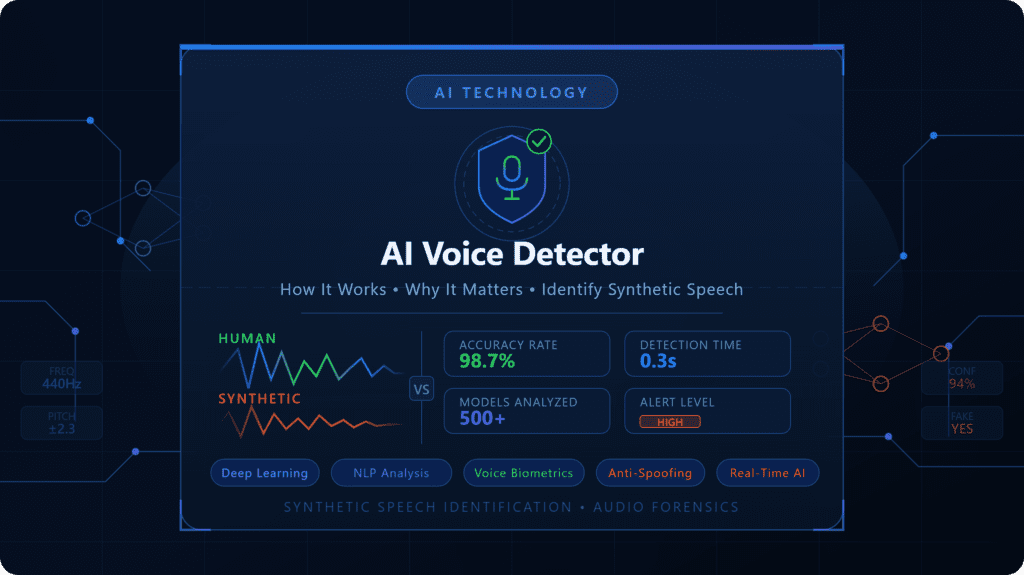
An AI voice detector is designed to analyze audio and identify whether speech originated from a real human speaker or was generated, cloned, or modified by artificial intelligence systems.
As synthetic voice technology becomes increasingly sophisticated, voice detection is moving from a niche cybersecurity tool into a critical trust mechanism across media, communication, and digital identity verification.
Understanding how these detectors work—and where their limitations lie—has become essential for anyone operating in a world where hearing is no longer believing.
What Is an AI Voice Detector?
An AI voice detector is a software system that analyzes speech recordings to determine whether the audio was produced by a human speaker or generated by an artificial intelligence model.
These systems use machine learning, audio forensics, signal processing, and pattern recognition techniques to examine characteristics that may reveal synthetic origins.
The detector evaluates elements such as:
- Speech rhythm
- Frequency patterns
- Pitch consistency
- Breathing sounds
- Vocal imperfections
- Acoustic transitions
- Background noise behavior
- Emotional variation
- Spectral fingerprints
The goal is not simply to identify “fake” audio.
Instead, modern voice detectors attempt to estimate the probability that speech was artificially generated, cloned, edited, or manipulated.
Why AI Voice Detection Has Become So Important
The demand for voice detection has exploded for several reasons.
Voice Cloning Is More Accessible Than Ever
Many AI voice generation tools can clone a person’s voice using only a few seconds of sample audio.
What once required advanced engineering teams is now available through consumer applications.
This accessibility creates legitimate opportunities but also introduces significant risks.
Deepfake Audio Is Increasing
Audio deepfakes are being used to:
- Impersonate executives
- Commit financial fraud
- Spread misinformation
- Manipulate political discussions
- Create fake celebrity recordings
- Bypass identity verification systems
A convincing voice clone can influence decisions before listeners have time to verify authenticity.
Trust Is Becoming a Competitive Advantage
Organizations increasingly need methods to verify digital communication.
Whether handling customer support calls, media interviews, podcasts, or legal evidence, confirming authenticity has become a business necessity.
How AI Voice Detectors Work
Most people assume detection systems simply listen for robotic sounds.
The reality is far more sophisticated.
Modern detectors rely on multiple analytical layers.
1. Acoustic Pattern Analysis
Human voices naturally contain imperfections.
People pause unexpectedly.
They hesitate.
Their pitch fluctuates.
They breathe irregularly.
Synthetic speech often struggles to replicate these nuances consistently.
Voice detectors analyze:
- Pitch variation
- Vocal energy distribution
- Resonance characteristics
- Harmonic structures
Small anomalies can reveal machine-generated origins.
2. Spectral Analysis
Every audio recording contains a spectral signature.
AI-generated speech may leave subtle artifacts that differ from naturally produced human sounds.
Spectral analysis examines:
| Feature | Human Voice | AI Voice |
|---|---|---|
| Frequency variation | Naturally irregular | Often more uniform |
| Harmonic structure | Dynamic | Sometimes overly smooth |
| Noise characteristics | Organic | Artificial patterns |
| Speech transitions | Natural fluctuations | Occasionally predictable |
These differences can be invisible to human listeners but detectable through machine analysis.
3. Temporal Pattern Recognition
Speech timing provides valuable clues.
Humans naturally vary:
- Speaking speed
- Pause length
- Emotional emphasis
- Word stress
AI models often produce timing patterns that appear statistically unusual.
Detectors search for these inconsistencies.
4. Deep Learning Classification
Many modern AI voice detectors use neural networks trained on vast datasets containing:
- Human speech samples
- Synthetic speech recordings
- Voice-cloned audio
- Deepfake speech
- Mixed and edited recordings
The system learns patterns associated with each category and predicts the likelihood of AI involvement.
5. Audio Forensics
Advanced solutions incorporate forensic analysis techniques.
These methods investigate:
- Compression artifacts
- Editing traces
- Signal discontinuities
- Metadata inconsistencies
- Layered audio modifications
This approach is particularly valuable in fraud investigations and legal environments.
Types of AI-Generated Voices
Not all synthetic speech is created the same way.
Understanding the categories helps explain detection challenges.
Text-to-Speech (TTS)
These systems convert written text into spoken language.
Examples include:
- Virtual assistants
- Accessibility tools
- Audiobook generators
- Customer support systems
Detection accuracy is generally higher for traditional TTS systems.
Voice Cloning
Voice cloning replicates a specific individual’s voice.
The generated speech sounds as though the original person actually spoke the words.
This is one of the most difficult categories to detect.
Real-Time Voice Conversion
These systems transform one speaker’s voice into another while speaking live.
Potential applications include:
- Gaming
- Content creation
- Translation systems
However, they also introduce impersonation risks.
Deepfake Audio
Deepfake speech combines advanced AI techniques to generate highly realistic vocal performances.
These systems often include:
- Emotional inflection
- Natural pauses
- Human-like imperfections
As deepfakes improve, detection becomes increasingly challenging.
Who Uses AI Voice Detectors?
The technology serves a surprisingly broad audience.
Businesses
Companies use voice detection to:
- Prevent fraud
- Protect customer accounts
- Secure call centers
- Verify communications
Financial Institutions
Banks increasingly evaluate synthetic voice risks because voice authentication systems can be vulnerable to cloning attacks.
Journalists
Media organizations use voice analysis to verify:
- Interview recordings
- Leaked audio
- Viral social media clips
- Source authenticity
Law Enforcement
Investigators may analyze recordings to determine whether audio evidence has been manipulated.
Content Platforms
Social media networks and content-sharing platforms use detection technologies to combat misinformation.
Educators
Universities and online learning platforms are beginning to evaluate AI-generated media within academic environments.
Can AI Voice Detectors Be Trusted?
This is where the conversation becomes more nuanced.
No detector is perfect.
Even advanced systems can produce errors.
False Positives
A detector incorrectly identifies a human recording as AI-generated.
False Negatives
A detector incorrectly classifies AI-generated speech as human.
As generation technology improves, distinguishing between the two becomes harder.
Detection should therefore be viewed as a probabilistic assessment rather than an absolute verdict.
Professionals often combine:
- AI detection tools
- Human review
- Contextual analysis
- Source verification
to reach reliable conclusions.
The Arms Race Between Generation and Detection
Voice synthesis and voice detection are advancing simultaneously.
Each breakthrough in generation technology forces detection systems to adapt.
This creates a technological arms race.
Generation models improve realism.
Detection models improve recognition.
Generation models remove detectable artifacts.
Detection models discover new forensic indicators.
The cycle continues.
This dynamic means no detection solution remains effective forever without ongoing updates.
Signs That Audio May Be AI-Generated
Even without specialized software, listeners can sometimes identify warning signs.
Watch for:
Unnaturally Consistent Speech
Humans rarely maintain identical tone and energy levels throughout a recording.
Strange Emotional Transitions
AI systems may struggle with sudden emotional shifts.
Missing Breathing Patterns
Some generated voices contain unrealistic breathing behavior.
Overly Perfect Pronunciation
Perfect articulation can occasionally signal synthetic speech.
Unusual Background Ambience
Generated audio sometimes lacks the natural environmental variability present in authentic recordings.
These indicators are helpful but should never be considered definitive proof.
Comparing Human Speech and AI Speech
| Characteristic | Human Speech | AI Speech |
| Imperfections | Frequent | Limited |
| Breathing Variability | Natural | Sometimes simulated |
| Emotional Consistency | Dynamic | Occasionally artificial |
| Pronunciation | Variable | Often highly precise |
| Acoustic Noise | Organic | Potentially synthetic |
| Speech Rhythm | Irregular | Can appear patterned |
The gap continues to narrow each year.
Common Misconceptions About AI Voice Detection
Myth 1: Humans Can Always Tell
Many people believe they can instantly recognize AI speech.
Research consistently shows that listeners often perform poorly when evaluating high-quality synthetic voices.
Myth 2: Detection Tools Are 100% Accurate
No commercial or academic system currently achieves perfect reliability.
Results should be interpreted carefully.
Myth 3: AI Voices Always Sound Robotic
Modern systems can sound remarkably natural.
Some synthetic voices are nearly indistinguishable from real speakers.
Myth 4: Only Criminals Use Voice Cloning
Voice cloning has legitimate applications, including:
- Accessibility
- Healthcare
- Entertainment
- Language preservation
- Customer support
The technology itself is neutral.
Its use determines the risk.
How to Evaluate an AI Voice Detector
If you are choosing a detection platform, consider the following checklist.
Evaluation Checklist
Accuracy
- Independent testing available
- Transparent performance metrics
- Published benchmarks
Detection Scope
Can it identify:
- TTS audio?
- Voice clones?
- Deepfake speech?
- Edited recordings?
Update Frequency
Detection models require regular retraining.
Reporting Quality
Look for:
- Confidence scores
- Forensic explanations
- Detailed analysis reports
Privacy Standards
Audio often contains sensitive information.
Ensure recordings are processed securely.
Practical Use Cases
Corporate Security
A finance executive receives an urgent phone call requesting a large wire transfer.
Voice detection tools can help assess whether the speaker is genuine or cloned.
Podcast Verification
A media company receives a controversial recording allegedly featuring a public figure.
Detection analysis can assist authenticity investigations.
Customer Service Protection
Organizations using voice authentication can add synthetic speech detection as an additional security layer.
Legal Evidence Review
Attorneys and investigators increasingly evaluate audio authenticity before relying on recordings.
Best Practices for Detecting AI Voices
For the most reliable results:
- Use multiple detection tools.
- Verify recording sources.
- Examine contextual evidence.
- Review metadata.
- Conduct human expert analysis.
- Compare against known voice samples.
- Maintain healthy skepticism toward viral recordings.
No single method should serve as the sole basis for major decisions.
The Future of AI Voice Detection
Voice generation technology is progressing at extraordinary speed.
Future detectors will likely incorporate:
- Real-time monitoring
- Behavioral biometrics
- Advanced forensic modeling
- Multi-modal verification
- Blockchain-based authenticity systems
- Continuous identity validation
Rather than simply identifying fake audio, future systems may focus on proving authenticity from the moment a recording is created.
The shift from “detecting deception” to “verifying truth” could define the next generation of digital trust technologies.
Final Thoughts
AI-generated voices have moved from experimental technology to mainstream reality. The benefits are substantial—greater accessibility, scalable content creation, personalized digital experiences, and new forms of human-computer interaction.
Yet the same technology also challenges one of our oldest assumptions: that hearing someone’s voice proves they actually said something.
AI voice detectors have emerged as a critical response to that challenge. They analyze acoustic patterns, forensic signals, and machine-learning indicators to estimate whether audio is genuine or synthetic. While no detector can guarantee perfect accuracy, these tools are becoming increasingly important for businesses, journalists, security professionals, investigators, and everyday users.
As synthetic speech grows more convincing, the ability to evaluate authenticity will become just as valuable as the ability to create realistic voices. In the years ahead, digital trust may depend not only on what we hear—but on our ability to verify where it came from.
Frequently Asked Questions (FAQ)
What is an AI voice detector?
An AI voice detector is a software tool that analyzes speech recordings to determine whether the audio was produced by a human speaker or generated using artificial intelligence.
How accurate are AI voice detectors?
Accuracy varies depending on the tool, audio quality, and type of synthetic speech. Most systems provide probability-based assessments rather than definitive answers.
Can AI voice detectors identify voice cloning?
Many advanced detectors can identify signs of voice cloning, although highly sophisticated cloned voices remain difficult to detect with complete certainty.
Are AI voice detectors free?
Some basic detection tools offer free analysis, while enterprise-grade platforms typically require paid subscriptions.
Can AI-generated voices fool humans?
Yes. Modern AI voice models can be realistic enough that many listeners cannot reliably distinguish them from human speech.
Why are AI voice detectors important?
They help combat fraud, misinformation, impersonation, deepfake attacks, and authenticity challenges across digital communication.
Can a voice detector prove audio is fake?
Not necessarily. Detection tools provide evidence and probability estimates. Final conclusions often require additional verification and expert analysis.
What industries benefit most from AI voice detection?
Banking, cybersecurity, journalism, law enforcement, media, customer service, legal services, and content moderation are among the sectors benefiting most.
Is AI voice detection becoming harder?
Yes. As synthetic speech improves, detectors face increasingly sophisticated challenges, creating a continuous technological competition between generation and detection systems.
What is the future of AI voice authentication?
Future systems are expected to combine AI detection, biometric analysis, cryptographic verification, and real-time authenticity tracking to strengthen digital trust.