 By
By
Introduction
A few years ago, the idea that an open-weight AI model could seriously compete with the world’s most advanced proprietary systems seemed unrealistic. The frontier of artificial intelligence appeared firmly controlled by a handful of well-funded companies with massive compute budgets, proprietary datasets, and exclusive infrastructure.
Then DeepSeek arrived.
The Chinese AI lab gained global attention after its earlier models demonstrated that architectural efficiency could sometimes matter as much as raw spending. Instead of simply scaling costs upward, DeepSeek focused on squeezing more performance out of every parameter, every training token, and every unit of compute.
With the release of DeepSeek V4, the company has taken its most ambitious step yet.
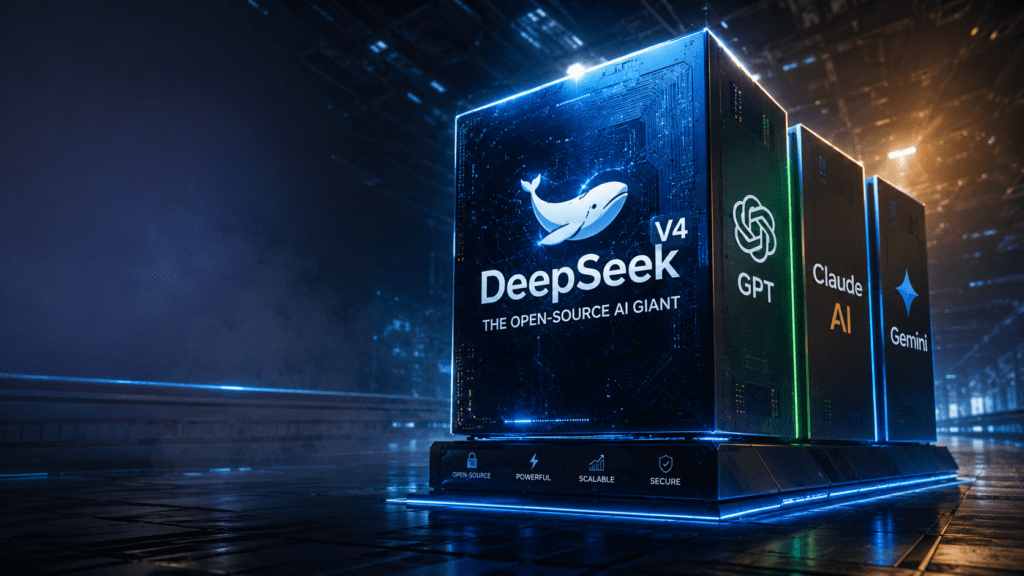
DeepSeek V4 is not merely another large language model update. It represents a broader shift in how AI systems are being built, deployed, and distributed. Featuring a trillion-scale mixture-of-experts architecture, an enormous context window, highly competitive coding performance, and open-weight availability, V4 has quickly become one of the most discussed AI releases of 2026.
For developers, researchers, startups, and enterprises, the key question is no longer whether DeepSeek is relevant.
The question is whether DeepSeek V4 has become a legitimate alternative to premium closed-source models from OpenAI, Anthropic, Google, and other AI leaders.
The answer requires looking beyond headlines and benchmark charts.
What Is DeepSeek V4?
DeepSeek V4 is the fourth major generation of large language models released by the Chinese AI company DeepSeek.
Released in preview form in April 2026, the model family includes two primary variants:
| Model | Parameters | Active Parameters | Primary Purpose |
|---|---|---|---|
| DeepSeek V4 Pro | 1.6 trillion | 49 billion | Advanced reasoning, coding, enterprise workloads |
| DeepSeek V4 Flash | 284 billion | 13 billion | Fast inference and cost-efficient deployment |
Both models support context windows reaching 1 million tokens, placing them among the largest context-capable AI systems currently available.
The release immediately attracted attention because it combines:
- Open-weight availability
- Frontier-level coding performance
- Massive context handling
- Competitive reasoning capabilities
- Extremely aggressive pricing
- Efficient deployment architecture
Together, these characteristics make DeepSeek V4 one of the strongest open AI ecosystems currently available.
Understanding the Mixture-of-Experts Architecture
One of the most misunderstood aspects of DeepSeek V4 is its parameter count.
People often hear:
“DeepSeek V4 has 1.6 trillion parameters.”
They assume every parameter is used for every prompt.
That isn’t how the system works.
DeepSeek V4 uses a Mixture-of-Experts (MoE) architecture. Rather than activating the entire model during inference, only a subset of specialized expert networks participate in generating each response.
Why This Matters
Traditional dense models:
- Activate every parameter
- Require enormous computational resources
- Become increasingly expensive at scale
MoE models:
- Activate only relevant experts
- Reduce inference costs
- Improve scalability
- Increase efficiency
For example:
- V4 Pro contains roughly 1.6 trillion parameters
- Only around 49 billion are active during a given query
This creates a system that behaves like a trillion-parameter model while operating closer to a much smaller model computationally.
The 1 Million Token Context Window Explained
One of DeepSeek V4’s most important innovations is its massive context capability.
Most users underestimate how transformative context size can be.
What Is a Context Window?
The context window determines how much information the AI can process at one time.
Examples:
| Context Size | Approximate Content |
|---|---|
| 8K | Short report |
| 128K | Several books |
| 1M | Entire codebases, research archives, legal libraries |
DeepSeek V4 supports approximately 1 million tokens, allowing users to load enormous quantities of information into a single session.
This creates new possibilities:
- Large-scale software analysis
- Long legal document review
- Enterprise knowledge systems
- Research synthesis
- Agent workflows
- Multi-document reasoning
For organizations working with large datasets, context length often becomes a bigger bottleneck than raw intelligence.
DeepSeek V4 directly addresses that limitation.
Key Technical Innovations Behind DeepSeek V4
Advanced Sparse Attention
Traditional transformers become increasingly expensive as context grows.
DeepSeek V4 introduces improved sparse-attention approaches that selectively focus on the most relevant information rather than processing everything equally.
Benefits include:
- Faster inference
- Reduced memory consumption
- Better long-context performance
- Lower infrastructure costs
Memory-Centric Design
Research surrounding the DeepSeek V4 ecosystem highlights the company’s emphasis on memory optimization.
Techniques associated with V4 aim to preserve critical information while dramatically reducing memory overhead during inference. Some implementations reportedly reduce active cache requirements by more than 80–90% for extremely long contexts.
This matters because:
- Long contexts are expensive
- GPU memory is limited
- Enterprise deployments need efficiency
DeepSeek appears focused on solving all three problems simultaneously.
Open-Weight Accessibility
Perhaps the most disruptive characteristic of DeepSeek V4 is not technical.
It’s philosophical.
Unlike many leading frontier models, DeepSeek has continued supporting open-weight releases under permissive licensing approaches.
This allows:
- Independent research
- Fine-tuning
- Enterprise customization
- On-premise deployment
- Greater transparency
For many organizations, this flexibility is more valuable than a few benchmark points.
DeepSeek V4 Performance Benchmarks
Benchmarks never tell the entire story.
However, they provide useful indicators.
According to reported evaluations, DeepSeek V4 demonstrates highly competitive results across:
Coding
DeepSeek V4 Pro performs particularly well in software engineering benchmarks.
Reported scores include:
- SWE-Bench Verified: approximately 80.6%
- LiveCodeBench: approximately 93.5%
These results place it among the strongest coding-focused AI models available.
Reasoning
DeepSeek V4 significantly improves reasoning compared to earlier generations.
Areas showing notable gains include:
- Multi-step logic
- Tool usage
- Mathematical reasoning
- Agent workflows
- Structured problem-solving
While some flagship proprietary models still maintain advantages in certain benchmarks, the gap appears smaller than previous generations.
Long-Context Tasks
Where V4 often stands out is information retrieval and reasoning across extremely large datasets.
The model’s architecture is specifically optimized for handling long contexts efficiently.
DeepSeek V4 vs GPT, Claude, and Gemini
Quick Comparison
| Feature | DeepSeek V4 Pro | GPT Family | Claude Family | Gemini Family |
|---|---|---|---|---|
| Open Weights | Yes | No | No | No |
| Context Window | 1M | Varies | High | High |
| Coding Strength | Excellent | Excellent | Excellent | Strong |
| Enterprise Customization | High | Limited | Limited | Limited |
| Cost Efficiency | Very High | Moderate | Moderate | Moderate |
| Self Hosting | Possible | No | No | No |
The biggest distinction is not necessarily intelligence.
It’s flexibility.
Organizations that need complete control over deployment often find open-weight systems significantly more attractive.
Why Developers Are Paying Attention
DeepSeek V4 solves several practical problems developers face every day.
AI Costs
Inference costs become significant at scale.
DeepSeek’s architecture and pricing strategy aim to lower those barriers considerably.
Large Codebases
Many AI systems struggle with massive repositories.
A million-token context window allows developers to analyze entire projects rather than isolated files.
Vendor Lock-In
Closed ecosystems can create long-term dependency.
Open-weight alternatives reduce that risk.
Practical Use Cases
Software Development
Teams can use DeepSeek V4 for:
- Code generation
- Refactoring
- Bug analysis
- Documentation creation
- Architecture reviews
Enterprise Knowledge Management
Organizations can:
- Upload internal documentation
- Create searchable AI assistants
- Build company-specific copilots
- Reduce knowledge silos
Research
Researchers benefit from:
- Long paper analysis
- Literature reviews
- Citation extraction
- Multi-source synthesis
Legal and Compliance
Large context windows make DeepSeek V4 attractive for:
- Contract review
- Regulatory analysis
- Policy comparison
- Due diligence
Common Misconceptions About DeepSeek V4
Bigger Parameter Count Automatically Means Better AI
Not necessarily.
Architecture, training quality, data, and alignment often matter more than raw size.
Open Models Are Always Inferior
That may have been true several years ago.
The gap between leading open models and proprietary systems has narrowed dramatically.
Long Context Solves Everything
Large context windows help, but they do not automatically improve reasoning quality.
Effective retrieval and attention mechanisms remain crucial.
Challenges and Limitations
No model is perfect.
DeepSeek V4 still faces several challenges.
Infrastructure Requirements
Even with MoE efficiency, trillion-scale systems remain demanding.
Running them at enterprise scale requires significant resources.
Regulatory Concerns
DeepSeek operates within an increasingly complex geopolitical environment.
The company has been referenced in broader discussions involving technology controls, export restrictions, and national-security debates.
Organizations evaluating deployment options should consider compliance and governance requirements.
Ecosystem Maturity
Open models continue improving rapidly, but some proprietary ecosystems still offer:
- More mature tooling
- Broader integrations
- Enterprise support networks
Expert Analysis: Why DeepSeek V4 Matters Beyond Benchmarks
The most significant aspect of DeepSeek V4 may not be its benchmark scores.
It may be what the model represents.
For years, many observers assumed frontier AI would become increasingly centralized around a handful of corporations.
DeepSeek V4 challenges that assumption.
Its emergence suggests that:
- Open-weight models can remain competitive.
- Architectural innovation can offset compute disadvantages.
- AI development is becoming more globally distributed.
- Cost efficiency is becoming a competitive weapon.
That shift could influence AI adoption as much as any technical breakthrough.
The history of technology repeatedly shows that accessibility often wins.
Not immediately.
But eventually.
Best Practices for Using DeepSeek V4
Choose V4 Flash When:
Speed matters
Cost matters
High-volume workloads exist
Real-time applications are required
Choose V4 Pro When:
Advanced coding is needed
Complex reasoning is required
Agent workflows are being built
Enterprise-scale analysis is involved
Deployment Checklist
- Define workload requirements
- Estimate token consumption
- Evaluate context needs
- Consider hosting strategy
- Assess compliance obligations
- Benchmark against existing models
- Monitor latency and costs
The Future of DeepSeek
DeepSeek’s influence continues expanding.
Recent reports indicate growing enterprise interest, major funding activity, and broader industry attention toward the company’s AI strategy.
Whether DeepSeek ultimately surpasses proprietary competitors remains uncertain.
What appears increasingly clear is that the company has secured a place among the most important AI developers shaping the industry’s future.
Final Thoughts
DeepSeek V4 arrives at a pivotal moment for artificial intelligence.
The model combines enormous scale, open-weight accessibility, impressive coding performance, million-token context handling, and highly competitive economics into a package that forces the industry to pay attention.
For developers, it offers flexibility.
For researchers, it offers transparency.
For enterprises, it offers an alternative path.
And for the broader AI ecosystem, it serves as evidence that innovation is no longer confined to a small circle of technology giants.
The significance of DeepSeek V4 isn’t simply that it is powerful.
It’s that it expands the number of organizations capable of building powerful AI systems themselves.
Frequently Asked Questions (FAQ)
What is DeepSeek V4?
DeepSeek V4 is a large language model family released by DeepSeek in 2026, featuring trillion-scale mixture-of-experts architecture, open-weight availability, and support for up to 1 million tokens of context.
When was DeepSeek V4 released?
DeepSeek introduced preview versions of V4, including V4 Pro and V4 Flash, in April 2026.
How many parameters does DeepSeek V4 have?
V4 Pro reportedly contains approximately 1.6 trillion parameters with around 49 billion active during inference, while V4 Flash contains approximately 284 billion parameters with 13 billion active.
Is DeepSeek V4 open source?
DeepSeek V4 is available as an open-weight model under a permissive licensing approach, making it more accessible than many proprietary competitors.
What is DeepSeek V4 best at?
The model is particularly strong in coding, long-context analysis, reasoning, software engineering workflows, and enterprise AI applications.
How large is DeepSeek V4’s context window?
DeepSeek V4 supports context windows up to 1 million tokens.
Is DeepSeek V4 better than GPT or Claude?
The answer depends on the task. DeepSeek V4 is highly competitive in coding, long-context processing, and open-weight deployment, while some proprietary models may still lead in specific reasoning and ecosystem capabilities.
Can businesses deploy DeepSeek V4 privately?
Yes. One of DeepSeek V4’s major advantages is the ability for organizations to customize and deploy the model in private environments.
Why is DeepSeek V4 considered disruptive?
Its combination of frontier-level performance, open-weight availability, long context handling, and aggressive pricing challenges assumptions about how advanced AI models must be built and distributed.
Will DeepSeek V4 influence the future of AI?
Many analysts believe DeepSeek V4 signals a broader trend toward efficient, open, and globally competitive AI development, making it one of the most influential model releases of 2026.