 By
By
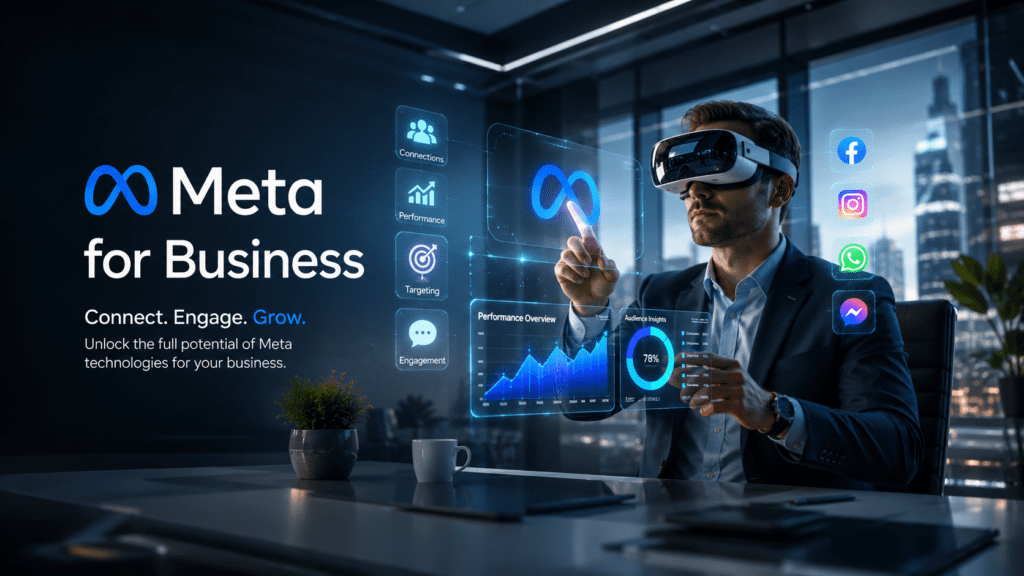
Meta for Business Explained: Tools, Benefits, Strategies, and Best Practices for Modern Marketing
Introduction
Few companies have shaped digital marketing as profoundly as Meta for Business.
What began as advertising opportunities on Facebook has evolved into a sophisticated ecosystem that helps businesses reach customers across multiple platforms, including Facebook, Instagram, Messenger, and WhatsApp Business.
For entrepreneurs, small business owners, marketing teams, and global enterprises, Meta for Business has become one of the most powerful customer acquisition and engagement platforms available.
Yet despite its popularity, many businesses struggle to understand how the ecosystem actually works. Questions frequently arise:
- What exactly is Meta for Business?
- How does Business Manager differ from Ads Manager?
- Is Meta advertising still effective?
- Which tools should small businesses use first?
- How can brands improve ROI on Meta platforms?
The confusion is understandable. Meta’s business ecosystem contains dozens of tools, dashboards, automation features, analytics systems, and advertising options.
The businesses that understand how these pieces connect often gain a significant competitive advantage. They build stronger brand awareness, generate more qualified leads, increase online sales, and create deeper relationships with customers.
This guide provides a comprehensive breakdown of Meta for Business, including its core features, strategic value, practical applications, and proven best practices for achieving measurable growth.
What Is Meta for Business?
Meta for Business is the business-focused platform developed by Meta that allows organizations to market, advertise, sell, communicate, and analyze performance across Meta-owned properties.
Rather than operating individual accounts separately, businesses can manage assets through a centralized ecosystem.
Key components include:
- Facebook Pages
- Instagram Business Accounts
- Meta Ads Manager
- Meta Business Manager
- Commerce Manager
- Meta Pixel
- Audience Insights
- Messenger Business Tools
- WhatsApp Business Solutions
- Creator Collaboration Tools
In simple terms, Meta for Business serves as the command center for digital marketing activities across Meta’s platforms.
Why Meta for Business Matters in Modern Marketing
Consumer attention is fragmented.
People move between social platforms, messaging apps, video content, shopping experiences, and online communities throughout the day.
Meta’s ecosystem allows businesses to reach users during multiple stages of the customer journey:
| Customer Stage | Meta Tool |
|---|---|
| Awareness | Facebook Ads, Instagram Ads |
| Interest | Video Content, Stories |
| Consideration | Retargeting Campaigns |
| Purchase | Shops and Commerce Features |
| Retention | Messenger and WhatsApp |
| Advocacy | Community Building and User-Generated Content |
This integrated approach reduces marketing friction and creates a more consistent customer experience.
The Core Components of Meta for Business
1. Meta Business Manager
Meta Business Manager acts as the central hub for managing business assets.
It enables companies to:
- Manage multiple Pages
- Control ad accounts
- Assign team permissions
- Secure business assets
- Collaborate with agencies
- Organize campaigns
For growing businesses, Business Manager becomes essential because it separates personal accounts from business operations.
Key Benefits
- Better security
- Team collaboration
- Asset ownership control
- Multi-account management
- Agency access management
2. Meta Ads Manager
Ads Manager is the platform used to create, launch, monitor, and optimize advertising campaigns.
This is where marketers:
- Build campaigns
- Define objectives
- Select audiences
- Set budgets
- Analyze performance
Common campaign objectives include:
- Brand Awareness
- Traffic
- Engagement
- Leads
- App Installs
- Sales
- Conversions
Ads Manager remains one of the most sophisticated advertising platforms available to businesses of all sizes.
3. Facebook Business Pages
A Facebook Business Page functions as a company’s public presence on Facebook.
Businesses use Pages to:
- Share updates
- Publish content
- Engage customers
- Run advertisements
- Collect reviews
- Build communities
For local businesses, Pages often serve as a digital storefront.
4. Instagram Business Accounts
Instagram has evolved far beyond photo sharing.
Business accounts gain access to:
- Insights
- Advertising tools
- Contact buttons
- Shopping features
- Professional dashboards
Brands in industries such as fashion, travel, fitness, food, and beauty often find Instagram particularly effective for visual storytelling.
5. Meta Pixel
Meta Pixel is a tracking technology installed on websites.
Its purpose is to measure user behavior and improve advertising performance.
Pixel tracks actions such as:
- Page views
- Product views
- Add-to-cart actions
- Purchases
- Form submissions
This data allows advertisers to:
- Measure conversions
- Build custom audiences
- Improve targeting
- Optimize campaigns
Without Pixel implementation, marketers lose valuable insights into customer behavior.
6. Commerce Manager
Commerce Manager helps businesses sell products directly through Meta platforms.
Capabilities include:
- Product catalogs
- Inventory management
- Product tagging
- Shop creation
- Shopping campaigns
This creates a smoother path from product discovery to purchase.
How Meta Advertising Works
Meta’s advertising system relies heavily on machine learning and audience targeting.
The process typically follows four steps:
Step 1: Define an Objective
Examples include:
- Lead generation
- Website traffic
- Online sales
- Brand awareness
Step 2: Build an Audience
Businesses can target users based on:
- Age
- Gender
- Interests
- Location
- Behaviors
- Device usage
Advanced targeting includes:
- Custom Audiences
- Lookalike Audiences
- Retargeting Segments
Step 3: Create Ad Creative
Options include:
- Images
- Videos
- Reels
- Stories
- Carousel Ads
- Collection Ads
Step 4: Optimize Performance
Meta’s AI system automatically adjusts delivery to maximize desired outcomes.
Meta for Business Use Cases
Small Local Business
A restaurant could:
- Promote special offers
- Target nearby customers
- Collect reservations
- Engage followers
Result:
Increased foot traffic and customer awareness.
E-commerce Store
An online retailer could:
- Run catalog ads
- Retarget abandoned carts
- Showcase products
- Track purchases
Result:
Higher conversion rates and improved ROAS.
B2B Company
A software company could:
- Generate leads
- Promote webinars
- Build brand authority
- Nurture prospects
Result:
More qualified sales opportunities.
Content Creator
Creators can:
- Grow audiences
- Monetize content
- Partner with brands
- Drive subscriptions
Result:
Increased revenue and audience engagement.
Expert Analysis: Why Meta Remains Dominant
Many marketers periodically question whether Meta advertising is still worth the investment.
The answer depends on strategy.
Businesses often fail because they focus on short-term sales rather than customer journeys.
The strongest-performing brands use Meta to build:
- Awareness
- Familiarity
- Trust
- Retargeting systems
- Long-term customer relationships
Meta’s greatest strength isn’t simply audience size.
Its real strength lies in the amount of behavioral data available for optimization.
When campaigns are structured correctly, businesses can identify high-intent users and guide them through the buying process with remarkable precision.
Common Mistakes Businesses Make
Running Ads Without a Strategy
Many companies launch campaigns immediately after creating an account.
Without clear objectives, performance suffers.
Better Approach
Define:
- Audience
- Goal
- Budget
- Success metrics
Before spending.
Ignoring Pixel Setup
Without tracking, optimization becomes guesswork.
Many businesses waste advertising budgets because conversion tracking is incomplete.
Weak Creative Assets
Even perfect targeting cannot save poor creative.
Common issues include:
- Generic visuals
- Weak headlines
- No value proposition
- Lack of social proof
Overly Broad Targeting
Broad audiences often create wasted spend.
Successful advertisers balance audience size with relevance.
Neglecting Retargeting
Most visitors do not convert immediately.
Retargeting helps recover potential customers who showed interest but did not complete a purchase.
Best Practices for Success With Meta for Business
Focus on Customer Intent
Understand:
- What users want
- What problems they face
- What motivates decisions
Campaigns perform better when they solve real customer needs.
Invest in Video Content
Video consistently generates strong engagement.
Effective formats include:
- Reels
- Product demonstrations
- Customer testimonials
- Behind-the-scenes content
Test Continuously
Top marketers rarely rely on assumptions.
They test:
- Headlines
- Images
- Videos
- Audiences
- Calls-to-action
Small improvements can create significant performance gains.
Build First-Party Data
Growing privacy regulations make owned data increasingly valuable.
Focus on:
- Email subscribers
- Customer lists
- Loyalty programs
- Lead generation campaigns
Monitor Key Metrics
Track:
- Cost Per Click (CPC)
- Cost Per Acquisition (CPA)
- Return on Ad Spend (ROAS)
- Click-Through Rate (CTR)
- Conversion Rate
Data-driven decisions outperform intuition.
Meta for Business Tools Comparison
| Tool | Primary Purpose | Best For |
| Business Manager | Asset Management | Teams and Agencies |
| Ads Manager | Advertising | Campaign Creation |
| Commerce Manager | Product Sales | E-commerce Brands |
| Meta Pixel | Tracking | Conversion Optimization |
| Facebook Pages | Community Building | Brand Presence |
| Instagram Business | Visual Marketing | Consumer Brands |
| Messenger Tools | Customer Service | Engagement |
| WhatsApp Business | Direct Communication | Lead Nurturing |
Meta for Business Checklist
Before launching campaigns, ensure:
Account Setup
Business Manager created
Ad account configured
Team permissions assigned
Security settings enabled
Tracking Setup
Pixel installed
Events configured
Conversion tracking verified
Campaign Preparation
Clear objectives defined
Audience researched
Creative assets prepared
Budget established
Optimization
A/B testing enabled
Reporting dashboard reviewed
Retargeting campaigns configured
The Future of Meta for Business
Meta continues investing heavily in:
- Artificial Intelligence
- Automation
- Conversational Commerce
- Messaging Platforms
- Augmented Reality
- Virtual Experiences
Businesses that adapt early often gain advantages in advertising efficiency and customer engagement.
The trend is clear: marketing is becoming increasingly personalized, automated, and data-driven.
Meta’s ecosystem is positioning itself at the center of that transformation.
Frequently Asked Questions
What is Meta for Business used for?
Meta for Business helps organizations manage marketing, advertising, customer communication, analytics, and sales activities across Facebook, Instagram, Messenger, and WhatsApp.
Is Meta for Business free?
Creating a Meta for Business account is free. Businesses only pay when running advertisements or using certain premium services.
What is the difference between Meta Business Manager and Ads Manager?
Business Manager organizes business assets and permissions, while Ads Manager is specifically designed for creating and managing advertising campaigns.
Can small businesses benefit from Meta for Business?
Yes. Small businesses often use Meta for Business to increase local visibility, generate leads, and attract customers with relatively modest budgets.
What is Meta Pixel?
Meta Pixel is a tracking tool that measures website activity and helps improve advertising performance through conversion tracking and audience creation.
Does Meta for Business include Instagram?
Yes. Instagram Business Accounts can be managed within the Meta ecosystem alongside Facebook assets.
How much should a business spend on Meta ads?
Budgets vary by industry, competition, and objectives. Many small businesses begin with modest daily budgets and scale based on performance data.
Is Meta advertising still effective in 2026?
For many industries, Meta remains one of the most effective digital advertising channels when campaigns are strategically planned and properly optimized.
Can Meta for Business help e-commerce stores?
Absolutely. Features such as product catalogs, retargeting, conversion tracking, and shopping integrations make it particularly valuable for online retailers.
What is the biggest mistake businesses make with Meta ads?
Launching campaigns without clear objectives, proper tracking, and strong creative assets is among the most common causes of poor performance.
Final Thoughts
Meta for Business is far more than an advertising platform. It is an interconnected ecosystem that enables organizations to build awareness, attract customers, nurture relationships, generate sales, and measure performance across multiple digital touchpoints.
Businesses that approach the platform strategically—combining audience insights, compelling creative, accurate tracking, and ongoing optimization—often discover that Meta can become one of their most profitable marketing channels.
Success rarely comes from simply running ads. It comes from understanding customer behavior, creating meaningful experiences, and using the platform’s tools to guide people through every stage of the buying journey.
For brands seeking sustainable digital growth, Meta for Business remains one of the most powerful ecosystems available.