 By
By
Google’s Quiet AI Release May Be More Important Than It Looks
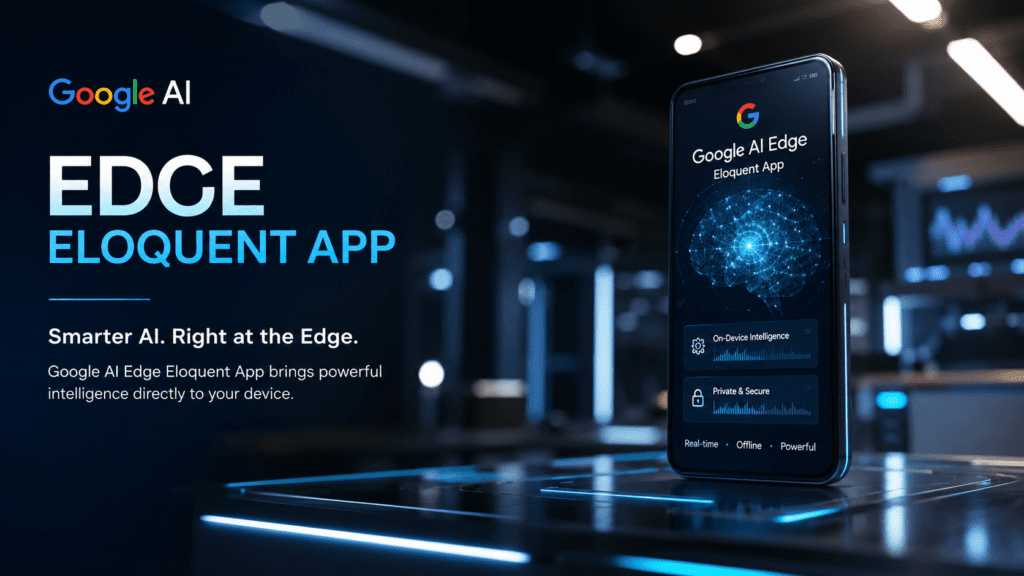
While most AI headlines focus on massive cloud-based models, multimodal assistants, and billion-dollar infrastructure investments, Google recently introduced something far more practical: Google AI Edge Eloquent.
At first glance, it appears to be another speech-to-text application. But a closer look reveals a product that tackles one of the biggest frustrations in voice dictation—turning messy human speech into polished, usable text without relying entirely on cloud processing.
The app arrived with surprisingly little fanfare. There was no major keynote announcement, no aggressive marketing campaign, and no lengthy product launch event. Yet among productivity enthusiasts, AI developers, journalists, and mobile professionals, Google AI Edge Eloquent quickly sparked discussion because of one feature that stands out in today’s AI ecosystem:
It works offline.
That single capability changes the conversation around privacy, reliability, speed, and the future of on-device artificial intelligence.
For writers, entrepreneurs, students, researchers, journalists, consultants, and anyone who thinks faster than they type, the app offers a glimpse into where personal AI may be heading.
But is Google AI Edge Eloquent genuinely revolutionary, or simply another transcription tool with a new AI label attached?
The answer lies somewhere in between—and that is exactly what makes it interesting.
Search Intent Analysis
Before evaluating the app itself, it’s important to understand why people are searching for “Google AI Edge Eloquent.”
Primary Search Intent
Users want to know:
- What Google AI Edge Eloquent is
- How it works
- Whether it is free
- Whether it works offline
- How it compares to competing AI transcription tools
Secondary Search Intent
Users also want answers to questions such as:
- Is it available on Android?
- What AI model powers it?
- Is it private and secure?
- Can it replace traditional dictation software?
- Is it useful for professional work?
Emotional Intent
Many users are tired of:
- Paying monthly subscriptions
- Uploading sensitive recordings to cloud services
- Cleaning up transcription errors manually
- Losing access when internet connectivity is poor
The attraction of AI Edge Eloquent is not simply convenience. It is the promise of privacy, speed, and ownership of personal data.
What Is Google AI Edge Eloquent?
Google AI Edge Eloquent is an AI-powered dictation and transcription application designed to transform spoken language into polished written text.
Unlike traditional speech-to-text systems that transcribe every pause, filler word, correction, and verbal stumble, Eloquent attempts to understand the speaker’s intended meaning and generate cleaner output automatically.
For example, a spoken sentence like:
“Um… I think… maybe we should move the meeting… actually Thursday works better.”
may be transformed into:
“We should move the meeting to Thursday.”
The goal is not merely transcription.
The goal is intelligent communication.
Why Google AI Edge Eloquent Matters
Most AI applications today depend heavily on cloud infrastructure.
When you speak into many popular transcription tools:
- Audio is recorded.
- Data is uploaded to remote servers.
- AI models process the speech.
- Results are returned to your device.
This process works well, but it introduces concerns around:
- Privacy
- Latency
- Connectivity
- Subscription costs
- Data security
Google AI Edge Eloquent takes a different approach.
The application relies heavily on on-device AI powered by Google’s Gemma architecture, allowing speech recognition and text refinement to occur locally on supported devices.
This represents a broader shift toward edge AI, where intelligence runs directly on the user’s hardware instead of distant servers.
Key Features of Google AI Edge Eloquent
1. Offline-First Dictation
The headline feature is offline functionality.
Once the required AI models are downloaded, users can continue dictating without an internet connection.
This is particularly valuable for:
- Travelers
- Remote workers
- Journalists in the field
- Researchers
- Students
- Professionals handling confidential information
Unlike many cloud-based alternatives, productivity does not stop when connectivity disappears.
2. Intelligent Speech Cleanup
Most dictation software records speech exactly as spoken.
Humans rarely speak in polished paragraphs.
We hesitate.
We restart.
We repeat ourselves.
We insert filler sounds.
Google AI Edge Eloquent automatically removes:
- Um
- Uh
- Ah
- False starts
- Mid-sentence corrections
The result is cleaner and more readable text.
This seemingly small improvement can save significant editing time.
3. Real-Time Transcription
The application provides live transcription while speaking.
Users can see their words appear instantly and review output as thoughts develop.
This feature is particularly useful during:
- Brainstorming sessions
- Interviews
- Meeting notes
- Content creation workflows
4. Audio and Video File Transcription
Google expanded functionality beyond live dictation.
Users can upload:
- Audio recordings
- Voice memos
- Video files
The app can transcribe and refine pre-recorded content directly on supported devices.
This capability significantly broadens the app’s usefulness.
5. Personal Vocabulary Learning
Industry terminology often confuses transcription systems.
Google addresses this through a customizable dictionary system.
Users can build personalized vocabularies and improve recognition accuracy for:
- Names
- Technical terminology
- Brand references
- Specialized jargon
Some optional features can leverage Google account information to improve vocabulary recognition while maintaining on-device processing workflows.
6. Multiple Writing Styles
The application goes beyond simple transcription.
Users can modify output into formats such as:
- Key points
- Formal writing
- Short summaries
- Expanded versions
These tools transform the app from a transcription product into a lightweight writing assistant.
The Technology Behind Google AI Edge Eloquent
The foundation of Eloquent is Google’s Gemma AI family, a collection of open-weight AI models optimized for efficient deployment.
Unlike enormous cloud models requiring datacenter-scale resources, Gemma was designed with efficiency in mind.
This allows sophisticated language processing to run on:
- Smartphones
- Tablets
- Consumer hardware
The significance cannot be overstated.
For years, AI innovation largely depended on larger models and bigger servers.
Google AI Edge Eloquent demonstrates a different path:
Making AI smaller, faster, and more personal.
Google AI Edge Eloquent vs Traditional Dictation Apps
| Feature | Google AI Edge Eloquent | Traditional Dictation Apps |
|---|---|---|
| Offline Functionality | Yes | Often Limited |
| AI Text Cleanup | Yes | Usually Minimal |
| Filler Word Removal | Automatic | Often Manual |
| On-Device Processing | Extensive | Usually Cloud-Based |
| Subscription Requirement | No major subscription requirement | Frequently Subscription-Based |
| Privacy Protection | Strong Local Processing | Depends on Vendor |
Based on currently available information, Google’s strongest competitive advantage is the combination of:
- Free access
- Offline capability
- AI-powered text refinement
- Google’s speech recognition expertise
Real-World Use Cases
Journalists
Reporters frequently conduct interviews in locations where connectivity is unreliable.
Offline transcription can dramatically streamline note-taking while improving privacy.
Students
Students can dictate:
- Lecture summaries
- Study notes
- Research ideas
- Assignment outlines
without needing continuous internet access.
Content Creators
Many creators think faster than they type.
Voice-first drafting can accelerate:
- Blog posts
- Scripts
- Podcasts
- Social media content
Business Professionals
Meeting summaries, brainstorming sessions, and client notes become easier to capture and organize.
Researchers
Field researchers often operate in environments where cloud access is impractical.
Offline transcription offers a practical solution.
Expert Analysis: Why Edge AI Is Becoming a Major Trend
Google AI Edge Eloquent is not just a productivity app.
It is a signal.
For years, the AI industry pursued increasingly massive cloud systems.
Yet users consistently encounter four challenges:
- Cost
- Latency
- Privacy concerns
- Internet dependency
Edge AI directly addresses these limitations.
The broader industry trend is becoming clear:
The future is not solely larger models in larger datacenters.
The future is also intelligent systems that operate locally on personal devices.
Google’s investment in Gemma, AI Edge technologies, and applications like Eloquent suggests the company sees significant long-term potential in this direction.
Common Misconceptions About Google AI Edge Eloquent
Myth 1: It’s Just Another Voice Recorder
False.
The app actively refines speech and restructures output rather than merely recording words.
Myth 2: Offline Means Lower Quality
Not necessarily.
Modern optimized AI models can deliver impressive performance directly on devices, especially for focused tasks such as transcription.
Myth 3: It Eliminates the Need for Editing
Not entirely.
AI refinement improves readability, but professional users should still review critical documents.
Myth 4: It’s Only Useful for Writers
Many professionals benefit from speech-to-text workflows, including:
- Lawyers
- Consultants
- Researchers
- Sales teams
- Students
- Healthcare professionals
Practical Tips for Getting Better Results
Speak Naturally
Avoid over-enunciating.
The system is designed to interpret natural speech patterns.
Use Custom Dictionaries
Add industry-specific terminology whenever possible.
Organize Long Sessions
Break extended dictation into manageable sections.
Review Important Content
Even advanced AI benefits from human oversight.
Experiment with Output Styles
Formal, concise, and key-point modes may suit different workflows better.
Advantages and Limitations
Advantages
Works offline
Free to use
Removes filler words automatically
Supports audio and video transcription
Privacy-friendly local processing
Fast performance
Useful customization features
Limitations
Currently focused on iOS availability
Some advanced functionality may still benefit from cloud integration
Accuracy varies with accents, noise levels, and terminology
Not a complete replacement for professional editing
What Google AI Edge Eloquent Means for the Future of AI
The most interesting aspect of Google AI Edge Eloquent is not dictation itself.
Speech recognition has existed for decades.
The real story is the shift toward AI systems that:
- Run locally
- Respect privacy
- Reduce cloud dependence
- Operate without subscriptions
- Remain available anywhere
As mobile processors become more powerful and AI models become more efficient, applications like Eloquent could represent the beginning of a larger transformation in personal computing.
Instead of constantly connecting to distant servers, future AI assistants may increasingly live directly on our devices.
Google AI Edge Eloquent offers one of the clearest examples of that vision becoming practical.
Frequently Asked Questions (FAQ)
What is Google AI Edge Eloquent?
Google AI Edge Eloquent is an AI-powered dictation and transcription app that converts spoken language into polished written text while supporting offline processing.
Is Google AI Edge Eloquent free?
Yes. Google currently offers the app without subscription fees or usage caps.
Does Google AI Edge Eloquent work offline?
Yes. After downloading the necessary AI models, users can perform dictation and transcription without an internet connection.
Which AI model powers the app?
The application uses Google’s Gemma-based AI architecture for speech recognition and text processing.
Can it transcribe audio files?
Yes. Users can upload audio and video files for transcription and text refinement.
Is my data sent to Google’s servers?
Core offline functionality operates locally on the device. Some optional features may use cloud-based services if enabled.
Is Google AI Edge Eloquent available on Android?
At launch, the app primarily targets iOS devices. Industry observers expect broader platform expansion, but availability may vary by region and device.
Can the app remove filler words automatically?
Yes. One of its signature features is eliminating words and sounds such as “um,” “uh,” and other speech disfluencies.
Who should use Google AI Edge Eloquent?
Writers, students, journalists, researchers, executives, content creators, and professionals who rely heavily on voice-to-text workflows can benefit from the app.
Is Google AI Edge Eloquent better than traditional dictation software?
Its offline processing, AI cleanup capabilities, privacy focus, and zero-cost model make it one of the most compelling new entrants in the AI dictation market, though the best choice depends on individual workflow needs.
Final Thoughts
Google AI Edge Eloquent may not be the flashiest AI launch of the year, but it addresses a genuine productivity challenge that millions of people encounter daily: turning spoken thoughts into polished written communication.
By combining offline AI, on-device processing, speech refinement, and practical usability, Google has created more than a transcription app. It has created a glimpse into a future where AI becomes increasingly personal, private, and available wherever users happen to be.
For professionals seeking faster workflows, stronger privacy protections, and fewer subscription costs, Google AI Edge Eloquent is one of the most intriguing AI productivity tools currently available.