 By
By
Why NVIDIA’s Physical AI Vision Matters More Than Most People Realize
Artificial intelligence has spent the past decade mastering language, images, and digital information. Large language models can write reports, generate code, summarize research, and hold surprisingly sophisticated conversations. Yet the physical world remains a far more difficult challenge.
A robot cannot simply understand words. It must understand gravity, motion, friction, timing, distance, force, and consequences. It must recognize that a dropped object falls, a door resists movement, a staircase creates risk, and a human standing nearby changes the environment entirely.
This is where NVIDIA’s concept of Physical AI enters the picture.
Physical AI represents a major shift in artificial intelligence development—from systems that understand information to systems that understand reality itself.
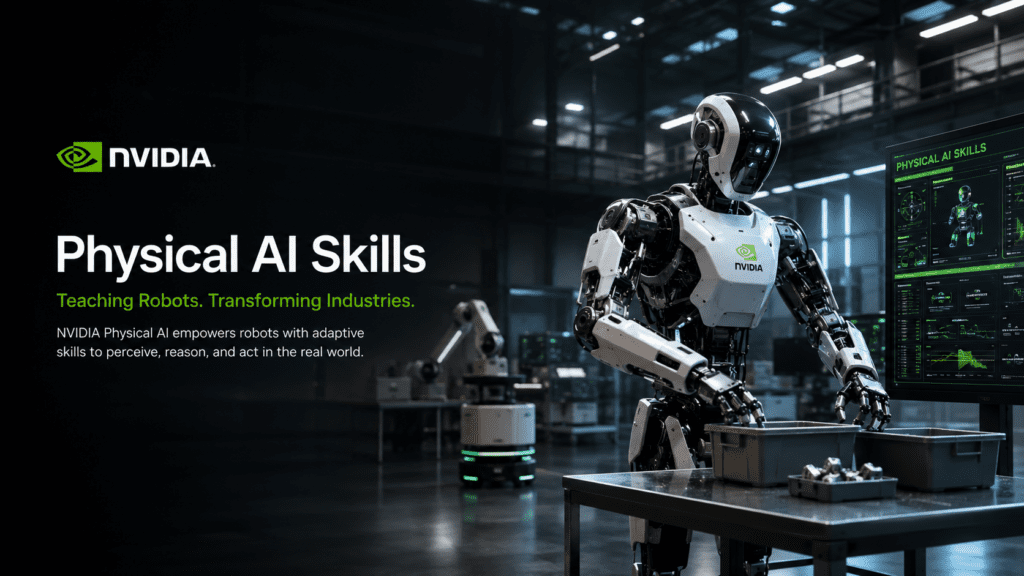
For businesses, engineers, robotics developers, manufacturers, and technology leaders, NVIDIA Physical AI skills are rapidly becoming some of the most valuable capabilities in modern computing. These skills combine advanced AI models, robotics, simulation, computer vision, digital twins, reinforcement learning, and accelerated computing to create machines capable of interacting intelligently with the physical world.
The significance extends beyond robotics laboratories.
Physical AI is expected to influence manufacturing, logistics, healthcare, automotive technology, industrial automation, smart cities, agriculture, defense systems, warehouse operations, and countless other sectors where machines must perceive, reason, and act in real environments.
Understanding NVIDIA Physical AI skills is no longer just a topic for AI researchers. It is becoming essential knowledge for anyone seeking to understand where artificial intelligence is heading next.
What Is NVIDIA Physical AI?
Physical AI refers to artificial intelligence systems designed to understand, simulate, and interact with the physical world.
Unlike traditional AI systems that operate primarily in digital environments, Physical AI must account for real-world physics and dynamic environments.
A Physical AI system can:
- Observe surroundings through sensors
- Understand spatial relationships
- Predict physical outcomes
- Plan actions
- Control movement
- Learn from interaction
- Adapt to changing environments
The goal is not merely intelligence.
The goal is embodied intelligence.
An AI model may know what a coffee mug is.
A Physical AI system understands:
- How to locate it
- How to grasp it
- How much force to apply
- How to avoid dropping it
- How to place it safely somewhere else
This distinction separates digital intelligence from physical intelligence.
NVIDIA’s Physical AI Ecosystem
NVIDIA has built one of the most comprehensive infrastructures for Physical AI development.
Rather than focusing solely on AI models, NVIDIA created an interconnected ecosystem consisting of:
| Component | Purpose |
|---|---|
| NVIDIA Omniverse | Simulation and digital twins |
| NVIDIA Isaac Platform | Robotics development |
| Cosmos Foundation Models | World modeling and synthetic data generation |
| DGX Systems | AI training infrastructure |
| Jetson Edge AI | Deployment on robots and devices |
| CUDA | Accelerated computing foundation |
| RTX GPUs | Real-time simulation and rendering |
| Isaac Sim | Physics-based robotics simulation |
Together, these technologies enable developers to train robots and autonomous systems inside virtual environments before deployment into real-world settings.
This dramatically reduces development cost, risk, and deployment time.
The Core NVIDIA Physical AI Skills
Understanding Physical AI requires understanding the skill set that powers it.
These skills represent the capabilities machines must acquire to function effectively in real-world environments.
1. Spatial Intelligence
Spatial intelligence enables machines to understand three-dimensional environments.
This includes:
- Object positioning
- Distance estimation
- Depth perception
- Navigation awareness
- Environmental mapping
A warehouse robot must understand where shelves exist, how far away they are, and how to navigate around obstacles.
Without spatial intelligence, autonomous movement becomes impossible.
Real-World Example
Modern warehouse robots can map thousands of square meters of space while continuously updating their understanding of:
- Human locations
- Inventory movement
- Temporary obstacles
- Route optimization
2. Computer Vision
Physical AI depends heavily on vision.
NVIDIA-powered systems use advanced vision models to interpret:
- People
- Objects
- Machinery
- Vehicles
- Infrastructure
- Environmental changes
Computer vision acts as the machine’s eyes.
However, Physical AI pushes vision further than simple image recognition.
Machines must understand:
- Context
- Motion
- Intent
- Relationships between objects
For example, a robot observing a person reaching toward a box must recognize not only the person and the box but also the likely future interaction.
3. World Modeling
One of the most important emerging Physical AI skills is world modeling.
World models allow AI systems to build internal representations of reality.
These models help machines answer questions such as:
- What will happen next?
- What actions are possible?
- What risks exist?
- What outcomes are likely?
Instead of reacting blindly, AI can predict consequences.
This capability resembles how humans mentally simulate future events before acting.
4. Reinforcement Learning
Physical AI systems learn through interaction.
Reinforcement learning teaches machines through rewards and penalties.
A robot may perform millions of simulated actions before discovering the most efficient behavior.
Examples include:
- Walking
- Balancing
- Grasping objects
- Vehicle navigation
- Industrial manipulation
Simulation environments provided by NVIDIA allow robots to gain years of experience in a matter of days.
5. Sensor Fusion
Physical environments generate enormous amounts of data.
Robots often rely on multiple sensors simultaneously:
- Cameras
- LiDAR
- Radar
- GPS
- Force sensors
- Temperature sensors
- Motion sensors
Sensor fusion combines these inputs into a coherent understanding of reality.
This capability improves accuracy, reliability, and safety.
6. Robotics Control Systems
Understanding an environment is only half the challenge.
A machine must also act within it.
Robotics control systems manage:
- Joint movement
- Motor coordination
- Balance
- Precision motion
- Force control
Physical AI integrates perception and action into a unified system.
This allows machines to make decisions and execute them effectively.
7. Simulation and Digital Twin Expertise
Perhaps NVIDIA’s greatest competitive advantage lies in simulation.
Training robots entirely in the real world is expensive and slow.
Digital twins solve this problem.
A digital twin is a virtual replica of a physical environment.
Developers can simulate:
- Factories
- Warehouses
- Vehicles
- Cities
- Power plants
- Industrial systems
Robots can learn safely inside these environments before entering reality.
Why Simulation Has Become the Secret Weapon of Physical AI
A self-driving vehicle cannot crash millions of times in the real world to learn.
A humanoid robot cannot spend decades learning basic movement.
Simulation changes the economics entirely.
Inside NVIDIA-powered simulation environments, AI systems can:
- Train continuously
- Experience dangerous situations safely
- Test edge cases
- Learn rare events
- Scale training massively
The result is faster development and more capable systems.
Many experts believe simulation will become as important to robotics as data became to machine learning.
NVIDIA Isaac: The Core Platform for Robotics AI
NVIDIA Isaac has emerged as one of the industry’s most important robotics development platforms.
The platform combines:
- AI training
- Simulation
- Perception systems
- Motion planning
- Deployment tools
Developers use Isaac to create:
- Autonomous mobile robots
- Industrial robots
- Humanoid robots
- Service robots
- Healthcare robots
The platform allows researchers to move from concept to deployment much faster than traditional robotics approaches.
Physical AI and Humanoid Robots
Humanoid robotics has become one of the most discussed applications of Physical AI.
Unlike specialized robots, humanoids must operate in environments designed for humans.
This creates enormous complexity.
Humanoid robots must learn:
- Walking
- Balance
- Hand-eye coordination
- Object manipulation
- Human interaction
- Environmental adaptation
Physical AI provides the intelligence layer required to manage these challenges.
Companies worldwide are now using NVIDIA platforms to accelerate humanoid development.
Industrial Applications of NVIDIA Physical AI
Manufacturing
Smart factories increasingly use AI-driven robots for:
- Quality inspection
- Material handling
- Assembly operations
- Predictive maintenance
Physical AI enables these systems to adapt rather than follow rigid programming.
Logistics and Warehousing
Warehouse automation is rapidly expanding.
Physical AI supports:
- Inventory movement
- Autonomous forklifts
- Package sorting
- Route optimization
- Demand forecasting
The ability to understand dynamic environments creates major efficiency gains.
Healthcare
Healthcare robotics is another emerging area.
Applications include:
- Surgical assistance
- Patient support
- Medical logistics
- Rehabilitation systems
Physical AI allows machines to interact safely and precisely around humans.
Agriculture
Modern farms increasingly deploy intelligent systems for:
- Crop monitoring
- Harvesting
- Irrigation management
- Pest detection
Physical AI improves decision-making in highly variable outdoor environments.
Autonomous Vehicles
Self-driving systems represent one of the most advanced forms of Physical AI.
Vehicles must continuously:
- Observe
- Predict
- Plan
- Act
NVIDIA’s automotive platforms leverage many of the same Physical AI principles found in robotics systems.
The Skills Professionals Need to Work with NVIDIA Physical AI
As demand grows, professionals need interdisciplinary expertise.
Technical Skills
- Python programming
- Machine learning
- Deep learning
- Robotics engineering
- Computer vision
- Reinforcement learning
- CUDA programming
- Sensor integration
NVIDIA-Specific Skills
- Omniverse workflows
- Isaac Sim
- Isaac Lab
- Jetson deployment
- RTX acceleration
- GPU optimization
Supporting Knowledge
- Physics simulation
- Robotics kinematics
- Motion planning
- Edge AI deployment
- Digital twin development
Professionals who combine these skills are increasingly sought after across robotics and AI industries.
Common Misconceptions About Physical AI
Myth 1: Physical AI Is Just Robotics
Robotics is only one application.
Physical AI encompasses perception, simulation, world modeling, prediction, and autonomous decision-making.
Myth 2: Large Language Models Alone Can Power Robots
Language models provide reasoning capabilities.
Physical interaction requires additional systems for perception, planning, control, and environmental understanding.
Myth 3: More Data Automatically Solves Everything
Real-world intelligence requires quality simulation, accurate world models, and sophisticated training environments.
Data alone is insufficient.
Myth 4: Physical AI Is Decades Away
Many Physical AI applications already operate commercially in warehouses, factories, logistics networks, and industrial facilities.
The technology is advancing much faster than many observers realize.
How to Start Learning NVIDIA Physical AI
For newcomers, the field can appear overwhelming.
A structured path helps.
Step 1: Learn AI Fundamentals
Focus on:
- Neural networks
- Deep learning
- Machine learning
- Computer vision
Step 2: Build Programming Expertise
Python remains the dominant language for AI and robotics development.
Step 3: Study Robotics Fundamentals
Learn:
- Sensors
- Actuators
- Kinematics
- Control systems
Step 4: Explore NVIDIA Tools
Gain hands-on experience with:
- Omniverse
- Isaac Sim
- Jetson
- CUDA
Step 5: Practice in Simulation
Simulation offers a safe and scalable environment for experimentation.
Many successful robotics engineers spend significant time developing virtual systems before deploying physical hardware.
The Future of NVIDIA Physical AI
The next phase of artificial intelligence will not be defined solely by better chatbots or larger language models.
The real transformation will occur when AI gains the ability to understand and operate within the physical world.
NVIDIA is positioning itself at the center of that transition.
By combining accelerated computing, simulation, robotics platforms, digital twins, and world models, the company is building infrastructure that could become foundational to future autonomous systems.
As Physical AI matures, we are likely to see:
- More capable humanoid robots
- Smarter industrial automation
- Advanced autonomous vehicles
- Intelligent healthcare assistants
- Fully digitalized factories
- AI-powered logistics networks
The organizations that understand these technologies early will be better positioned to capitalize on the next wave of automation and machine intelligence.
Frequently Asked Questions (FAQ)
What are NVIDIA Physical AI skills?
NVIDIA Physical AI skills are the capabilities required to develop AI systems that understand and interact with the physical world, including computer vision, robotics, simulation, world modeling, reinforcement learning, sensor fusion, and autonomous control.
How is Physical AI different from traditional AI?
Traditional AI primarily processes digital information such as text, images, and data. Physical AI combines perception, reasoning, and action to operate within real-world environments.
What is NVIDIA Isaac?
NVIDIA Isaac is a robotics development platform that provides tools for simulation, AI training, perception, motion planning, and deployment of autonomous machines.
Why are digital twins important for Physical AI?
Digital twins allow developers to create virtual replicas of real environments where AI systems can train safely, efficiently, and at scale before real-world deployment.
What industries use NVIDIA Physical AI?
Manufacturing, logistics, healthcare, agriculture, autonomous vehicles, smart infrastructure, retail automation, and robotics are among the primary industries adopting Physical AI technologies.
Do I need robotics experience to learn Physical AI?
Not necessarily. Many professionals begin with machine learning, computer vision, or software development before expanding into robotics and simulation technologies.
Is Physical AI connected to humanoid robots?
Yes. Humanoid robots are one of the most prominent applications of Physical AI because they require sophisticated perception, reasoning, movement, and environmental adaptation.
Which programming language is most useful for Physical AI?
Python is the most widely used language for AI and robotics development, though knowledge of C++, CUDA, and GPU programming can provide significant advantages.
Can Physical AI work without simulation?
It can, but development becomes slower, more expensive, and riskier. Simulation dramatically accelerates training and testing.
What makes NVIDIA a leader in Physical AI?
NVIDIA combines powerful GPUs, AI frameworks, simulation platforms, digital twins, robotics tools, and accelerated computing infrastructure into a unified ecosystem that supports end-to-end Physical AI development.