 By
By
Inside the Custom C-Based System Designed to Challenge Conventional AI Infrastructure
Artificial intelligence development has entered a phase where raw computing power is no longer the only competitive advantage. The companies leading the race are increasingly defined by how efficiently they can move data, orchestrate hardware, eliminate software bottlenecks, and scale training workloads across thousands—or even hundreds of thousands—of accelerators.
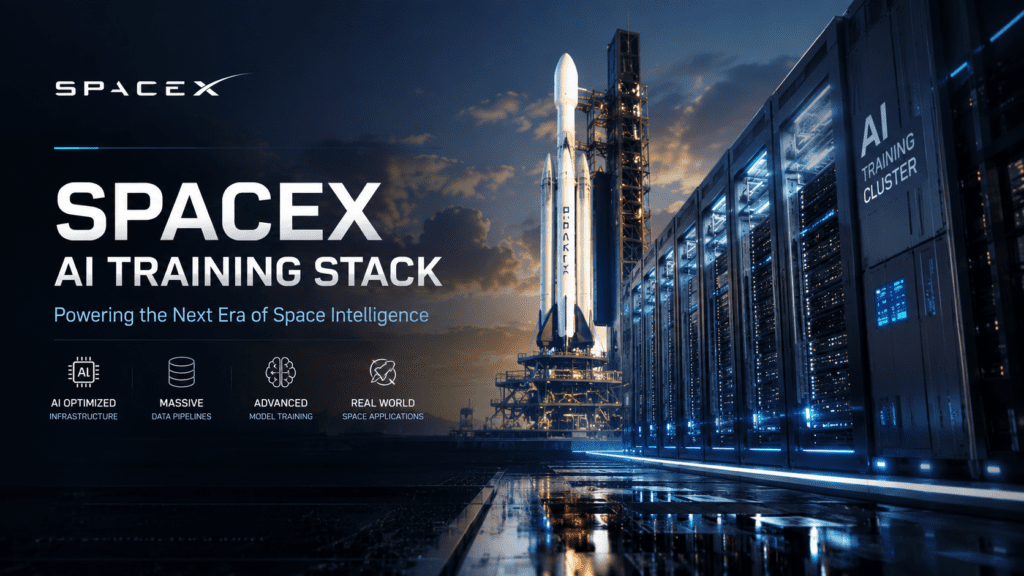
That reality helps explain why reports surrounding the newly revealed SpaceX AI Training Stack have attracted so much attention across the AI industry.
According to statements attributed to Elon Musk and individuals familiar with the project, SpaceX has been building a highly optimized AI training infrastructure engineered almost entirely in C, with a focus on reducing software overhead and maximizing hardware utilization. The initiative reportedly represents a major step toward vertical integration, where everything from networking and orchestration to distributed training is controlled by a tightly engineered software layer.
For AI researchers, infrastructure architects, cloud providers, and technology investors, the implications are significant.
If successful, this approach could challenge some of the assumptions that have guided large-scale AI development for years.
The question is not simply whether the SpaceX AI Training Stack is faster.
The more interesting question is whether radically simplifying the software stack can unlock an entirely different level of efficiency for training next-generation AI models.
Understanding the SpaceX AI Training Stack
At its core, the SpaceX AI Training Stack is believed to be a custom-built software ecosystem designed to support massive distributed AI workloads while minimizing the layers of abstraction commonly found in modern machine learning infrastructure.
Most AI training environments rely on a combination of:
- Operating systems
- Container orchestration systems
- Networking frameworks
- Communication libraries
- Distributed schedulers
- Machine learning frameworks
- Hardware drivers
Each layer introduces flexibility and convenience.
Each layer also introduces overhead.
The SpaceX approach appears to target those inefficiencies directly.
Rather than relying heavily on generalized software designed for broad compatibility, the stack is reportedly engineered specifically for the hardware and workloads it supports.
This philosophy mirrors the engineering culture that helped SpaceX revolutionize rocket development.
Instead of purchasing complex third-party systems and adapting around them, the company often builds specialized solutions optimized for specific mission requirements.
The same philosophy now appears to be extending into artificial intelligence.
Why AI Training Infrastructure Has Become a Competitive Battleground
Training frontier AI models is no longer merely a software challenge.
It has become an infrastructure challenge.
Modern large language models can require:
| Resource Area | Scale Required |
|---|---|
| GPUs | Tens of thousands |
| Networking | Multi-terabit bandwidth |
| Storage | Petabytes of data |
| Memory Movement | Massive distributed synchronization |
| Power Consumption | Hundreds of megawatts |
As model sizes grow, communication overhead becomes increasingly problematic.
A surprising amount of training time is often spent waiting for:
- Gradient synchronization
- Network communication
- Data transfers
- Resource scheduling
- Memory coordination
In many large-scale clusters, GPUs are not fully utilized because software inefficiencies prevent them from remaining continuously occupied.
Even a small improvement in utilization can generate enormous cost savings.
A 5% efficiency gain across tens of thousands of GPUs can translate into millions of dollars in reduced training costs.
This economic reality explains why companies are aggressively pursuing infrastructure innovation.
The Significance of a C-Based AI Stack
One of the most discussed aspects of the SpaceX AI Training Stack is the reported decision to build Version 1.0 entirely in C.
That choice stands out in an era dominated by higher-level languages and frameworks.
Most AI systems today rely heavily on:
- Python
- CUDA libraries
- Distributed frameworks
- Containerized services
- Abstraction layers
Python remains popular because it accelerates development.
However, convenience often comes with performance trade-offs.
C offers several advantages:
Direct Hardware Access
Developers can interact with hardware at a much lower level.
This allows finer control over:
- Memory allocation
- CPU scheduling
- Networking operations
- Resource management
Reduced Runtime Overhead
Higher-level languages frequently introduce:
- Garbage collection
- Runtime environments
- Interpreter costs
A C-based implementation eliminates many of these factors.
Predictable Performance
Large distributed systems benefit from deterministic behavior.
Reducing abstraction layers can improve consistency and reduce unexpected performance bottlenecks.
Greater Optimization Opportunities
Engineers can optimize critical paths with extraordinary precision.
This becomes increasingly valuable when workloads involve thousands of interconnected processors.
Vertical Integration: The Real Strategic Goal
The AI industry often focuses on GPUs, but hardware alone rarely determines success.
The most valuable advantage frequently comes from controlling the entire technology stack.
SpaceX appears to be pursuing a model similar to what Apple achieved in consumer electronics.
Apple controls:
- Silicon
- Operating systems
- Software frameworks
- Device design
This vertical integration allows optimization across every layer.
A similar strategy in AI could enable SpaceX and Elon Musk’s broader ecosystem to optimize:
- Data pipelines
- Networking architecture
- Training frameworks
- Scheduling systems
- Hardware utilization
When every layer is designed together, performance improvements compound.
The cumulative effect can be far greater than improving any single component in isolation.
How the SpaceX AI Training Stack Could Reduce Bottlenecks
One of the largest challenges in distributed AI training is coordination.
Thousands of GPUs must continuously exchange information.
Even minor inefficiencies multiply rapidly.
Potential areas where the SpaceX stack may improve performance include:
Network Communication
Large AI clusters constantly exchange gradients and model updates.
Reducing latency can significantly accelerate training.
Memory Management
Moving data efficiently between storage, memory, and accelerators is essential.
Custom memory strategies can improve throughput dramatically.
Resource Scheduling
Intelligent workload distribution prevents idle hardware.
Higher utilization directly reduces training costs.
Failure Recovery
Large clusters experience hardware failures regularly.
Custom recovery mechanisms can improve resilience while minimizing downtime.
Synchronization Overhead
Distributed training often slows because systems wait for slower nodes.
Optimized synchronization techniques can improve scaling efficiency.
Comparing Traditional AI Infrastructure vs SpaceX’s Approach
| Category | Traditional AI Stack | SpaceX AI Training Stack |
| Architecture | Layered | Highly integrated |
| Language Focus | Python-centric | C-centric |
| Optimization | General purpose | Hardware-specific |
| Flexibility | High | Potentially lower |
| Efficiency | Moderate | Potentially much higher |
| Development Speed | Faster initially | Longer upfront investment |
| Scaling Focus | Broad compatibility | Maximum performance |
This comparison highlights a critical trade-off.
General-purpose systems offer flexibility.
Custom systems often deliver superior efficiency.
SpaceX appears willing to sacrifice convenience to maximize performance.
What This Means for xAI and Future AI Models
The SpaceX AI Training Stack is particularly relevant because of its connection to Elon Musk’s AI ambitions through xAI.
Training frontier AI systems requires unprecedented infrastructure.
As models become larger, the costs associated with inefficiency grow exponentially.
If SpaceX successfully develops a highly optimized training platform, xAI could benefit through:
- Faster model development
- Lower training costs
- Improved scaling efficiency
- Better hardware utilization
- Reduced infrastructure complexity
These advantages could become increasingly important as competition intensifies among major AI laboratories.
The Industry Trend Toward Infrastructure Specialization
SpaceX is not alone in pursuing infrastructure innovation.
Across the industry, major organizations are increasingly developing custom solutions.
Examples include:
- Google designing proprietary TPUs
- Amazon creating Trainium accelerators
- Microsoft investing in custom AI hardware
- Meta building specialized AI infrastructure
- OpenAI optimizing large-scale training environments
The common theme is clear.
Competitive advantages increasingly emerge from infrastructure engineering rather than model architecture alone.
The era when raw GPU purchases determined success is ending.
The next phase is about extracting maximum value from every computational resource.
Expert Analysis: Why This Could Be More Important Than a New AI Model
Many technology headlines focus on model releases.
Infrastructure rarely receives the same attention.
Yet history suggests infrastructure breakthroughs often have longer-lasting effects than individual software products.
Consider:
- The internet’s backbone technologies
- Cloud computing infrastructure
- Modern semiconductor manufacturing
- High-speed networking
These innovations enabled entire ecosystems rather than single applications.
The SpaceX AI Training Stack has the potential to fit into this category.
If the reported efficiency gains are substantial, the technology could influence how future AI systems are designed, deployed, and scaled.
That impact could extend far beyond any single company.
Common Misconceptions About the SpaceX AI Training Stack
Misconception 1: It Is Just Another AI Framework
The stack appears to be much broader than a training framework.
It represents an infrastructure-level redesign.
Misconception 2: Writing Everything in C Automatically Makes It Faster
Language choice alone does not guarantee performance.
The architecture and implementation quality matter far more.
Misconception 3: This Replaces GPUs
The stack complements accelerators rather than replacing them.
Its purpose is to maximize hardware efficiency.
Misconception 4: Only SpaceX Can Benefit From These Ideas
Many optimization principles could influence future industry practices even if the exact software remains proprietary.
Misconception 5: Infrastructure Is Less Important Than AI Models
In large-scale AI development, infrastructure increasingly determines what models can realistically be trained.
Practical Lessons for AI Engineers and Infrastructure Teams
Organizations may not have SpaceX-level resources, but several principles remain valuable.
Minimize Unnecessary Abstractions
Every software layer introduces potential overhead.
Evaluate whether complexity delivers meaningful value.
Measure Utilization Carefully
Idle hardware is expensive.
Continuous monitoring often reveals hidden inefficiencies.
Optimize Data Movement
Data transfer bottlenecks frequently limit performance more than raw compute capacity.
Design for Scale Early
Systems that perform well at small scales often behave differently at cluster scale.
Treat Infrastructure as a Product
Infrastructure should receive the same engineering attention as customer-facing software.
Potential Risks and Challenges
Despite its promise, the approach is not without risks.
Development Complexity
Custom infrastructure requires significant engineering resources.
Maintenance Burden
Highly specialized systems can be harder to update and maintain.
Talent Requirements
Few engineers possess expertise across low-level systems, networking, and AI training.
Ecosystem Compatibility
Proprietary solutions may integrate less easily with external tools.
Rapid Industry Evolution
AI technologies evolve quickly, making long-term infrastructure bets challenging.
These factors help explain why relatively few organizations pursue such aggressive vertical integration.
The Bigger Picture: AI’s Infrastructure Arms Race
The emergence of the SpaceX AI Training Stack reflects a broader shift in the artificial intelligence industry.
The competition is no longer solely about algorithms.
It is about:
- Data
- Compute
- Networking
- Energy
- Software efficiency
- Vertical integration
Organizations capable of optimizing across all these dimensions may hold significant advantages in the coming decade.
As AI systems continue growing in complexity, infrastructure innovation could become the defining factor separating industry leaders from followers.
The companies that build the most efficient training environments may ultimately gain the ability to train larger models, iterate faster, and deploy new capabilities at lower cost.
In that context, the SpaceX AI Training Stack is more than a software project.
It represents a glimpse into the future architecture of large-scale artificial intelligence.
Frequently Asked Questions
What is the SpaceX AI Training Stack?
The SpaceX AI Training Stack is a reportedly custom-built infrastructure platform designed to optimize large-scale AI training through low-level software engineering, hardware-specific optimization, and reduced system overhead.
Why is SpaceX building an AI training stack?
The goal appears to be maximizing training efficiency, reducing bottlenecks, improving hardware utilization, and supporting large-scale AI initiatives connected to Elon Musk’s broader technology ecosystem.
Why is the stack reportedly written in C?
C offers low-level hardware access, reduced runtime overhead, predictable performance, and greater optimization opportunities compared with many higher-level programming languages.
How could the stack benefit AI development?
Potential benefits include faster training, lower infrastructure costs, better scaling efficiency, improved reliability, and increased GPU utilization.
Is this related to xAI?
Industry observers believe the technology could support xAI’s growing demand for large-scale model training infrastructure.
Does this replace AI frameworks like PyTorch?
Not necessarily. It may operate beneath existing frameworks or integrate with them while optimizing lower-level infrastructure components.
What makes this approach different?
The emphasis on vertical integration, hardware-specific optimization, and minimizing abstraction layers distinguishes it from many conventional AI training environments.
Could other companies adopt similar strategies?
Yes. The broader industry trend increasingly favors custom infrastructure, specialized hardware, and tightly integrated AI ecosystems.
Is there proof of major performance gains yet?
Publicly available technical benchmarks remain limited. Much of the discussion currently relies on reported statements and industry analysis rather than independently verified performance data.
Why are AI infrastructure innovations becoming so important?
As models grow larger, infrastructure efficiency directly impacts cost, speed, scalability, and competitiveness, making it one of the most critical factors in modern AI development.