 By
By
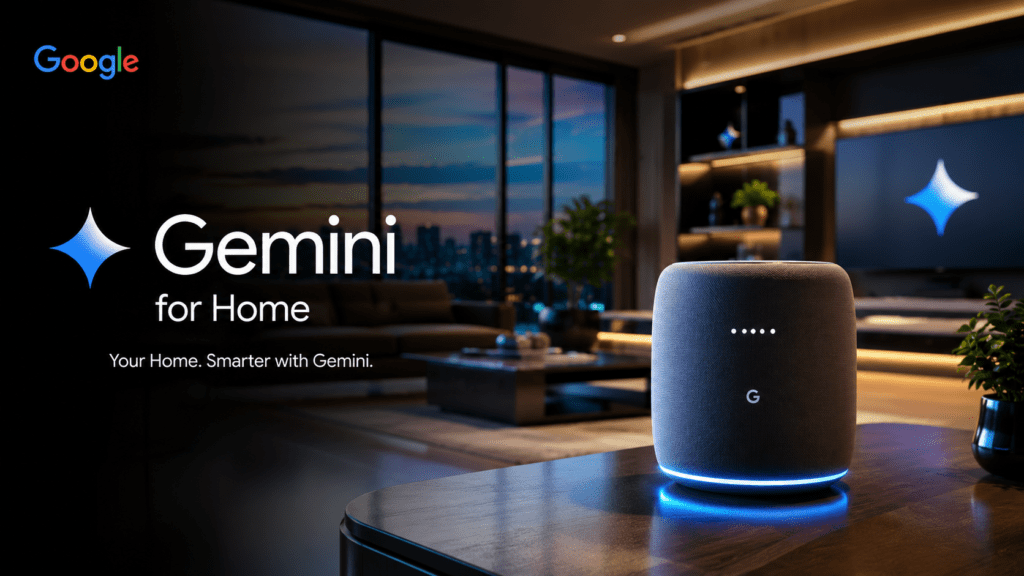
Google Gemini for Home Is Redefining What a Smart Home Can Do
For years, smart home technology promised convenience. Lights could turn on automatically. Thermostats could adjust themselves. Security cameras could send alerts when motion was detected.
The reality, however, often felt far less intelligent than the marketing suggested.
Most smart home systems have operated on rigid rules:
- If motion is detected, turn on a light.
- If a door opens, send a notification.
- If the temperature reaches a certain point, adjust the thermostat.
These automations are useful, but they are not truly smart. They react to events without understanding them.
Google’s latest Gemini for Home initiative represents a significant shift away from that model. Instead of merely responding to triggers, Gemini introduces contextual understanding into the smart home ecosystem. Cameras can interpret what they see. Devices can understand natural language. Automations can become dynamic rather than rule-based.
The result is a smart home that behaves less like a collection of connected gadgets and more like an intelligent assistant that understands what’s happening around it.
For homeowners, renters, technology enthusiasts, and anyone invested in the future of connected living, Gemini for Home may be one of the most important smart home developments in years.
Search Intent Analysis: Why People Are Interested in Gemini for Home
Before exploring the technology itself, it helps to understand what users are actually searching for.
Primary Search Intent
People want to know:
- What Gemini for Home is
- How it works
- What new features it brings
- Whether it improves existing smart home systems
Secondary Search Intent
Users are also looking for:
- Compatibility information
- Security implications
- Real-world use cases
- Device requirements
- Comparisons with Alexa and Apple Home
Emotional Intent
Many users are curious about whether AI can finally make smart homes genuinely intelligent rather than frustratingly complicated.
There is excitement, but also skepticism.
People want to know:
“Will this actually make my home smarter, or is it just another AI buzzword?”
That question sits at the center of Gemini for Home.
What Is Google Gemini for Home?
Gemini for Home is Google’s next-generation AI-powered smart home platform that integrates Gemini’s multimodal artificial intelligence capabilities with smart home devices.
Unlike traditional automation systems that depend on fixed conditions and commands, Gemini can understand:
- Visual information
- Spoken language
- Contextual situations
- Environmental changes
- User preferences
- Complex requests
In practical terms, Gemini enables smart home devices to understand events rather than simply detect them.
A conventional camera might detect movement.
A Gemini-powered camera can potentially understand:
- A package being delivered
- A family member arriving home
- A dog entering the yard
- A vehicle pulling into the driveway
- Someone lingering near the front door
That distinction changes everything.
The Evolution of Smart Homes: From Rules to Understanding
To appreciate Gemini’s impact, it’s important to understand how smart homes have evolved.
Connected Devices
The first wave focused on connectivity.
Examples included:
- Smart bulbs
- Smart plugs
- Smart speakers
Devices could be controlled remotely but offered little intelligence.
Automation
The second phase introduced routines.
Examples:
- Motion sensors activate lights
- Thermostats adjust schedules
- Cameras send alerts
These systems improved convenience but remained dependent on predefined rules.
AI Understanding
Gemini for Home represents a third phase.
Instead of asking:
“What sensor was triggered?”
The system asks:
“What is happening?”
This transition from detection to interpretation may become the defining characteristic of future smart homes.
How Gemini Uses Vision AI Inside Smart Homes
One of the most significant advancements involves camera intelligence.
Traditional security cameras produce enormous amounts of footage but often provide limited insight.
Users frequently receive alerts such as:
“Motion detected.”
That notification tells you almost nothing.
Gemini changes the equation by applying advanced visual understanding.
Example Scenarios
Package Delivery Recognition
Instead of reporting motion, the system can identify:
“A package was delivered at your front door.”
This creates a more useful and actionable alert.
Pet Activity Monitoring
The system may recognize:
- Dogs
- Cats
- Specific animal behaviors
This helps homeowners monitor pets more effectively.
Vehicle Recognition
Gemini can distinguish:
- Cars
- Trucks
- Bicycles
- Delivery vehicles
The system gains contextual awareness rather than simple movement detection.
Visitor Understanding
Future implementations may understand:
- Familiar faces
- Frequent visitors
- Delivery personnel
- Unexpected activity
This dramatically increases the value of home security notifications.
Natural Language Changes Everything
One of Gemini’s strongest capabilities is conversational interaction.
Historically, smart assistants required precise commands.
Users needed to remember specific phrases.
Examples:
- “Turn on kitchen lights.”
- “Set thermostat to 72 degrees.”
Gemini introduces a more natural experience.
You can communicate intent instead of commands.
For example:
“Make the house comfortable for movie night.”
A sufficiently advanced Gemini-powered home might:
- Dim lights
- Close blinds
- Adjust temperature
- Activate entertainment systems
without requiring multiple individual commands.
This mirrors how people communicate with other humans.
Why Multimodal AI Matters in the Home
Gemini’s underlying strength comes from multimodal intelligence.
Multimodal AI can process multiple forms of information simultaneously.
These include:
- Images
- Video
- Audio
- Text
- Sensor data
Rather than treating every signal independently, Gemini combines information to understand situations.
Example
Imagine:
- A camera sees a child entering the house.
- The front door sensor activates.
- The system recognizes a familiar face.
- Indoor microphones detect conversation.
Instead of separate events, Gemini understands:
“A family member has arrived home.”
This contextual reasoning creates more intelligent responses.
Real-World Use Cases for Gemini for Home
Technology becomes meaningful when it solves everyday problems.
Here are some practical applications.
Enhanced Home Security
Gemini can potentially:
- Reduce false alerts
- Prioritize important notifications
- Recognize unusual behavior
- Provide richer incident summaries
Instead of reviewing hours of footage, homeowners receive meaningful information.
Smarter Family Assistance
The system may:
- Recognize family routines
- Adjust environments automatically
- Provide contextual reminders
- Assist elderly family members
Homes become adaptive rather than reactive.
Energy Efficiency
AI can analyze:
- Occupancy patterns
- Lighting usage
- Heating preferences
- Appliance activity
This allows more efficient resource management.
Energy savings could become a major benefit of AI-driven homes.
Pet Monitoring
Pet owners gain new visibility into:
- Feeding routines
- Activity levels
- Movement patterns
- Potential concerns
The home effectively becomes an intelligent observer.
Accessibility Support
For individuals with disabilities or mobility limitations, natural language control can dramatically improve independence.
Complex automation no longer requires technical setup.
Simple conversational requests become sufficient.
How Gemini for Home Compares to Alexa and Apple Home
The smart home market is highly competitive.
Here’s how Gemini differs conceptually.
| Feature | Gemini for Home | Alexa Ecosystem | Apple Home |
|---|---|---|---|
| Advanced AI Reasoning | Strong Focus | Moderate | Emerging |
| Visual Understanding | High Priority | Limited | Growing |
| Natural Language Flexibility | Very High | High | High |
| Context Awareness | Advanced | Moderate | Moderate |
| Camera Intelligence | Major Focus | Limited | Moderate |
| Ecosystem Integration | Google-Centric | Amazon-Centric | Apple-Centric |
The key differentiator is contextual understanding.
Google appears to be positioning Gemini as the intelligence layer that sits above traditional automation.
Expert Analysis: Why This Matters More Than Previous Smart Home Upgrades
Most smart home innovations have focused on hardware.
Better cameras.
Better speakers.
Better sensors.
Gemini shifts attention toward intelligence.
Historically, every new smart home feature required additional user setup.
Users had to create routines, define conditions, and troubleshoot automations.
AI changes that relationship.
Instead of programming behavior manually, homeowners can describe goals.
The system handles execution.
This represents a fundamental change in user experience.
If successful, Gemini could reduce one of the biggest barriers to smart home adoption: complexity.
Potential Privacy and Security Concerns
With greater intelligence comes greater responsibility.
Many consumers understandably ask:
“How much information is my home collecting?”
This is one of the most important discussions surrounding Gemini for Home.
Potential concerns include:
- Camera analysis
- Audio processing
- Behavioral pattern recognition
- Data storage
- Cloud processing
Consumers will likely demand transparency regarding:
- What data is collected
- How long data is stored
- Whether data remains local
- How information is protected
Trust may ultimately determine how widely AI-powered smart homes are adopted.
Common Misconceptions About Gemini for Home
Myth 1: It’s Just Another Voice Assistant
Reality:
Gemini goes beyond voice commands by incorporating vision, reasoning, and contextual understanding.
Myth 2: AI Replaces Automation
Reality:
Automation remains important.
Gemini enhances automation rather than replacing it.
Myth 3: It Only Benefits Tech Enthusiasts
Reality:
Many benefits target everyday users who simply want simpler, more intuitive home management.
Myth 4: More AI Automatically Means Better Results
Reality:
Performance depends on implementation quality, privacy protections, and practical usefulness.
How Homeowners Can Prepare for AI-Powered Smart Homes
The transition toward AI-driven homes is already underway.
To prepare:
Evaluate Existing Devices
Determine which devices already support advanced AI features.
Invest in Quality Cameras
Visual understanding depends heavily on image quality.
Build a Unified Ecosystem
Fragmented smart homes often create compatibility challenges.
Focus on Privacy Settings
Understand available controls before enabling advanced AI features.
Start Small
Begin with a few meaningful automations rather than attempting a complete smart home transformation immediately.
The Future of Gemini for Home
The most interesting aspect of Gemini for Home is not what it does today.
It’s what it could become.
Future developments may include:
- Personalized household intelligence
- Advanced predictive automation
- Health and wellness monitoring
- Enhanced elder care assistance
- Richer environmental awareness
- More autonomous home management
As AI models become more capable, homes may transition from connected environments to adaptive living spaces.
The distinction is subtle but profound.
A connected home responds.
An adaptive home understands.
Gemini is Google’s attempt to bridge that gap.
Pros and Cons of Gemini for Home
| Pros | Cons |
| More intelligent automation | Privacy concerns |
| Better camera understanding | Potential cloud dependency |
| Natural language interactions | Ecosystem limitations |
| Reduced manual setup | Learning curve for some users |
| Improved contextual awareness | Requires compatible hardware |
| Enhanced security insights | Ongoing AI trust questions |
Quick Checklist: Is Gemini for Home Right for You?
You already use Google smart home products
You want fewer manual automations
You value advanced camera intelligence
You prefer natural language interactions
You want more contextual smart home experiences
You are comfortable with AI-powered services
If most of these apply, Gemini for Home could be a significant upgrade.
Frequently Asked Questions (FAQ)
What is Google Gemini for Home?
Gemini for Home is Google’s AI-powered smart home platform that combines natural language understanding, visual intelligence, contextual reasoning, and automation to create more intelligent home experiences.
How is Gemini for Home different from Google Assistant?
Google Assistant primarily focuses on commands and voice interactions. Gemini adds advanced reasoning, multimodal understanding, and contextual awareness.
Can Gemini-powered cameras recognize people and activities?
Google’s AI vision capabilities are designed to interpret events, people, objects, and activities more intelligently than traditional motion detection systems.
Does Gemini for Home require Nest devices?
Many Gemini Home features are expected to integrate closely with the Google Nest ecosystem, though compatibility may expand over time.
Is Gemini for Home secure?
Security depends on implementation, encryption practices, account protection, and user privacy settings. Google continues developing safeguards around AI-powered services.
Can Gemini help reduce energy usage?
Potentially yes. AI can analyze occupancy patterns, device usage, and environmental conditions to optimize energy consumption.
Will Gemini replace traditional smart home automations?
No. Traditional automations remain useful. Gemini enhances them through contextual understanding and intelligent decision-making.
Does Gemini process camera footage in real time?
Certain AI-powered features may analyze visual data to generate insights, notifications, and contextual understanding depending on device capabilities and system settings.
Can Gemini learn household routines?
Over time, AI systems may identify recurring patterns and use them to improve personalization and automation experiences.
Is Gemini for Home available now?
Google continues rolling out Gemini-powered smart home capabilities across supported products and services, with availability varying by feature, device, and region.
Final Thoughts
For more than a decade, smart home technology has focused primarily on connectivity and automation. Google Gemini for Home introduces a different vision—one centered on understanding.
The breakthrough is not that devices can turn on lights, lock doors, or send notifications. They have been doing that for years.
The breakthrough is that AI can increasingly understand context, interpret situations, and respond in ways that feel more natural to humans.
Whether Gemini ultimately becomes the foundation of the next generation of smart homes will depend on execution, privacy protections, and real-world usefulness. Yet one thing is already clear: the industry is moving beyond simple automation, and Google intends to be at the center of that transformation.