 By
By
Why the Google Coral Board Is Generating So Much Attention in 2026
Artificial intelligence has spent years moving in one direction: bigger models, larger data centers, and ever-growing cloud infrastructure. Yet a different revolution has been quietly unfolding at the edge.
Instead of sending every request to remote servers, developers increasingly want AI systems that can think locally, respond instantly, protect privacy, and operate without constant internet connectivity. This shift has created demand for compact AI hardware capable of running sophisticated machine learning workloads directly on devices.
That is precisely where Google’s Coral platform enters the conversation.
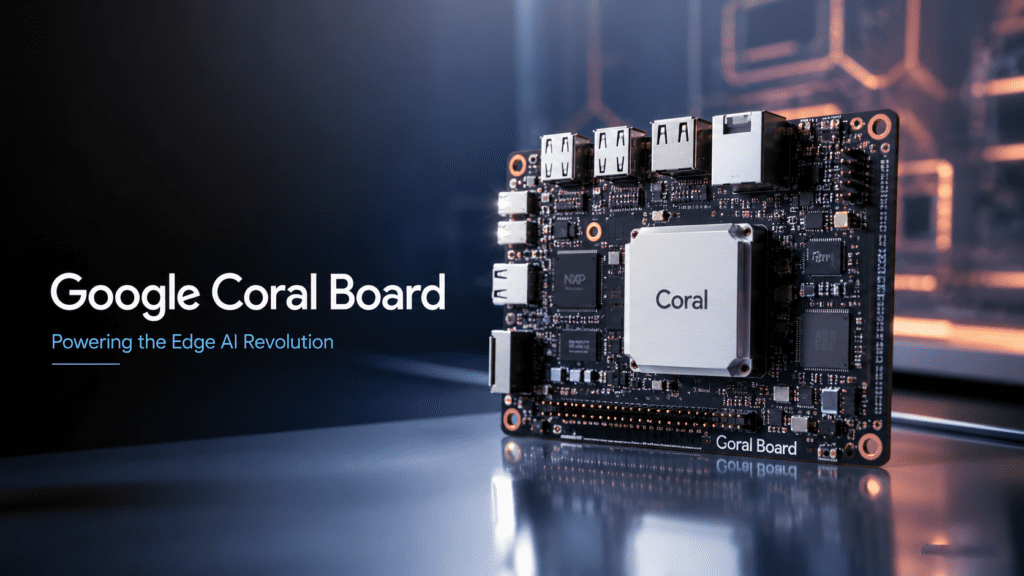
The recent emergence of the Google Coral Board in public demonstrations has reignited interest in edge AI, particularly after reports highlighted on-device voice translation, natural-language hardware control, and AI-generated music running locally on remarkably efficient hardware. For developers, robotics enthusiasts, researchers, and businesses exploring intelligent edge systems, the Coral Board represents something increasingly rare in modern computing: practical AI performance without dependence on the cloud.
The excitement isn’t merely about another development board. It reflects a larger industry transition toward local AI inference, privacy-preserving computing, and energy-efficient machine learning.
This article explores what the Google Coral Board is, why it matters, how it works, potential use cases, strengths and limitations, and what its future could mean for edge computing.
Search Intent Analysis: What Users Really Want to Know About Google Coral Board
People searching for “Google Coral Board” typically fall into several categories:
Primary Intent
They want to understand:
- What the Google Coral Board actually is
- How it works
- What makes it different from other AI development boards
- Whether it is suitable for their projects
Secondary Intent
Users also want to know:
- Performance specifications
- AI capabilities
- Real-world applications
- Comparison with Raspberry Pi and NVIDIA Jetson
- Availability and future roadmap
Emotional Intent
Many readers are curious because AI hardware announcements often promise revolutionary capabilities but deliver incremental improvements. They want to know whether Google’s latest Coral platform is genuinely meaningful or simply another developer board entering a crowded market.
Common Confusion
Several misconceptions frequently appear:
- Confusing Coral with Google’s Gemini AI models
- Assuming Coral requires cloud connectivity
- Believing edge AI hardware is only for experts
- Assuming small hardware cannot run meaningful AI workloads
This article addresses those questions directly.
What Is the Google Coral Board?
The Google Coral Board is an edge AI development platform designed to run machine learning models directly on local hardware.
Unlike traditional cloud-based AI systems, Coral devices perform inference locally, enabling:
- Lower latency
- Reduced bandwidth usage
- Improved privacy
- Offline operation
- Lower operating costs
At its core, Coral combines embedded computing hardware with Google’s specialized AI acceleration technology.
The defining feature is the integration of Google’s Edge TPU architecture, a dedicated accelerator built specifically for machine learning inference workloads.
Rather than processing AI tasks through general-purpose CPUs, Coral uses specialized silicon optimized for neural network execution.
The result is dramatically faster inference with significantly lower power consumption.
Understanding Edge AI: Why Local Processing Matters
To understand the Coral Board’s significance, it helps to understand the broader edge AI movement.
Traditional AI workflow:
- Device captures data
- Data sent to cloud
- AI model processes request
- Response returns to device
While effective, this approach introduces several challenges:
| Challenge | Impact |
|---|---|
| Network latency | Slower response times |
| Connectivity dependence | Requires internet access |
| Privacy concerns | Sensitive data leaves device |
| Bandwidth costs | Expensive at scale |
| Cloud expenses | Ongoing operational costs |
Edge AI changes the model entirely.
Instead:
Device captures data
AI processes locally
Immediate response generated
The benefits become particularly valuable for:
- Smart cameras
- Industrial automation
- Robotics
- Medical devices
- Agriculture systems
- Retail analytics
- Smart home products
The Technology Behind Google Coral
The Coral ecosystem centers around Google’s Tensor Processing Unit architecture.
What Is an Edge TPU?
An Edge TPU is a custom AI accelerator designed specifically for running trained machine learning models efficiently.
Unlike CPUs that perform many tasks reasonably well, Edge TPUs focus on one objective:
Executing neural network inference extremely efficiently.
Key advantages include:
Speed
Inference operations execute significantly faster than general-purpose processors.
Energy Efficiency
Edge devices often operate under strict power constraints.
Coral hardware is optimized for:
- Battery-powered systems
- Portable devices
- Embedded products
- Industrial sensors
Scalability
Developers can deploy thousands of devices without needing corresponding cloud infrastructure growth.
Google Coral Board Architecture
Although configurations can vary, Coral-based systems generally include:
Processor
Handles operating system functions and general computation.
Edge TPU Accelerator
Dedicated neural network inference engine.
Memory
Supports machine learning workloads and application execution.
Connectivity
Typically includes combinations of:
- USB
- Ethernet
- Wi-Fi
- Bluetooth
- GPIO interfaces
Expansion Support
Enables robotics, IoT, and industrial integrations.
This modular architecture allows developers to create highly specialized intelligent systems.
Why Developers Are Excited About the New Coral Board
Recent demonstrations have showcased capabilities that extend beyond simple image recognition.
Among the reported demonstrations:
Real-Time Voice Translation
The board translated speech locally without depending on remote servers.
Potential applications include:
- Travel devices
- Accessibility solutions
- Enterprise communication systems
- Educational technology
Natural Language Hardware Control
Users could interact with hardware using conversational language.
Examples:
- “Turn the motor speed down by half.”
- “Show me temperature readings from today.”
- “Activate energy-saving mode.”
This dramatically lowers technical barriers for device interaction.
AI Music Generation
Perhaps the most surprising demonstration involved music generation based on environmental inputs.
By combining sensor data, audio input, and machine learning models, the board generated creative outputs locally.
This illustrates how edge AI is moving beyond classification tasks toward generative capabilities.
Real-World Use Cases for Google Coral Board
1. Smart Security Systems
Modern security cameras increasingly require intelligence rather than simple recording.
Coral-powered systems can:
- Detect people
- Recognize vehicles
- Identify suspicious behavior
- Trigger alerts instantly
Because processing occurs locally:
- Video remains private
- Latency decreases
- Cloud costs shrink
2. Industrial Automation
Factories generate enormous volumes of operational data.
Coral can support:
- Defect detection
- Predictive maintenance
- Equipment monitoring
- Worker safety systems
Local processing enables real-time decisions without relying on external infrastructure.
3. Robotics
Robots require fast decision-making.
Cloud dependence creates delays that can impact navigation and safety.
Coral enables:
- Object recognition
- Autonomous movement
- Environmental awareness
- Voice interaction
All performed locally.
4. Agriculture
Agricultural technology increasingly relies on AI.
Coral-powered systems can analyze:
- Crop health
- Soil conditions
- Pest activity
- Irrigation requirements
This provides actionable insights directly in the field.
5. Healthcare Devices
Healthcare often demands:
- Privacy
- Reliability
- Low latency
Potential applications include:
- Diagnostic assistance
- Patient monitoring
- Medical imaging support
- Wearable health technology
Google Coral vs Raspberry Pi
One of the most common comparisons involves Raspberry Pi.
| Feature | Google Coral Board | Raspberry Pi |
|---|---|---|
| AI Acceleration | Dedicated TPU | CPU-based |
| ML Performance | Significantly higher | Limited without accelerator |
| Edge AI Focus | Native design goal | General computing |
| Power Efficiency | AI optimized | General purpose |
| AI Deployment | Streamlined | Additional setup often needed |
The Raspberry Pi remains extraordinarily versatile.
However, for dedicated machine learning inference, Coral’s specialized architecture often provides substantial advantages.
Google Coral vs NVIDIA Jetson
Another major competitor is NVIDIA’s Jetson platform.
| Category | Coral Board | Jetson |
|---|---|---|
| Power Consumption | Lower | Higher |
| AI Inference Efficiency | Excellent | Excellent |
| GPU Capability | Limited | Strong |
| Computer Vision | Strong | Strong |
| Generative AI Potential | Growing | Very strong |
| Cost Efficiency | Often favorable | Varies |
The decision often depends on workload requirements.
For lightweight edge inference, Coral shines.
For larger generative AI workloads and GPU-intensive applications, Jetson frequently offers greater flexibility.
Expert Analysis: Why Edge AI Is Becoming a Strategic Priority
The industry’s fascination with larger AI models sometimes obscures an equally important reality:
Not every AI task belongs in the cloud.
Organizations increasingly recognize that sending all data to centralized infrastructure creates:
- Cost challenges
- Security concerns
- Latency bottlenecks
- Regulatory complications
The next phase of AI deployment will likely involve hybrid architectures.
In this model:
Cloud AI Handles
- Model training
- Large-scale reasoning
- Massive datasets
Edge AI Handles
- Real-time inference
- Local automation
- Privacy-sensitive tasks
- Immediate decision making
Google Coral sits squarely within this emerging framework.
Its importance is not that it replaces cloud AI.
Its importance is that it reduces dependence on cloud AI where local intelligence makes more sense.
Common Misconceptions About Google Coral Board
Myth 1: It Is Just Another Raspberry Pi
Not exactly.
While both are compact development platforms, Coral was designed with machine learning acceleration as a central objective.
Myth 2: You Need Constant Internet Access
False.
One of Coral’s biggest advantages is offline AI processing.
Many applications can function without cloud connectivity.
Myth 3: Edge AI Is Only for Experts
Increasingly untrue.
Modern AI frameworks, pretrained models, and developer tools continue lowering barriers to entry.
Myth 4: Small Hardware Cannot Run Serious AI
Advances in model optimization are rapidly changing this assumption.
Quantization, pruning, and specialized accelerators allow surprisingly capable AI workloads to run on compact hardware.
Best Practices for Building Projects with Google Coral
If you’re considering Coral for a project, these guidelines can help.
Choose Models Optimized for Edge Deployment
Large cloud-scale models often require adaptation.
Look for:
- Quantized models
- TensorFlow Lite compatibility
- Efficient architectures
Prioritize Real-Time Requirements
Coral performs best when rapid local inference matters.
Examples include:
- Video analytics
- Sensor processing
- Robotics control
Design for Power Efficiency
Take advantage of Coral’s strengths by creating solutions that operate efficiently over extended periods.
Use Hybrid Architectures
Many successful deployments combine:
- Local Coral inference
- Cloud analytics
- Centralized management
This often provides the best balance of performance and scalability.
Challenges and Limitations
No hardware platform is perfect.
Potential limitations include:
Memory Constraints
Large foundation models may exceed available resources.
Model Compatibility
Not every machine learning model is optimized for Edge TPU execution.
Development Learning Curve
New users may need time to understand deployment workflows.
Rapid AI Evolution
Hardware designed today must adapt to quickly changing AI demands.
These are industry-wide challenges rather than Coral-specific weaknesses.
What the Future Could Hold for Google Coral
The recent demonstrations suggest a significant shift.
Historically, edge AI devices focused on:
- Classification
- Detection
- Recognition
The next generation appears increasingly capable of:
- Language understanding
- Generative AI
- Interactive agents
- Multimodal processing
If Google continues integrating advances from its AI research ecosystem into Coral hardware, future versions could become foundational platforms for intelligent devices operating independently of the cloud.
That prospect extends far beyond hobbyist development.
It touches manufacturing, transportation, healthcare, retail, education, and consumer technology.
The long-term opportunity is not simply running AI on smaller hardware.
It is enabling billions of devices to become intelligent on their own.
Frequently Asked Questions (FAQ)
What is the Google Coral Board used for?
The Google Coral Board is primarily used for edge AI applications, allowing machine learning models to run locally on hardware instead of relying on cloud servers.
Does the Google Coral Board require internet access?
No. Many Coral applications can operate entirely offline, which is one of its major advantages for privacy and low-latency processing.
Is Google Coral better than Raspberry Pi?
For AI inference workloads, Coral typically offers significantly better performance due to its dedicated Edge TPU accelerator. Raspberry Pi remains more general-purpose.
Can the Google Coral Board run generative AI?
Limited generative AI workloads may be possible depending on model size and optimization. Recent demonstrations suggest expanding capabilities in this area.
Is Google Coral suitable for beginners?
Yes. While some technical knowledge helps, modern AI tools and documentation have made Coral increasingly accessible to students, hobbyists, and developers.
What programming frameworks work with Coral?
TensorFlow Lite is the most commonly associated framework, particularly for models optimized for Edge TPU deployment.
Can Coral be used for robotics?
Absolutely. Robotics is one of the strongest use cases because Coral provides fast local inference for navigation, object detection, and decision-making.
Why is edge AI becoming more important?
Organizations want lower latency, better privacy, reduced cloud costs, and improved reliability. Edge AI addresses all of these requirements.
Final Thoughts
The Google Coral Board arrives at a moment when the AI industry is reassessing where intelligence should live. For years, the answer seemed obvious: the cloud. Today, a growing number of developers, businesses, and researchers are discovering that local intelligence often delivers faster, cheaper, and more private results.
What makes Coral compelling is not simply its hardware specifications. It represents a broader philosophy that AI should be capable of operating where data is created, whether that’s inside a factory, on a farm, in a robot, within a smart home, or inside a handheld device.
As edge computing and generative AI continue to converge, platforms like Coral could become some of the most influential pieces of technology in the next decade—not because they are the largest AI systems, but because they bring intelligence closer to the real world where decisions actually happen.