 By
By
Introduction
The race to bring artificial intelligence into real-world business operations has entered a new phase. For years, enterprise AI adoption has been slowed by a fundamental challenge: organizations want the power of advanced AI models, but they also need control over sensitive data, internal systems, regulatory requirements, and existing infrastructure.
That tension has created a massive gap between AI experimentation and large-scale enterprise deployment.
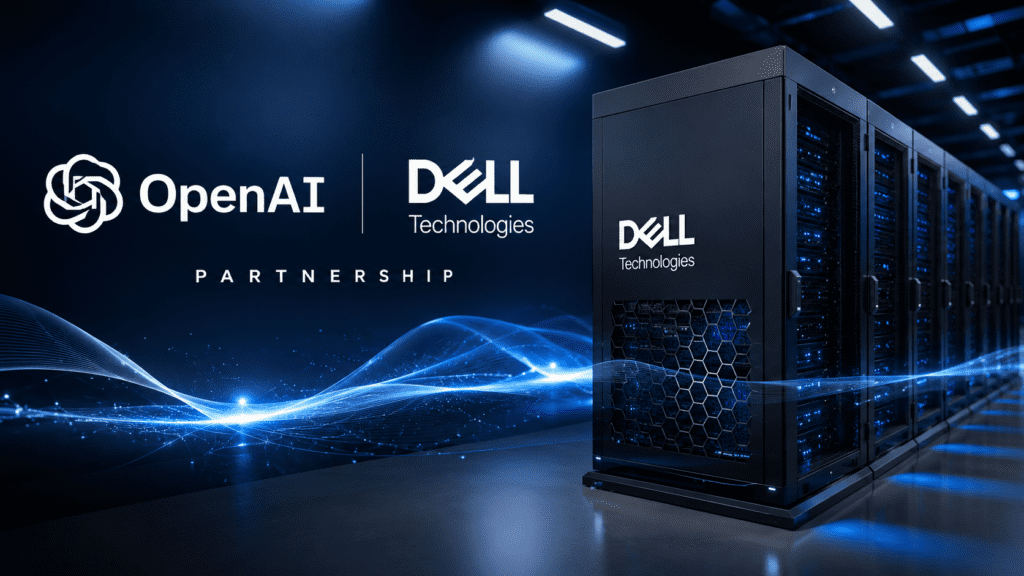
The recent partnership between OpenAI and Dell Technologies aims to address exactly that problem.
Announced in May 2026, the collaboration focuses on bringing OpenAI’s rapidly growing Codex platform into hybrid and on-premises enterprise environments, allowing businesses to deploy AI closer to their own data and operational systems. Rather than forcing organizations to move everything to the public cloud, the partnership seeks to integrate AI into environments where companies already store and govern their most valuable information.
This is more than a standard technology partnership.
It represents a broader shift occurring across the AI industry—one where enterprise customers increasingly demand sovereignty, security, compliance, and flexibility alongside cutting-edge AI capabilities.
For CIOs, CTOs, software leaders, AI strategists, and enterprise decision-makers, understanding the significance of the OpenAI–Dell partnership offers valuable insight into where enterprise AI is heading next.
Search Intent Analysis
Before diving deeper, it’s useful to understand why people are searching for “OpenAI Dell Partnership.”
Primary Search Intent
Users want to know:
- What the partnership actually is
- Why OpenAI partnered with Dell
- What products are involved
- How enterprises benefit
Secondary Search Intent
Readers also want answers to:
- What is Codex?
- How does hybrid AI deployment work?
- What role does Dell’s AI infrastructure play?
- Will this affect enterprise AI adoption?
Emotional Intent
Many business leaders are asking a larger question:
“Can we adopt advanced AI without losing control of our data?”
The OpenAI–Dell partnership directly addresses that concern.
Common Confusion
Many assume AI deployment requires:
- Fully cloud-based infrastructure
- Moving sensitive data outside the organization
- Major architectural changes
This partnership challenges those assumptions.
What Is the OpenAI–Dell Partnership?
In May 2026, OpenAI and Dell Technologies announced a collaboration designed to bring OpenAI’s Codex platform into enterprise hybrid and on-premises environments. The goal is to allow organizations to deploy AI-powered coding and workflow agents closer to their existing data, systems, and operational infrastructure.
The partnership specifically connects Codex with:
- Dell AI Data Platform
- Dell AI Factory
- Enterprise governance systems
- Internal documentation repositories
- Business workflows
- Existing software infrastructure
According to OpenAI, enterprises increasingly want AI systems that can operate within their own controlled environments while still leveraging frontier AI capabilities.
Understanding Codex’s Expanding Role
Many people still think of Codex as a coding assistant.
That description is becoming outdated.
OpenAI reports that more than four million developers use Codex weekly, and organizations are increasingly applying it beyond software development. Use cases now include:
- Report generation
- Knowledge retrieval
- Workflow automation
- Lead qualification
- Documentation analysis
- Product feedback processing
- Incident response
- Cross-system coordination
The result is a shift from “AI coding tool” to “enterprise AI agent platform.”
This broader vision explains why infrastructure partnerships have become strategically important.
Why Dell Was a Strategic Choice
Dell occupies a unique position within enterprise technology.
Unlike cloud-first providers, Dell has deep relationships with organizations operating:
- Private data centers
- Hybrid cloud environments
- Regulated industries
- Government systems
- Healthcare networks
- Financial institutions
Many of these organizations cannot simply move critical workloads into public cloud environments.
Dell’s infrastructure footprint therefore gives OpenAI access to a segment of the market that often faces barriers to AI adoption.
The partnership combines:
| OpenAI Strengths | Dell Strengths |
|---|---|
| Advanced AI models | Enterprise infrastructure |
| AI agents | Data governance |
| Codex platform | On-premises deployments |
| Reasoning systems | Hybrid environments |
| Developer ecosystem | Enterprise relationships |
This creates a complementary rather than competitive relationship.
The Enterprise Problem This Partnership Solves
Enterprise AI adoption often stalls because of four major concerns.
1. Data Security
Organizations worry about exposing proprietary information.
Examples include:
- Source code
- Customer data
- Financial records
- Research data
- Trade secrets
Keeping AI systems closer to enterprise-controlled infrastructure helps reduce those concerns.
2. Regulatory Compliance
Industries such as:
- Healthcare
- Banking
- Insurance
- Government
- Defense
must comply with strict regulations governing data handling.
Hybrid and on-premises deployment models often simplify compliance requirements.
3. Context Access
AI systems are only as useful as the information they can access.
An enterprise agent needs visibility into:
- Internal documentation
- Knowledge bases
- Repositories
- Tickets
- Databases
- Business systems
The Dell integration aims to provide that context while maintaining governance controls.
4. Operational Control
Large enterprises prefer:
- Defined security boundaries
- Existing workflows
- Internal governance models
The partnership allows organizations to integrate AI into current environments rather than redesign everything around AI.
How the Dell AI Data Platform Fits In
A central component of the partnership is integration with Dell’s AI Data Platform.
The platform helps organizations:
- Store enterprise information
- Govern data access
- Manage permissions
- Organize operational data
By connecting Codex directly to these systems, organizations can provide AI agents with richer context while preserving enterprise controls.
This is crucial because enterprise AI value comes from context.
A model without organizational context is generic.
A model connected to enterprise knowledge becomes significantly more useful.
The Role of Dell AI Factory
Another major component is Dell AI Factory.
Dell AI Factory provides infrastructure that enterprises use for:
- AI workloads
- Data preparation
- Model deployment
- Operational AI systems
OpenAI and Dell indicated they will explore ways for:
- Codex
- ChatGPT Enterprise
- OpenAI APIs
to interact with AI Factory environments.
For enterprises, this could create a smoother path from AI experimentation to production deployment.
Why This Matters for the Future of Enterprise AI
The broader significance goes beyond OpenAI and Dell.
The AI market is evolving from:
Experimentation
Companies tested AI through chatbots and pilots.
Productivity
Organizations adopted AI assistants for employees.
Operational AI
Businesses now want AI integrated into:
- Business processes
- Software systems
- Internal workflows
- Enterprise knowledge
The OpenAI–Dell partnership is aligned with Phase 3.
Rather than offering standalone AI tools, it focuses on embedding AI into enterprise operations.
Expert Analysis: A Shift Toward AI Sovereignty
One of the most important trends in enterprise technology today is AI sovereignty.
Organizations increasingly want:
- Control over infrastructure
- Control over data
- Control over deployment
- Control over governance
The OpenAI–Dell partnership reflects this reality.
Instead of insisting that enterprises move entirely into cloud-hosted AI environments, the collaboration acknowledges that many businesses require flexible deployment models.
This makes the partnership strategically significant.
It addresses one of the largest obstacles to enterprise AI adoption.
Practical Use Cases
Software Development Teams
A global software company could use Codex connected to:
- Internal repositories
- Documentation
- Testing systems
- Incident reports
Developers gain AI assistance grounded in company-specific knowledge.
Financial Institutions
Banks could deploy AI agents within governed environments while maintaining compliance controls.
Potential use cases include:
- Risk analysis
- Documentation review
- Regulatory reporting
- Internal knowledge retrieval
Healthcare Organizations
Healthcare providers often face strict privacy requirements.
Hybrid deployment could allow AI-assisted workflows without exposing sensitive patient information unnecessarily.
Manufacturing Enterprises
Manufacturers can connect AI systems to:
- Operations manuals
- Maintenance records
- Supply chain documentation
- Engineering knowledge bases
This transforms institutional knowledge into searchable operational intelligence.
Common Misconceptions About the OpenAI–Dell Partnership
Myth 1: It’s Only About Coding
Reality:
Codex is increasingly being used across broader business workflows.
Myth 2: OpenAI Is Moving Away From Cloud AI
Reality:
The partnership expands deployment options rather than replacing cloud infrastructure.
Hybrid environments are becoming an additional deployment model.
Myth 3: Only Large Enterprises Benefit
Reality:
While large enterprises are primary beneficiaries, mid-sized organizations using Dell infrastructure may also gain access to more flexible AI deployments.
Myth 4: On-Premises Means No AI Innovation
Reality:
Modern hybrid environments can still leverage advanced AI capabilities while maintaining stronger operational control.
Benefits and Challenges
| Benefits | Challenges |
|---|---|
| Greater data control | Integration complexity |
| Enhanced compliance support | Infrastructure investment |
| Better enterprise context | Governance requirements |
| Hybrid deployment flexibility | Change management |
| AI closer to business systems | Talent requirements |
| Reduced operational friction | Scaling considerations |
Actionable Recommendations for Enterprise Leaders
If you’re evaluating AI adoption, consider the following framework.
Step 1: Assess Data Sensitivity
Identify:
- Highly regulated data
- Confidential information
- Internal knowledge assets
Step 2: Review Infrastructure Strategy
Determine whether:
- Cloud-only
- Hybrid
- On-premises
best aligns with organizational goals.
Step 3: Prioritize High-Value Use Cases
Focus on areas such as:
- Software development
- Knowledge management
- Process automation
- Operational workflows
Step 4: Establish Governance Early
Create policies around:
- Access controls
- Audit trails
- Data permissions
- AI oversight
Step 5: Start Small and Scale
Begin with targeted deployments before expanding organization-wide.
The Bigger Picture: OpenAI’s Enterprise Expansion Strategy
The Dell partnership fits into a broader OpenAI strategy focused on enterprise adoption.
Recent years have seen OpenAI strengthen relationships across:
- Infrastructure providers
- Cloud platforms
- Hardware companies
- Enterprise software ecosystems
The objective appears clear:
Move AI from standalone tools into the operational core of businesses.
The Dell collaboration represents one piece of that larger enterprise infrastructure strategy.
Final Thoughts
The OpenAI–Dell partnership is not simply another technology announcement.
It addresses one of the most persistent challenges in enterprise AI: how to deploy powerful AI systems while maintaining control over data, governance, and infrastructure.
By connecting Codex with Dell’s AI Data Platform and AI Factory ecosystem, the collaboration creates a pathway for organizations to bring advanced AI capabilities closer to the environments where critical business information already resides.
For enterprises that have been hesitant to move sensitive workloads entirely into public cloud environments, this approach could significantly lower adoption barriers.
More broadly, the partnership signals a future in which AI is no longer confined to isolated tools. Instead, AI becomes embedded within enterprise systems, workflows, and decision-making processes—securely, contextually, and at scale.
FAQ
What is the OpenAI–Dell partnership?
The partnership allows enterprises to deploy OpenAI’s Codex platform within Dell’s hybrid and on-premises environments, bringing AI closer to enterprise data and workflows.
When was the partnership announced?
OpenAI and Dell Technologies announced the collaboration on May 18, 2026.
What is Codex?
Codex is OpenAI’s AI platform used for coding assistance, automation, reasoning across repositories, workflow management, and enterprise AI agent applications.
Why does on-premises AI matter?
On-premises deployment can provide greater control over sensitive data, compliance requirements, governance, and operational security.
What is Dell AI Data Platform?
Dell AI Data Platform helps organizations store, manage, govern, and organize enterprise data that AI systems can utilize securely.
What is Dell AI Factory?
Dell AI Factory is Dell’s infrastructure ecosystem for building, deploying, and managing AI workloads at enterprise scale.
Which industries benefit most from this partnership?
Industries with strict security and compliance requirements—including finance, healthcare, government, manufacturing, and large enterprise software organizations—may benefit significantly.
Does this replace cloud AI deployments?
No. The partnership expands deployment flexibility by supporting hybrid and on-premises environments alongside cloud-based AI strategies.
Why is this partnership strategically important?
It addresses one of the largest barriers to enterprise AI adoption: balancing advanced AI capabilities with data control, governance, and infrastructure flexibility.
Could this accelerate enterprise AI adoption?
Many analysts believe so. By reducing infrastructure and governance concerns, hybrid AI deployments may help more organizations move from experimentation to production-scale AI implementation.