
 By
By
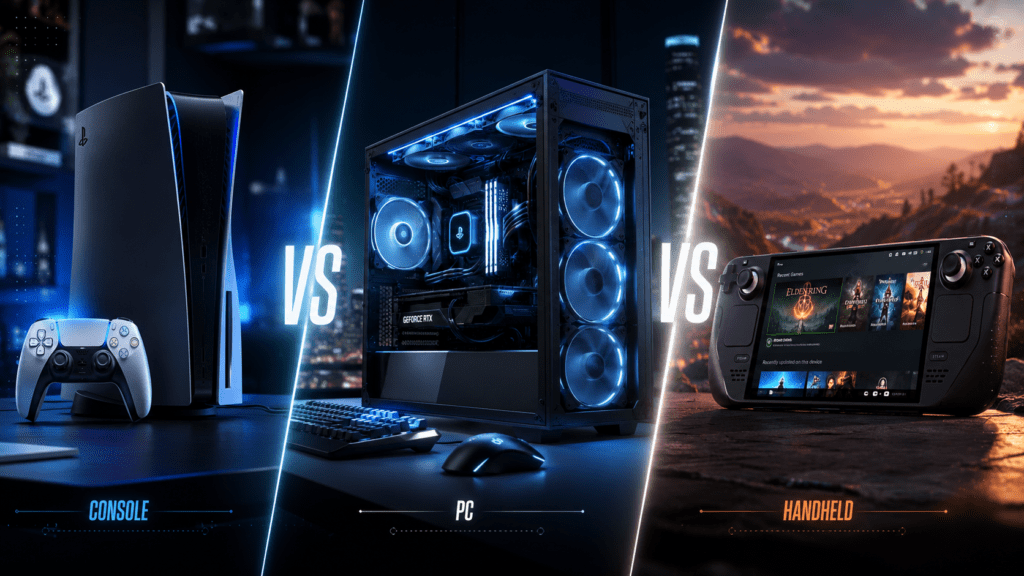
Gaming no longer lives in one place.
A decade ago, choosing a platform felt simple. Buy a console, build a PC, or play on a phone casually during breaks. That distinction has collapsed. Modern gaming exists across living rooms, desks, backpacks, airplanes, college dorms, esports arenas, and cloud-connected ecosystems.
A player can start a game on a handheld device during a commute, continue on a gaming PC at home, and finish sessions through a console connected to a 4K television. Hardware capabilities overlap. Cross-platform multiplayer is increasingly normal. Performance expectations have changed. Budgets vary wildly.
Which raises one of gaming’s biggest questions:
Should you buy a console, invest in a gaming PC, or choose a handheld gaming system?
The answer depends less on raw power and more on lifestyle, priorities, budget, and gaming habits.
Someone chasing competitive frame rates has very different needs from a player who wants convenience after work. A college student with limited space approaches gaming differently from a content creator streaming to thousands of viewers.
This guide breaks down the strengths, weaknesses, costs, misconceptions, and practical realities behind all three major gaming ecosystems.
By the end, you’ll know exactly which platform fits your situation — and why.
Understanding the Three Gaming Categories
Before comparisons become meaningful, define what each category represents.
Console Gaming
Consoles prioritize accessibility and standardized experiences.
Examples include:
- PlayStation systems
- Xbox systems
- Nintendo gaming platforms
Characteristics:
- Fixed hardware
- Optimized game development
- Plug-and-play simplicity
- Lower technical barriers
- Living-room-focused design
A console buyer typically values convenience over customization.
PC Gaming
Gaming PCs prioritize performance, flexibility, and control.
Characteristics:
- Upgradeable hardware
- Adjustable graphics settings
- Multi-purpose functionality
- High-performance potential
- Modding capability
- Expanded input options
A gaming PC is not merely a gaming machine. It becomes a workstation, streaming device, editing system, development platform, and entertainment hub.
Handheld Gaming
Handheld gaming combines mobility with increasingly capable hardware.
Modern handheld gaming focuses on:
- Portability
- Battery-powered gaming
- Flexible play locations
- Hybrid gaming ecosystems
- Compact form factors
Handheld systems now range from dedicated gaming hardware to PC-powered portable devices.
The line separating handheld and PC gaming continues to blur.
Quick Comparison Table
| Feature | Console | Gaming PC | Handheld |
|---|---|---|---|
| Initial Cost | Moderate | High to Very High | Moderate |
| Upgradability | No | Yes | Limited |
| Performance Ceiling | Fixed | Highest | Moderate |
| Portability | Low | Low | Excellent |
| Ease of Use | Excellent | Moderate | Excellent |
| Graphics Quality | High | Highest | Good |
| Competitive Gaming | Strong | Best | Limited |
| Battery Dependency | No | No | Yes |
| Game Modding | Limited | Excellent | Limited |
| Multi-Purpose Use | Moderate | Excellent | Moderate |
| Long-Term Hardware Flexibility | Low | Excellent | Low |
No platform dominates every category.
Trade-offs define the decision.
Console Gaming: Strengths and Weaknesses
Console gaming remains dominant because simplicity matters.
People often underestimate how valuable convenience becomes after long workdays.
You turn it on.
You launch a game.
You play.
No driver troubleshooting. No graphics optimization research. No hardware compatibility concerns.
That frictionless experience explains console popularity.
Major Advantages
1. Lower Entry Cost
Building a capable gaming PC often costs significantly more than purchasing a console.
A console purchase typically includes:
- Hardware
- Controller
- Operating environment
- Optimized gaming ecosystem
Budget-conscious players frequently find stronger value here.
2. Game Optimization
Developers build console games for fixed specifications.
That matters.
A developer targeting identical hardware across millions of devices can optimize aggressively.
Results include:
- Stable frame pacing
- Fewer compatibility issues
- Predictable performance
PC hardware diversity introduces complexity consoles avoid.
3. Couch Gaming Experience
Large-screen gaming remains a console advantage.
Shared gaming environments feel natural.
Examples:
- Family gaming nights
- Local multiplayer
- Casual party gaming
- Sports games with friends
Console ecosystems excel socially.
4. Reduced Technical Complexity
Many players do not want to learn:
- GPU architectures
- CPU bottlenecks
- RAM timings
- Driver optimization
- Thermal management
Console gaming removes those variables.
Console Limitations
Fixed Hardware Lifespan
A console purchased today remains largely unchanged throughout its lifecycle.
Technology evolves.
Hardware remains fixed.
Performance improvements require waiting for next-generation releases.
Limited Customization
PC users can modify:
- Graphics settings
- Game files
- Community modifications
- Input configurations
Console ecosystems remain controlled environments.
Some players appreciate that.
Others find it restrictive.
Subscription Ecosystems
Modern consoles increasingly rely on paid online ecosystems.
Additional recurring costs matter when calculating long-term value.
Gaming PCs: Maximum Performance, Maximum Flexibility
PC gaming attracts enthusiasts for a reason.
Performance potential remains unmatched.
Competitive players chasing responsiveness understand this immediately.
Frame rate differences influence gameplay.
Input latency matters.
Customization changes experiences dramatically.
Major Advantages
1. Superior Performance Potential
A high-end gaming PC can deliver:
- Higher frame rates
- Better visual fidelity
- Faster loading
- Expanded graphics options
- Advanced ray tracing capabilities
Competitive titles particularly benefit.
Examples include:
- First-person shooters
- Strategy games
- Simulation titles
- Esports-focused experiences
Precision matters.
PC gaming delivers precision.
2. Hardware Upgradability
A console generation eventually ends.
PC ecosystems evolve incrementally.
Upgrade paths include:
- Graphics cards
- Processors
- RAM
- Storage
- Cooling systems
Instead of replacing everything, users improve specific components.
Long-term flexibility becomes powerful.
3. Modding Communities
Mods extend game lifespans dramatically.
Examples include:
- Visual overhauls
- Gameplay improvements
- Fan expansions
- Performance optimization tools
- Accessibility enhancements
Some games remain relevant for years largely because PC communities continue improving them.
4. Multi-Purpose Value
A gaming PC handles:
- Gaming
- Video editing
- Programming
- Streaming
- School work
- Content creation
- Productivity applications
This changes value calculations.
A console primarily games.
A PC becomes infrastructure.
5. Better Competitive Ecosystem
Professional competitive gaming heavily favors PC environments.
Reasons include:
- Lower latency
- Higher refresh rates
- Mouse precision
- Performance tuning flexibility
Competitive ambitions strongly influence platform selection.
PC Gaming Weaknesses
Higher Costs
Power costs money.
Beyond hardware:
- Monitors
- Peripherals
- Upgrades
- Cooling solutions
Premium experiences scale upward quickly.
Technical Learning Curve
PC ownership introduces responsibility.
Potential challenges:
- Driver updates
- Hardware compatibility
- Software troubleshooting
- Thermal management
- Configuration optimization
Some enjoy that process.
Others hate it.
Space Requirements
Gaming desktops consume physical space.
Not every living situation accommodates large setups comfortably.
Students and apartment residents often consider this heavily.
Handheld Gaming: The Platform Reshaping Gaming Habits
Handheld gaming changed from casual entertainment into serious gaming infrastructure.
That shift accelerated rapidly.
Portable gaming hardware now runs experiences previously locked to desktops and consoles.
Freedom drives handheld appeal.
Gaming adapts to life instead of demanding dedicated spaces.
Major Advantages
1. Portability Changes Everything
Gaming becomes possible:
- During travel
- Between classes
- On flights
- In waiting rooms
- On couches away from televisions
Flexibility changes habits.
People often play more because handheld access reduces friction.
2. Hybrid Usage Models
Modern handheld ecosystems increasingly support:
- Docked play
- Portable play
- Cloud gaming integration
- Cross-save ecosystems
One device serves multiple scenarios.
3. Lower Setup Complexity
Portable systems minimize technical barriers.
Open device.
Launch game.
Play.
Convenience drives adoption.
4. Space Efficiency
Dorm room.
Studio apartment.
Shared housing.
Portable gaming fits environments where larger hardware struggles.
Handheld Limitations
Battery Constraints
Battery life introduces unavoidable limitations.
Performance demands consume power.
Portable gaming requires charging discipline.
Reduced Performance Ceiling
Compact thermal solutions limit sustained performance.
Portable hardware cannot consistently match high-end desktop capabilities.
Smaller Displays
Display size influences immersion.
Some players adapt easily.
Others strongly prefer larger viewing environments.
Final Verdict: Console vs PC vs Handheld
No gaming platform wins universally.
The right platform depends entirely on how gaming fits into your life.
Choose console if convenience, affordability, and simplicity matter most.
Choose PC if flexibility, performance, and long-term customization drive your priorities.
Choose handheld if portability and gaming freedom outweigh raw performance.
The strongest gaming setup is not necessarily the most expensive.
It is the one that fits naturally into your lifestyle.
Gaming hardware matters.
Gaming experience matters more.
FAQ
Is PC gaming more expensive than console gaming?
Usually yes. Gaming PCs often require larger upfront investment, though upgrade flexibility and multi-purpose functionality can offset costs.
Are handheld gaming systems powerful enough for modern games?
Modern handheld devices have improved dramatically and can run increasingly demanding games.
Which platform is best for competitive gaming?
Gaming PCs usually provide the strongest competitive advantages because of frame rates, latency improvements, and precision controls.
Are consoles better for beginners?
For many players, yes. Consoles reduce technical complexity and provide simpler gaming experiences.
Can handheld gaming replace consoles?
For some gamers yes, but players wanting maximum performance or large-screen immersion may still prefer consoles or PCs.