 By
By
Search Intent Analysis
People searching “Google Gemini usage limits” usually want one of four answers:
- How many prompts or messages Gemini allows
- Why Gemini introduces limits at all
- How usage caps differ between free and paid plans
- Whether limits depend on prompt complexity, model type, or computing resources
There is also a deeper layer of confusion. Many users assume AI limits work like social media limits — a fixed number of actions per day. Modern AI systems do not operate that way.
Large language models consume computational resources differently depending on prompt length, context windows, reasoning depth, image generation demands, memory usage, and model architecture. A simple question costs less than a multi-step analysis involving long documents or advanced reasoning.
Understanding Google Gemini usage limits requires understanding how modern generative AI infrastructure works.
This guide breaks down the mechanics behind Gemini limits, explains why restrictions exist, explores how Google manages AI compute allocation, and clarifies what users can realistically expect as generative AI becomes more resource-dependent.
What Are Google Gemini Usage Limits?
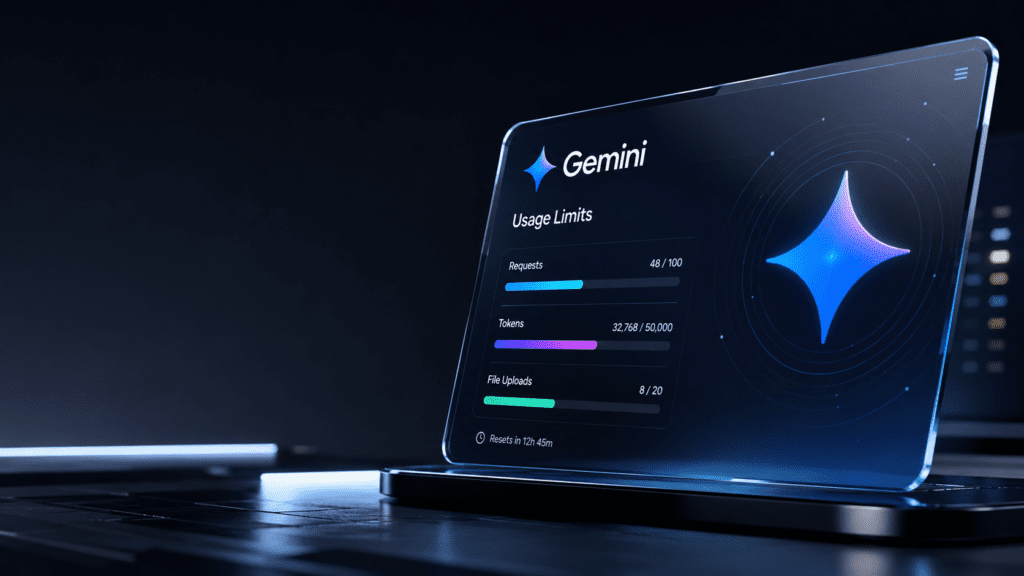
Google Gemini usage limits are operational restrictions placed on how frequently users can access AI capabilities within Google’s Gemini ecosystem.
These limits can involve:
- Message caps
- Rate limits
- Token processing limits
- Context window restrictions
- Image generation limits
- Compute allocation systems
- Priority access tiers
- Model-specific restrictions
- Daily or rolling usage thresholds
Unlike traditional software subscriptions, AI systems consume infrastructure resources dynamically.
A user asking:
“What is the weather tomorrow?”
Consumes far fewer resources than a user requesting:
“Analyze this 150-page PDF, extract trends, compare findings against market reports, and create an executive summary.”
Modern AI systems increasingly allocate access based on computational cost rather than raw message counts.
Google’s approach reflects a larger industry movement.
AI companies face three difficult realities:
- Advanced reasoning models cost substantial compute power.
- GPU infrastructure remains expensive.
- User demand grows faster than hardware expansion.
Usage limits help balance those pressures.
Why Google Gemini Introduces Usage Limits
AI systems operate differently from conventional cloud applications.
Streaming a video requires infrastructure. Running advanced reasoning models requires substantially more.
Every Gemini interaction activates complex inference pipelines involving:
- Large-scale neural networks
- GPU clusters
- Memory allocation systems
- Token prediction engines
- Context retrieval mechanisms
- Safety filtering systems
- Multimodal processing infrastructure
The computational burden increases dramatically when users request:
Long Context Processing
Uploading lengthy documents requires more memory allocation and token handling.
Advanced Reasoning
Complex analytical tasks require additional inference cycles.
Image and Multimodal Features
Generating images or processing visual inputs increases hardware requirements.
High-Concurrency Demand
Millions of simultaneous users create infrastructure pressure.
Usage controls help maintain:
| Goal | Why It Matters |
|---|---|
| Service reliability | Prevents overload |
| Response quality | Reduces infrastructure bottlenecks |
| Fair resource distribution | Prevents extreme usage concentration |
| Cost management | Controls operational expenses |
| Scalability | Supports expanding user growth |
AI infrastructure economics increasingly determine product design decisions.
The Compute-Based Model Behind Modern AI Limits
Early AI systems often relied on simple message caps.
Modern generative AI increasingly uses compute-aware systems.
Instead of:
“You get exactly 100 messages.”
Platforms increasingly evaluate:
- Prompt complexity
- Model selection
- Processing depth
- Token usage
- Context length
- Multimodal requirements
- Concurrent demand
A short prompt may consume minimal compute.
A large document analysis request can require substantially more.
This explains why users sometimes experience limits that feel inconsistent.
The restriction may not be based purely on message volume.
It may depend on compute consumption.
Understanding Tokens and Why They Matter
One of the most misunderstood concepts behind Gemini usage limits is token processing.
AI models do not process language the way humans do.
They process tokens.
Tokens can represent:
- Whole words
- Partial words
- Punctuation
- Symbols
- Fragments of text
For example:
“Artificial intelligence changes software development.”
May become multiple computational units internally.
Longer prompts increase:
- Compute load
- Memory usage
- Processing time
- Infrastructure cost
Large context windows amplify those requirements.
A model analyzing 100,000+ tokens consumes significantly more resources than one handling short interactions.
This is one reason AI providers implement sophisticated usage management systems.
Free Users vs Premium Users: Why Limits Often Differ
AI subscription tiers typically exist because compute costs differ dramatically.
Free access serves discovery.
Premium access funds infrastructure expansion.
Users paying for advanced AI subscriptions often receive:
- Higher usage thresholds
- Priority processing
- Faster response times
- Access to stronger reasoning models
- Expanded context windows
- Additional multimodal capabilities
Infrastructure economics shape these decisions.
Consider a simplified example:
| User Type | Usage Pattern | Infrastructure Demand |
|---|---|---|
| Casual user | Short prompts | Lower |
| Research user | Large document analysis | Medium |
| Developer | Heavy API utilization | High |
| Enterprise team | Continuous workflows | Very high |
Without usage balancing, infrastructure congestion becomes more likely.
Why AI Compute Costs Matter More Than Most Users Realize
Generative AI systems rely heavily on accelerated hardware.
Training large models is expensive.
Running them continuously can be even more operationally demanding.
Cost drivers include:
GPU Infrastructure
Advanced AI workloads require specialized hardware.
Power Consumption
AI inference systems consume substantial electricity.
Memory Requirements
Large context windows increase memory pressure.
Data Center Scaling
Growing demand requires infrastructure expansion.
Model Improvement Cycles
Newer models often increase capability while also increasing compute requirements.
Companies building frontier AI systems constantly balance:
- Performance
- Availability
- Speed
- Cost
- User satisfaction
Usage limits are part of that balancing act.
How Prompt Complexity Can Influence Limits
Not all prompts are equal.
Example 1: Simple Query
“What is the capital of Japan?”
Low compute demand.
Minimal reasoning.
Fast inference.
Example 2: Deep Analytical Request
“Compare semiconductor market recovery trends across five global regions using uploaded reports and summarize future risks.”
Higher compute demand.
Longer processing chains.
More resource utilization.
Example 3: Multimodal Request
“Analyze this image, explain visual patterns, and create recommendations.”
Additional visual processing requirements.
More infrastructure usage.
Users often assume limits operate linearly.
Modern AI systems increasingly operate dynamically.
Rolling Windows vs Daily Limits
AI platforms commonly implement two usage frameworks.
Daily Limits
Users receive fixed allocation resets every 24 hours.
Example:
- 50 advanced requests daily
Simple to understand.
Less adaptive.
Rolling Window Systems
Usage resets continuously over time.
Example:
- 100 actions every 3 hours
Advantages:
- Better infrastructure smoothing
- Reduced traffic spikes
- More predictable compute allocation
Many AI providers increasingly favor rolling systems.
Why Some Gemini Features May Limit Faster Than Others
Different Gemini capabilities consume different resources.
| Capability | Relative Compute Demand |
|---|---|
| Basic text responses | Lower |
| Advanced reasoning | Higher |
| Large file processing | Higher |
| Image generation | High |
| Multimodal analysis | High |
| Long-context workflows | Very high |
A user might hit limits faster while using compute-intensive capabilities.
This sometimes creates confusion because usage feels “inconsistent.”
The underlying resource consumption often explains the difference.
Enterprise and API Usage Limits
Business AI environments introduce another layer.
Enterprise customers frequently operate under:
Rate Limits
Requests per minute.
Token Quotas
Processing allocations.
Throughput Controls
Concurrency management.
Billing-Based Scaling
Infrastructure access tied to usage volume.
Organizations deploying AI internally require predictable performance.
Infrastructure governance becomes essential.
Without controls, system reliability suffers.
Common Misconceptions About Google Gemini Usage Limits
Myth 1: Every Prompt Costs the Same
Reality:
Complexity influences resource demand.
Myth 2: Limits Exist Only to Force Upgrades
Reality:
Infrastructure constraints genuinely exist.
Advanced AI systems are computationally intensive.
Myth 3: Paid Users Have Unlimited Access
Reality:
Even premium plans often include fair-use systems.
Infrastructure remains finite.
Myth 4: AI Companies Can Expand Capacity Instantly
Reality:
Scaling advanced AI infrastructure requires:
- Hardware procurement
- Data center expansion
- Energy planning
- Networking upgrades
- Deployment optimization
Expansion takes time.
Practical Tips for Managing Gemini Usage More Efficiently
1. Consolidate Related Questions
Instead of:
“Question one.”
Then:
“Question two.”
Then:
“Question three.”
Bundle context intelligently.
Better prompts often reduce repeated interactions.
2. Avoid Redundant Re-Explanations
Provide context once.
Repeated context increases token usage.
3. Structure Complex Requests Clearly
Example:
Bad:
“Analyze this.”
Better:
“Summarize key findings, identify trends, and provide three recommendations.”
Precision improves efficiency.
4. Prioritize Higher-Value Interactions
Use advanced reasoning features when deeper analysis matters.
Reserve lightweight tasks for lighter workflows.
5. Break Extremely Large Projects Into Stages
Massive requests can consume substantial resources.
Segmenting work improves control.
The Industry Trend: AI Usage Limits Are Becoming Smarter
AI infrastructure management is evolving rapidly.
The future likely involves:
- Adaptive Compute Allocation
- Model-Aware Pricing
- Intelligent Capacity Forecasting
- Infrastructure Optimization
- Hybrid Compute Systems
AI access management is becoming more compute-aware rather than less.
Expert Perspective: Why Usage Limits Reflect Maturity, Not Weakness
Sophisticated infrastructure governance often signals operational maturity.
Resource allocation systems help platforms:
- Maintain quality
- Improve reliability
- Support broader adoption
- Protect infrastructure stability
- Sustain long-term development
Advanced AI increasingly depends on sustainable infrastructure management.
Google Gemini Usage Limits: Key Takeaways Checklist
AI limits increasingly depend on compute usage rather than raw message counts
Prompt complexity influences infrastructure demand
Long context windows consume more resources
Multimodal capabilities require additional compute
Premium plans often increase thresholds but may still include fair-use controls
Rolling usage systems are becoming more common
AI infrastructure costs heavily influence platform design
Efficient prompting can improve resource utilization
Compute-aware allocation is becoming an industry standard
Frequently Asked Questions
Does Google Gemini use message limits or compute limits?
Modern AI systems increasingly incorporate compute-aware allocation alongside traditional usage restrictions.
Why do AI systems restrict usage?
Restrictions help maintain reliability, fairness, performance quality, and infrastructure stability.
Do longer prompts consume more AI resources?
Yes. Longer prompts generally require additional token processing and computational effort.
Why can image features reach limits faster?
Visual processing often requires more computational resources than text-only interactions.
Are premium AI subscriptions unlimited?
Not necessarily. Many premium systems still apply fair-use protections.
What is a rolling usage window?
A rolling window resets usage continuously over time rather than waiting for a fixed daily reset.
Why are AI infrastructure costs so high?
Large AI systems rely on specialized hardware, electricity consumption, memory resources, networking systems, and data center infrastructure.
Will AI usage limits become less restrictive over time?
Infrastructure improvements may reduce constraints, but demand growth also expands resource requirements.
Google Gemini usage limits represent a broader shift happening across artificial intelligence. AI products are moving away from simple message counting toward infrastructure-aware resource allocation. Understanding that shift helps users better understand why limits exist and how modern AI systems operate behind the scenes.