 By
By
Samsung: A Comprehensive Guide to the Tech Giant’s History, Innovations, and Global Impact
Introduction
In the modern digital age, few names are as ubiquitous as Samsung. It’s a brand that powers the smartphone in your pocket, the television in your living room, and the memory chips in the world’s data centers. But what is the story behind the logo? How did a small South Korean trading company evolve into a global behemoth that influences how we work, communicate, and experience the world?
Samsung is far more than a consumer electronics manufacturer; it is a complex, deeply integrated ecosystem of businesses that touches nearly every facet of modern technology. This guide explores Samsung’s incredible journey, its core product lines, the technological innovations that define it, and its profound—and sometimes controversial—impact on the global stage. Whether you are a tech enthusiast, a potential buyer, or a business professional seeking to understand one of the world’s most influential corporations, this comprehensive resource will provide the expert-level analysis and practical insights you need.
Chapter 1: The Genesis and Evolution of Samsung
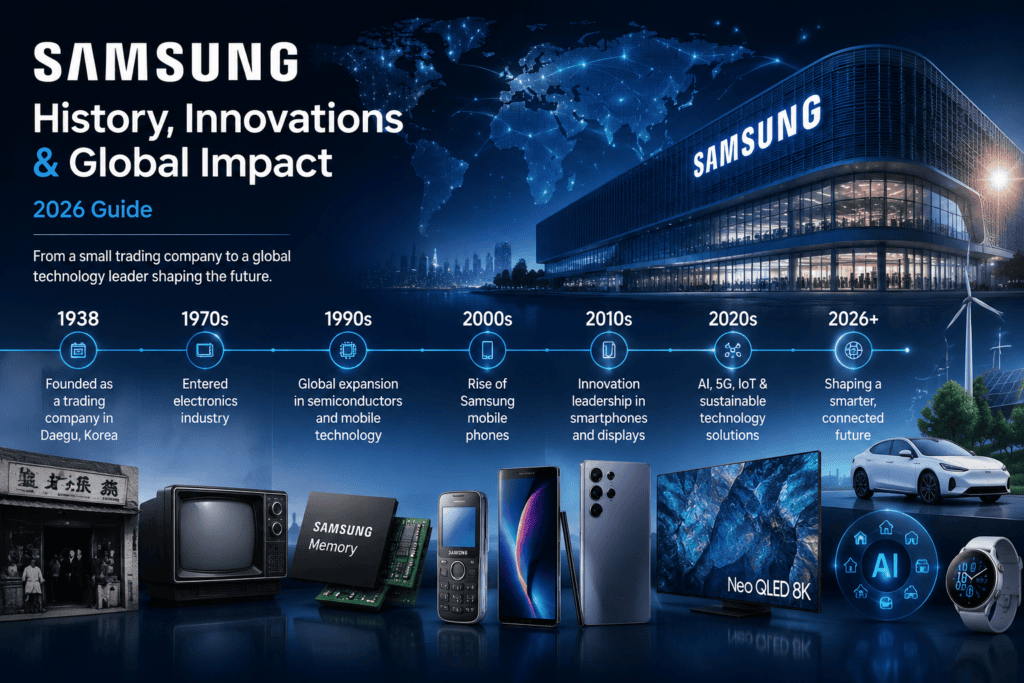
Samsung’s story begins in 1938, not in a sleek silicon fabrication plant, but in a small trading store in Daegu, Japanese-occupied Korea. Founded by Lee Byung-chul, Samsung started as a modest exporter of dried fish, locally grown groceries, and noodles. The name 삼성 (Samsung) translates to “three stars” in Korean, representing something big, numerous, and powerful.
1.1 The Post-War Transformation and Industrial Diversification
The Korean War devastated the peninsula, but it also created an environment ripe for rebuilding. Samsung, under the leadership of its founder, began to expand aggressively. In the 1950s and 60s, the company moved into textiles, insurance, and retail, establishing the foundations of a chaebol, a large, family-owned South Korean business conglomerate. This diversification was not merely about growth; it was a strategic move to build a self-sustaining industrial empire that could fuel South Korea’s rapid economic development.
1.2 The Electronics Pivot: A Defining Decade
The most consequential shift in Samsung’s history occurred in the late 1960s. The decision to enter the electronics industry marked a turning point. In 1969, Samsung Electronics was established, initially producing black-and-white televisions for the domestic market. This foray was a calculated gamble, positioning the company at the forefront of a technological revolution that would define the 21st century. The early years were characterized by absorbing foreign technology, but the ambition was always to become a global leader, not a perpetual follower.
1.3 From Follower to Industry Leader in Memory Chips
Perhaps the most dramatic chapter of Samsung’s corporate history is its rise in the semiconductor industry. In the 1980s, the semiconductor market was dominated by Japanese giants. Samsung, entering the fray, was perceived as a latecomer. However, the company made a massive, concerted investment in Research & Development (R&D), aggressively recruiting top Korean engineers and licensing technology. This led to a pivotal breakthrough: in 1993, Samsung became the world’s largest producer of memory chips, a position it has fiercely defended ever since. This success was not just about capacity but about consistently pioneering new technologies like the DRAM and NAND flash memory that form the backbone of modern computing.
Chapter 2: The Core Ecosystem of Samsung Products
Samsung’s business is vast, often compared to an iceberg, where the consumer products are the visible tip, and a massive industrial and technological foundation lies beneath.
2.1 The Galaxy Universe: Smartphones and Wearables
For most consumers, Samsung is synonymous with its Galaxy line of smartphones. Since the launch of the first Galaxy S in 2010, Samsung has grown into one of the two dominant players in the global smartphone market, alongside Apple.
-
The Galaxy S Series: The flagship line, representing the pinnacle of Samsung’s mobile technology. These devices are known for their premium builds, powerful camera systems, and integration with the broader Samsung ecosystem. They serve as the primary competitor to the iPhone.
-
The Galaxy Z Series (Foldables): Samsung is the undisputed pioneer and market leader in the foldable smartphone category. The Galaxy Z Fold and Galaxy Z Flip lines represent a significant innovation, pushing the boundaries of what a smartphone can be by merging the form factor of a phone and a tablet.
-
The Galaxy A Series: This is Samsung’s mid-range and budget offering. The A-series is critical for Samsung’s market share, bringing premium features like excellent cameras and large displays to a more accessible price point. It is a primary battleground for competition with Chinese manufacturers like Xiaomi and OnePlus.
-
Galaxy Wearables and Buds: Samsung has strategically built a robust ecosystem of wearables, including the Galaxy Watch (running on Wear OS) and Galaxy Buds. These devices are designed to seamlessly integrate with Galaxy smartphones, offering features like health tracking and immersive audio, locking users into the Samsung ecosystem.
2.2 Visual Displays: QLED, Neo QLED, and OLED
Samsung has been a dominant force in the display industry for decades. The company produces many of the world’s television panels and has consistently pushed the envelope in display technology.
-
QLED (Quantum Dot LED): Samsung championed QLED technology as a direct competitor to OLED. QLED TVs utilize a quantum dot layer to enhance brightness and color volume. They are particularly well-suited for brightly lit living rooms and offer superior peak brightness.
-
Neo QLED (Quantum Mini LED): This is Samsung’s premium display technology, which replaces traditional LEDs with Mini LEDs—microscopic LEDs that are 1/40th the height of a conventional LED. This allows for far greater control over local dimming zones, delivering deeper blacks and more precise contrast, narrowing the gap with OLED.
-
OLED: Samsung is also a major player in the OLED market, supplying screens for its own devices and competitors like Apple. In televisions, the Samsung OLED lineup offers the perfect blacks and infinite contrast that the technology is known for, providing consumers with a choice against traditional QLED.
2.3 Smart Living: Home Appliances
Beyond screens and smartphones, Samsung is a leader in smart home appliances, integrating connectivity and AI to enhance daily life. Products like the Family Hub refrigerator come with touchscreens that allow you to manage groceries, stream music, and even see inside without opening the door. AI-powered washing machines and robotic vacuum cleaners learn user habits to optimize performance. This strategic integration of software and hardware is central to Samsung’s vision of a fully connected, intelligent home, positioning the company as a key player in the Internet of Things (IoT).
Read Also: Nothing Phone (4b): Full Specs, Price & Buying Guide
Chapter 3: The Invisible Engine: Samsung Electronics’ B2B Powerhouse
The most significant part of Samsung’s business is invisible to most consumers. It is the world’s leading manufacturer of key electronic components.
3.1 Semiconductor Dominance
Samsung’s semiconductor division is its most profitable and strategically important unit. The company manufactures chips for other tech giants, including Apple and Qualcomm.
-
DRAM (Dynamic Random-Access Memory): Used in computers, servers, and mobile devices as the primary working memory. Samsung consistently leads in DRAM density, speed, and power efficiency.
-
NAND Flash: Used in SSDs (Solid State Drives), USB drives, and memory cards for data storage. Samsung’s proprietary V-NAND technology stacks memory cells vertically to increase density and performance without sacrificing reliability. This technology is crucial for the massive data storage demands of cloud computing.
-
Logic Chips and Foundries: Samsung is one of the few companies in the world that can manufacture high-end application processors. Its foundry business produces chips for other companies, including for Exynos (its own brand of processors for Galaxy phones in some regions) and competing AI processors. This places Samsung in fierce competition with TSMC and Intel for future chip manufacturing technologies.
3.2 Display Manufacturing
Samsung Display is a world leader in producing display panels for various applications, from massive commercial signage to the flexible OLED screens used in the latest smartphones. This gives Samsung a significant advantage, as it can control the supply chain and drive innovation in its own consumer products ahead of the competition. Its development of technologies like QD-OLED is a testament to its commitment to display innovation.
Chapter 4: How Does Samsung Compare? A Competitive Landscape
To truly understand Samsung’s market position, a direct comparison with its major competitors is essential.
Comparison Table: Samsung vs. Key Competitors
| Feature/Area | Samsung | Apple | LG | TSMC |
|---|---|---|---|---|
| Core Business | Diverse electronics, components, appliances, and services. | Consumer hardware (iPhone, Mac), software (iOS, macOS), and services. | Home appliances, televisions, and displays. | Semiconductor manufacturing (Foundry). |
| Smartphone Strategy | Multi-tiered (Flagship, Foldable, Mid-range, Budget). Offers choice and feature richness. | Premium-only, focusing on a unified high-end user experience and ecosystem lock-in. | N/A (No longer major player in phones). | N/A |
| Display Technology | Leader in QLED, Neo QLED, and OLED. Significant B2B display manufacturer. | Uses OLED panels from Samsung and LG for iPhones, but doesn’t manufacture them. | Leader in OLED panels, especially for TVs. | N/A |
| Semiconductor Role | Top global producer of memory chips (DRAM/NAND) and a leading foundry. | Designs its own chips (Apple Silicon) but relies on TSMC for manufacturing. | Minimal in this area. | Pure-play foundry; the world’s largest producer of advanced chips for others. |
| Ecosystem | Expanding and connecting devices across appliances, mobile, and PCs (via Windows). | Very strong, integrated ecosystem (Apple Watch, AirPods, Mac, iPhone). Seamless integration is a key differentiator. | Limited consumer electronics ecosystem. | N/A (Provides components). |
| Key Strength | Vertical integration and scale in manufacturing. | Brand loyalty, high margins, and premium software experience. | High-quality OLED panels and innovative home appliances. | Process technology leadership and huge manufacturing capacity. |
Chapter 5: Innovation, Philosophy, and Controversies
Understanding Samsung’s success requires appreciating its core innovation philosophy and the controversies it has navigated.
5.1 The “Fast Follower” Philosophy: A Legacy of Ambition
For much of its history, Samsung employed a “fast follower” strategy. This involved closely observing market trends, reverse-engineering the successful products of rivals, and then launching its own version with improved features at a competitive price. This allowed Samsung to rapidly scale and overtake more established, but slower-moving, players. This is precisely how it conquered the memory chip market and the television market. While this strategy has been immensely successful, it has also led to criticism regarding a lack of “true” originality compared to companies like Apple.
5.2 The Galaxy Note 7 Incident and a Culture Change
The Galaxy Note 7 battery debacle in 2016 was one of the most significant crises in corporate history. The flagship phone was recalled twice before being discontinued due to fires caused by battery defects. This massive failure cost Samsung billions of dollars and severely damaged its brand reputation. However, the response was a watershed moment. Samsung established an 8-point battery safety check and overhauled its quality assurance processes, showing a newfound commitment to rigorous safety and transparency. This crisis was a painful but necessary catalyst for a deep-rooted cultural change within the company.
5.3 Navigating Global Geopolitics
As a South Korean chaebol, Samsung exists in a complex geopolitical environment. Its business is highly sensitive to the ongoing rivalry between the US and China, particularly concerning the semiconductor supply chain. This has forced Samsung to navigate trade restrictions, navigate chip export controls, and strategically plan its foundry investments in the US and elsewhere. The company’s decisions are no longer just business decisions; they are high-stakes diplomatic acts.
Chapter 6: Expert Analysis: The Future of Samsung
Looking ahead, Samsung’s future is full of promise and peril. Its ability to adapt to emerging technology trends will determine its position in the next decade.
6.1 The Race for AI Hardware: A New Paradigm
The artificial intelligence boom presents a massive opportunity for Samsung. AI requires specialized chips for training and inference. Samsung’s expertise in memory and advanced packaging positions it to be a dominant supplier for AI hardware. A key focus will be HBM (High Bandwidth Memory), a critical component for AI accelerators, where Samsung is rapidly innovating to catch up with and potentially surpass its main rival, SK Hynix. This is the most significant technological battleground for Samsung’s semiconductor division since its DRAM supremacy.
6.2 Beyond Mobile: The Age of AI and Hyperconnectivity
Samsung’s future success depends on its ability to move beyond being a “phone company.” Its strategy is to build a world where devices are not just smart but intuitive and collaborative. This vision involves:
-
On-Device AI: Integrating powerful AI directly into its phones and appliances, allowing them to perform complex tasks without needing to connect to the cloud, which improves privacy and speed.
-
SmartThings Integration: Deepening its SmartThings platform to control a vast ecosystem of devices, becoming the central nervous system of the smart home.
-
Healthcare Integration: Enhancing health monitoring capabilities in wearables, potentially moving from fitness tracking to more serious health diagnostics.
6.3 Challenges on the Horizon
Despite its strengths, Samsung faces significant headwinds. The fierce competition in the consumer electronics market is relentless. In smartphones, it must contend with Apple’s premium brand strength and the aggressive pricing of Chinese brands. In semiconductors, TSMC’s foundry dominance and China’s ambitions to become self-sufficient in chip production are major threats. Furthermore, the company must continue to navigate a complex global regulatory environment regarding privacy, anti-competitive behavior, and environmental sustainability.
Chapter 7: Common Mistakes and Best Practices When Engaging with Samsung
For partners, investors, and consumers, understanding how to best engage with Samsung is key.
Common Mistakes to Avoid
-
Assuming Samsung is only a phone maker: This leads to underestimating its economic and technological power in areas like semiconductors and displays.
-
Neglecting ecosystem integration: A Samsung phone works best within the Samsung ecosystem (e.g., Galaxy Buds, Watch). Using competitor’s products can result in a less seamless experience.
-
Overlooking product tiers: Not every “Galaxy” phone is a flagship. Confusing the A-series with the S-series can lead to unmet performance expectations.
Best Practices for Different Audiences
-
For Consumers: Watch or read in-depth reviews before purchasing. Understand the specific strengths and weaknesses of the product tier (e.g., Foldable vs. S-Series). Look for trade-in deals to maximize value.
-
For Business Partners: Leverage Samsung’s developer tools for B2B and IoT solutions. Understand the full power of its components if you are an OEM looking to source chips or displays.
-
For Investors: Pay close attention to the semiconductor division’s performance, as it drives profitability. Track its foundry investments and its market share in HBM and DRAM, as this is the primary profit driver.
Chapter 8: Conclusion
Samsung’s story is one of relentless ambition, technological mastery, and extraordinary resilience. From a small trading company to a global leader in semiconductors, displays, and mobile technology, its journey has been a defining force in the digital age. The company is more than the sum of its products; it is an engine of innovation that powers the global tech industry.
The immediate future hinges on its ability to navigate the high-stakes world of AI and advanced chip manufacturing. Yet, its legacy is already secure as a company that not only adapted to technological change but often drove it. For anyone seeking to understand the modern technological landscape, understanding Samsung is not optional—it is essential.
Key Takeaways
-
Diverse Powerhouse: Samsung is a multi-faceted conglomerate, with a massive consumer electronics division and an equally powerful, yet invisible, B2B component business.
-
Manufacturing Dominance: It is a global leader in DRAM, NAND flash memory, and display panels, powering devices from many other major brands.
-
Consumer Innovation: From pioneering the foldable phone to perfecting QLED and Neo QLED displays, Samsung consistently pushes the boundaries of consumer technology.
-
Strategic Resilience: The company has proven its ability to pivot, survive major crises like the Note 7 incident, and adapt its strategy to remain a market leader.
-
AI and Future Growth: The future for Samsung is deeply intertwined with the AI revolution, where its expertise in memory chips is set to be a critical advantage.
Read Also: Vivo V70 Pro: Expected Specs, Price, Features & Launch Guide (2026)
9. FAQ (Frequently Asked Questions)
1. What does the name “Samsung” mean?
“Samsung” is derived from the Korean word 삼성, which translates to “three stars.” The “three” represents something big, numerous, and powerful.
2. Is Samsung still making phones?
Yes. Samsung is one of the world’s largest smartphone manufacturers, with a portfolio that includes the flagship Galaxy S series, the innovative Galaxy Z foldable series, and the popular mid-range Galaxy A series.
3. What is the difference between QLED and Neo QLED?
Both are LED-based television technologies. QLED uses a quantum dot filter to enhance color and brightness. Neo QLED is an advancement that uses Mini LEDs (much smaller light sources) for superior contrast, deeper blacks, and more precise dimming.
4. What is Samsung’s most profitable business?
Samsung’s most profitable business is its semiconductor division, specifically the production of DRAM and NAND memory chips used in everything from smartphones to data centers.
5. Does Samsung use its own chips in its smartphones?
Yes, some Galaxy S and Z series phones in certain regions use Samsung’s in-house Exynos processor. However, many models, especially in the US and Canada, use Snapdragon processors from Qualcomm.
6. Is Samsung an American or South Korean company?
Samsung is a South Korean multinational conglomerate. Its global headquarters is located in Suwon, South Korea.
7. What is the Galaxy Ecosystem?
The Galaxy Ecosystem refers to the seamless network of Samsung devices and services, including Galaxy smartphones, tablets, watches, and Buds. They are designed to work together, allowing for features like seamless file sharing, device switching, and health data integration.
8. Did Samsung invent the smartphone?
No. While Samsung was an early adopter, the first smartphone is widely considered to be the IBM Simon (1992). However, Samsung played a pivotal role in popularizing Android smartphones and making them mainstream with the launch of the Galaxy S series.
9. What is Samsung doing about AI?
Samsung is heavily investing in AI, both in terms of chip hardware (like advanced memory for AI servers) and in integrating on-device AI features into its consumer products (Galaxy AI) for tasks like photo editing, translation, and personalized user experiences.
10. Is Samsung a reliable brand?
Yes, Samsung is considered a very reliable and reputable brand globally. While they have faced issues (e.g., the Note 7 battery crisis), they have implemented rigorous quality and safety measures. For product-specific reliability, it is always recommended to consult professional reviews for the particular model you are considering.